Okay, so you know that moment when you finally find the perfect trailing pothos for your shelf — the one that looks straight off your Pinterest board — and then your cat eats half of it by Tuesday?
Yeah. Been there.
My cousin called me in a panic last spring because her tabby chewed through three of her new plants in one week. Two of them? Toxic. The vet bill alone still makes me cringe.
Here’s the thing — you shouldn’t have to choose between a gorgeous home and a safe space for your fur baby.
So I put together a list of 20 cat safe house plants that are genuinely stunning and won’t send your golden retriever’s feline roommate to the emergency vet.
Every single one is lush, low-drama, and completely cat-approved.
#1: Majesty Palm (Ravenea rivularis) — The Tall, Drama-Free Palm Your Cat Will Ignore
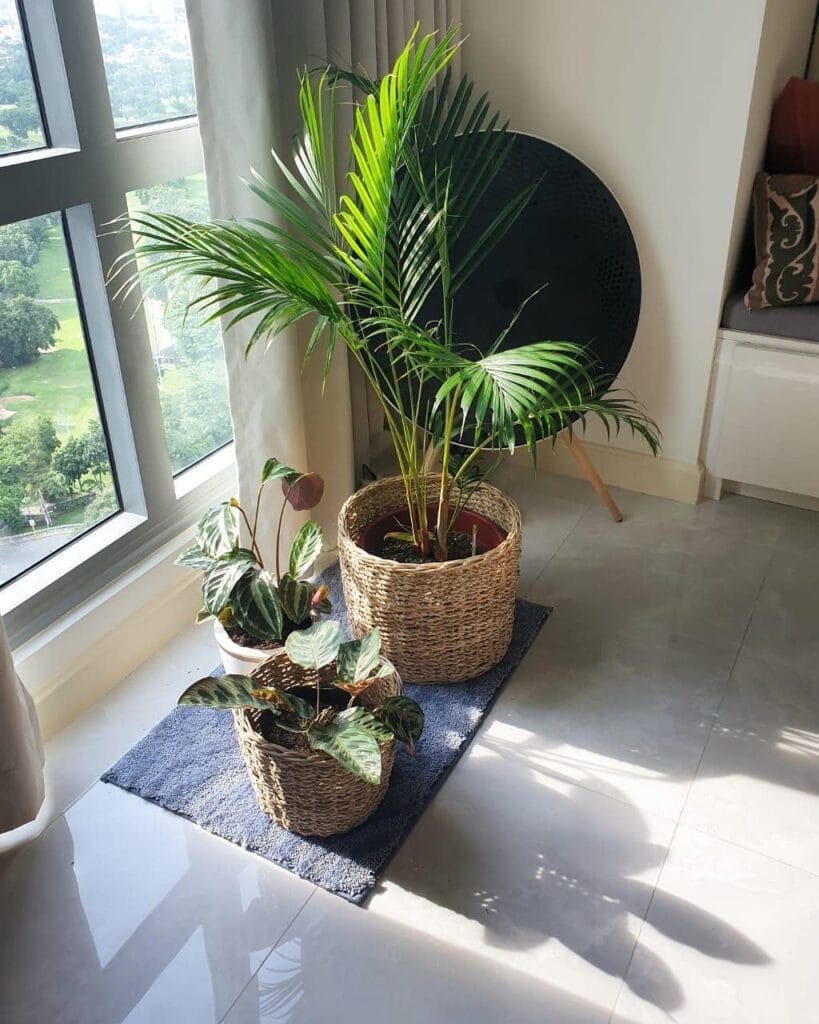
Okay, so you know that corner by the big window that your golden just loves to park herself in front of? The one where the afternoon sun pools on the floor and she does that full-body flop? This setup is exactly that energy — warm light, a green canopy overhead, and enough visual texture to make the whole corner feel like a little urban jungle. And the best part? Every single plant in this image is safe for cats.
The star here is a Majesty Palm planted inside a large natural seagrass basket planter — roughly 12–14 inches in diameter. The palm’s feathery, arching fronds fan out wide, giving you that lush tropical height without any toxicity risk. Cats can brush past it, sniff it, or bat at a frond, and nothing bad happens. That peace of mind alone is worth it.
Tucked alongside it are two Calathea (Prayer Plant) varieties — one in a white ceramic pot and one in a smaller woven seagrass basket. Those bold, painterly leaf patterns are the reason plant people lose their minds over Calatheas. Both are 100% non-toxic to cats and dogs per the ASPCA list.
The whole arrangement sits on a navy blue cotton runner rug, which anchors the grouping and keeps the pots from sliding on polished tile. It’s a small move that makes the corner look intentional instead of random.
Small change, big win: Place a pebble tray with water beneath the Majesty Palm — it raises humidity, keeps the fronds from browning, and means you’re watering less often.
Keep the Majesty Palm in bright indirect light and water it only when the top 2 inches of soil feel dry. Overwatering kills these faster than anything. Calatheas want lower light and consistent moisture — they’ll tell you when they’re unhappy by curling their leaves inward.
📸 Photo credit: Instagram @alexonehortaleza
#2: Watermelon Peperomia, Fittonia & More — The Cutest Cat-Safe Trio You’ll Actually Want to Display
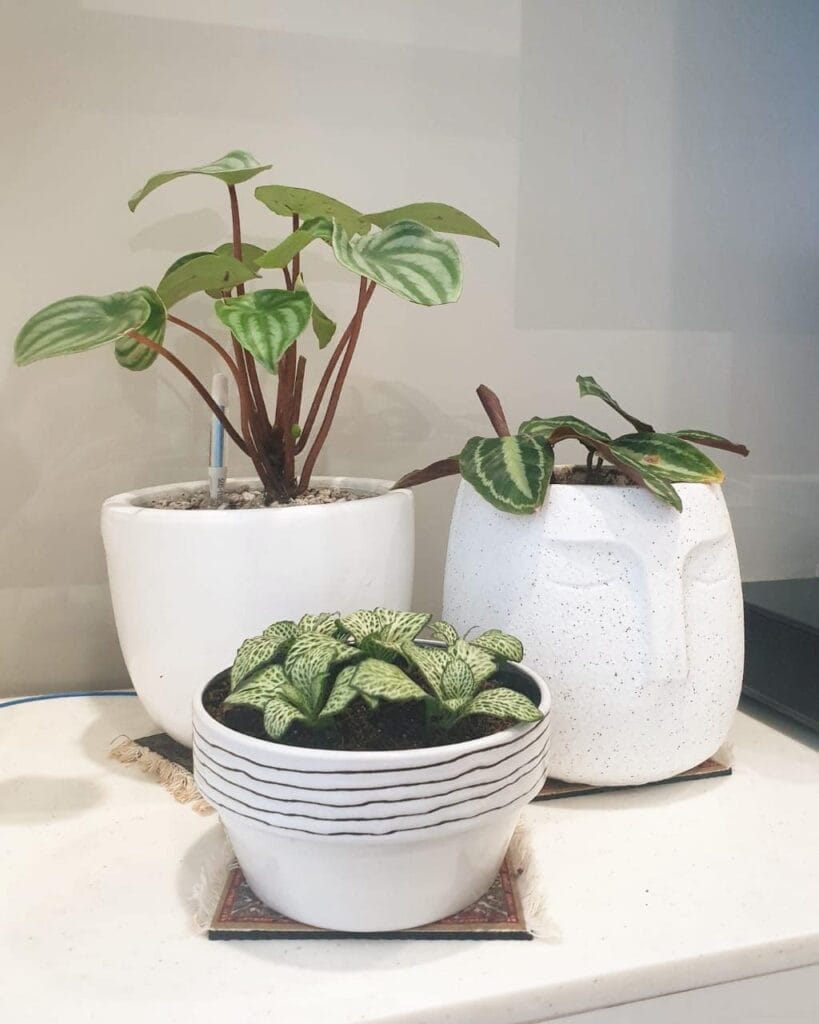
You know that moment when you’re rearranging your shelf for the tenth time trying to make it look exactly like your Pinterest board, and your golden just walks right through it, tail wagging, knocking everything sideways? Yeah. Been there. The last thing you need on top of that is a plant situation that sends you spiraling into a 2am Google search about whether your cat ate something toxic.
These three plants sitting together in white ceramic pots? This is the setup you want.
The tall one in the back-left is a Watermelon Peperomia (Peperomia argyreia). Those round leaves with silvery-green stripes — they genuinely look like tiny watermelon rinds, which is wild. It’s sitting in a smooth white matte ceramic pot, roughly 4-5 inches wide, with what looks like a moisture meter stick tucked into the soil. Smart move, honestly. Peperomias hate overwatering, and that little tool saves them every time. The feature here is the compact root system — it stays small, fits any shelf, and your cat can sniff it all day without a trip to the vet.
The front-center pot is a Fittonia (also called nerve plant), and it’s stunning up close. Those tiny green leaves are covered in white veining that looks almost hand-painted. It’s planted in a striped black-and-white ceramic bowl, maybe 5 inches in diameter, sitting on what looks like a small woven trivet or a decorative tile coaster. Fittonias are dramatic — they droop when thirsty and bounce right back after watering. But here’s what I love: they’re 100% non-toxic to cats and dogs.
The pot on the right has a face molded into it — like a little ceramic head — and it’s honestly the cutest planter I’ve ever seen. The plant inside appears to be another Peperomia variety, possibly a Peperomia caperata or a similar ripple-leaf type. The speckled white glaze on that face planter gives it this artsy, handmade feel that looks incredible against a white wall or a light wood shelf.
Quick note: grouping plants in odd numbers (like three here) is a classic design trick that makes any surface look intentional instead of random.
All three plants thrive in indirect light, which makes them perfect for a north or east-facing window ledge. None of them need direct sun, so you can place them a few feet back from the window without worrying. They also prefer humidity, so if your bathroom gets good light, that’s honestly a dream spot for them — and it keeps them away from curious paws entirely.
If you want to recreate this exact look, grab a moisture meter (they run about $10-15 on Amazon), invest in two or three white ceramic pots in different shapes and textures, and mix your planter styles — one smooth, one patterned, one sculptural. That variety is what makes the grouping feel collected rather than matchy-matchy. Place them on small trivets or decorative tiles to protect your surfaces and add one more layer of visual interest.
Fittonias do need consistent moisture, so don’t let the soil fully dry out between waterings. A small pebble tray with water underneath the pot raises humidity without soaking the roots — that’s the move for keeping them lush without rotting them out.
📸 Photo credit: Instagram @alexonehortaleza
#3: Pilea Peperomioides (Chinese Money Plant) — The Round-Leaf Beauty That’s Totally Safe for Cats
Your golden retriever just knocked over another plant, dirt everywhere, and your cat is already sniffing the leaves before you’ve even grabbed the paper towels. Sound familiar?
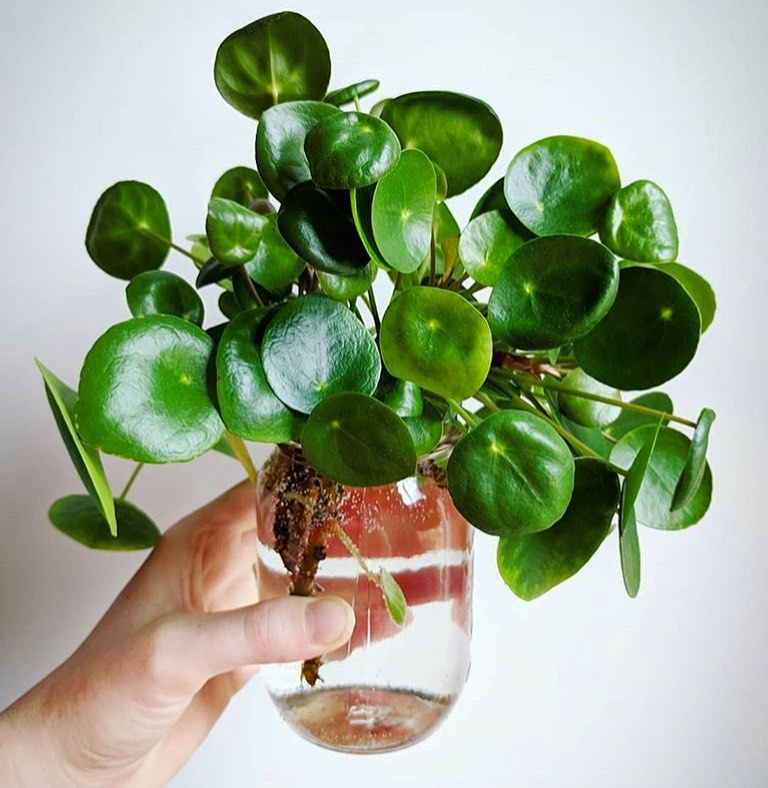
This is the Pilea peperomioides — also called the Chinese Money Plant — and it’s one of those plants that looks like it belongs in a design magazine but is completely non-toxic to cats.
Those perfectly round, pancake-shaped leaves grow on thin green stems that radiate out from a central woody stalk. The leaves are a deep, glossy green with a slightly raised center where the stem attaches — called a peltate attachment — and that’s actually what makes this plant so visually distinctive. It almost looks sculpted.
To get this exact look, start with a clear glass vessel (a stemless wine glass works perfectly here) for water propagation, or pot it in a 4-6 inch terracotta pot with well-draining soil once the roots develop. The roots you’re seeing in the image are healthy — tan-colored, slightly branchy — which means this cutting is ready to pot up.
Pileas thrive in bright, indirect light — a north or east-facing windowsill is your sweet spot. Direct sun scorches those gorgeous round leaves fast.
And the best part? This plant produces little “pups” — baby offshoots at the base — that you can separate and propagate endlessly. Free plants for every room.
📸 Photo credit: Instagram @leaf.and.paw
#4: Pilea Peperomioides (Chinese Money Plant) — The UFO Plant Your Cat Can’t Kill (And Neither Can You)
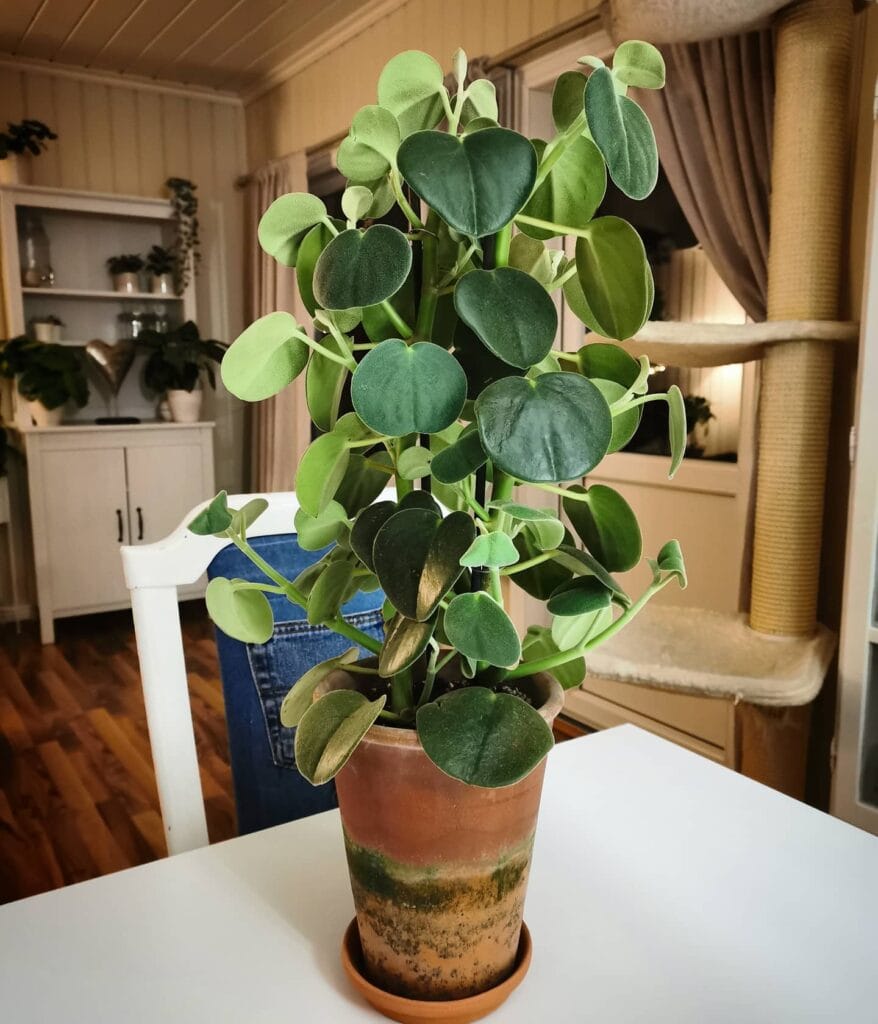
Okay so picture this — you’re doing your Saturday morning Pinterest scroll, coffee in hand, and you keep seeing that plant. You know the one. Those perfect little pancake-shaped leaves stacked on a tall stem like nature built a tiny tree just for aesthetics. That’s the Pilea peperomioides, and honestly? It belongs in your home.
The one in this photo is thriving — we’re talking a full, bushy plant easily 12-15 inches tall, sitting in a terracotta pot with a warm rust-and-moss glaze that looks like it came straight from a Scandinavian market. The white table it’s sitting on makes those deep green leaves pop hard.
Here’s what you need to recreate this exact look. Grab a 4-6 inch unglazed terracotta pot with a matching saucer — the natural clay actually helps prevent overwatering because it breathes. Pair it on a white or light wood side table near a window with indirect light. The neutral tones around it (creamy walls, linen curtains, muted wood floors) let the plant do all the talking.
The pancake leaves — round, peltate, deep emerald green — grow on individual stems that branch off a central woody stalk. Completely non-toxic to cats. Your cat can sniff it, bat at it, even knock a leaf off, and zero drama at the vet.
One thing to remember: Pilea drops lower leaves as it matures, which gives it that sculptural, tree-like shape you’re seeing here. Don’t panic — it’s not dying. It’s just getting cooler.
Rotate the pot a quarter turn every week. Pilea literally leans toward light like it has a personality, and rotating keeps it growing straight and full instead of sideways.
📸 Photo credit: Instagram @catfriendlyplants
#5: Ficus Elastica (Rubber Plant) — The Cat-Safe Statement Leaf Your Home Needs
Picture this — your cat has claimed the entire plant shelf as her personal jungle gym, and you’re constantly holding your breath wondering what she’s chewing on. Been there. My aunt had this moment when her tabby knocked over three plants in one afternoon and she had no idea which ones were dangerous.
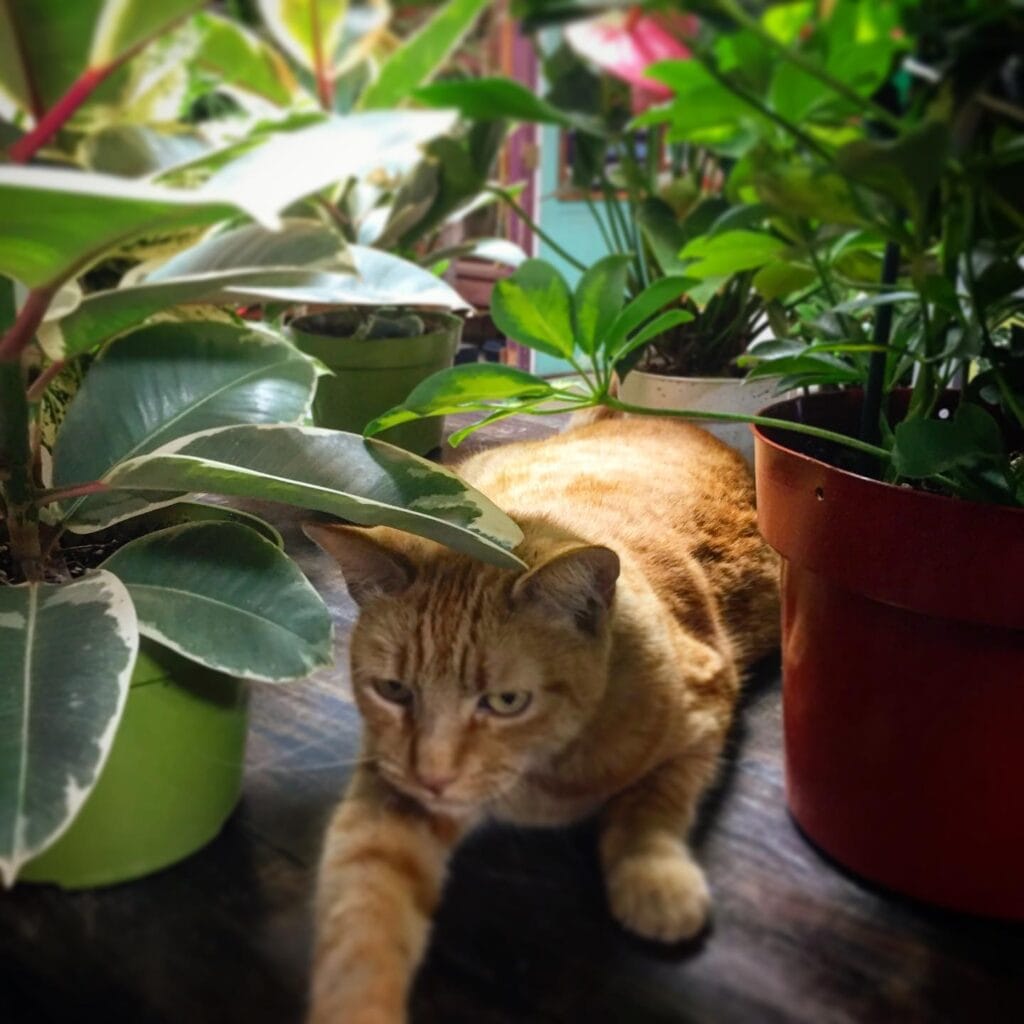
The variegated Ficus elastica ‘Tineke’ in this photo — the one with the creamy white and green leaves — is actually non-toxic to cats according to the ASPCA. I know, I was shocked too, because rubber plants have such a bold, dramatic presence you’d assume they’d be on the danger list.
Start here: grab a 10-inch lime green ceramic pot (exactly like the one pictured) and plant your Ficus elastica in well-draining peat-free potting mix with perlite. The thick, waxy leaves come in deep green with ivory edges, and they grow fast in bright indirect light near a window.
What makes this setup work is how the plant sits low on a dark wood floor surface, tucked between other non-toxic companions like a Schefflera (umbrella plant) and what looks like a Calathea. That layered, jungle-style grouping? Cats love the texture, and you get a Pinterest-worthy shelf moment.
Keep the soil only slightly moist — overwatering is the number one reason rubber plants die indoors. Wipe the leaves monthly with a damp microfiber cloth to keep that glossy finish and help the plant breathe.
📸 Photo credit: Instagram @jackalopenh
#6: Microsorum Diversifolium (Kangaroo Paw Fern) — The Lush, Spiky Beauty That Won’t Hurt Your Cat
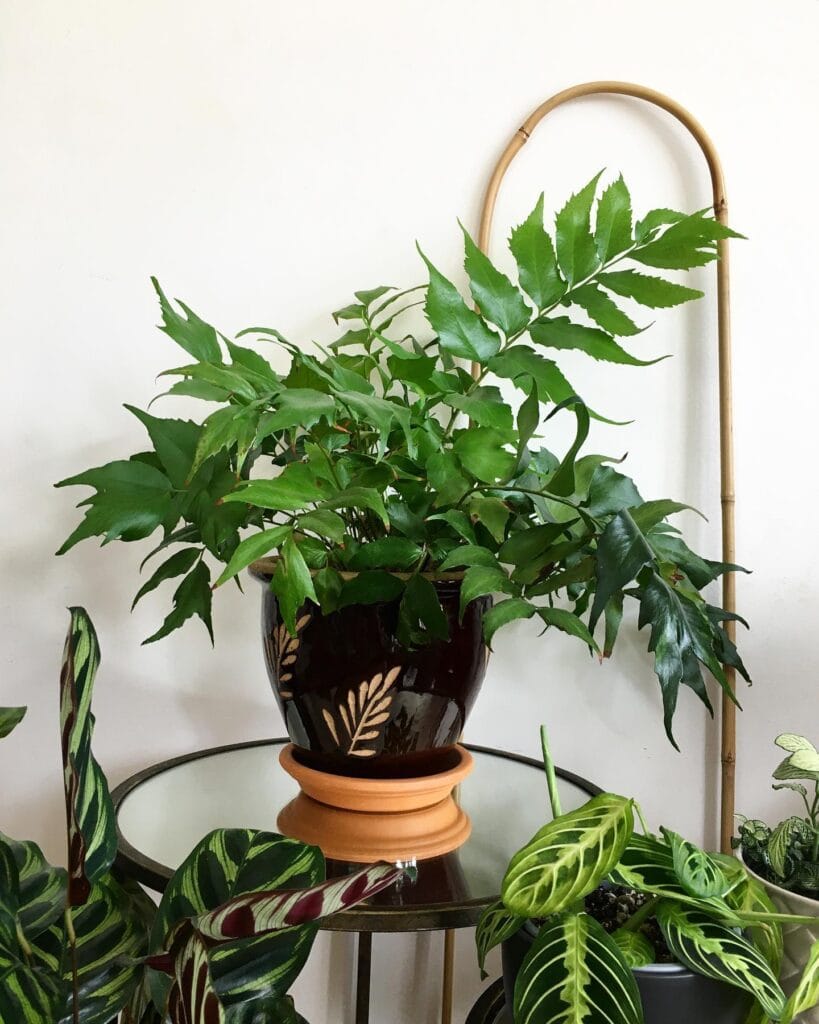
Picture this: you walk into your living room, golden retriever sprawled across the floor, tail wagging at absolutely nothing, and your plant shelf just looks so good you stop and stare for a second. That’s the energy this setup gives off. A deep burgundy ceramic pot painted with golden fern motifs sits on a mirrored brass side table, surrounded by a whole little plant community — prayer plants, maranta, and this gorgeous, wild-looking fern spilling out in every direction. It’s Pinterest in real life, and nothing in this corner will send your cat to the vet.
The star here is the Microsorum diversifolium, also called the Kangaroo Paw Fern. Those leaves are something else — deep green, glossy, with jagged serrated edges that look almost prehistoric. It’s completely non-toxic to both cats and dogs, which honestly makes it even better than it already looks.
The pot is a dark brown glazed ceramic urn-style planter with carved leaf detailing in a natural terracotta tone. It sits in a terracotta saucer on top of a round mirrored brass accent table — the reflection doubles the visual impact of every plant around it. The bamboo arch trellis leaning against the wall behind it adds height without needing a nail in the wall.
The best part: Kangaroo Paw Ferns thrive in indirect light and humidity, making them ideal for a room your pets already hang out in. Mist the fronds a couple times a week — the fern stays lush, the leaves stay perky, and your cat can rub their face on it all they want.
Keep the soil consistently moist but never soggy. These ferns hate dry roots, so a terracotta saucer with a little pebble tray underneath helps maintain humidity around the base without overwatering. Repot every spring into well-draining indoor potting mix with added perlite — the roots fill out fast once this plant gets comfortable.
📸 Photo credit: Instagram @amysgreenishthumb
#7: Asparagus Fern — The Fluffy Green Cloud Your Cat Will Absolutely Try to Eat (But Shouldn’t)
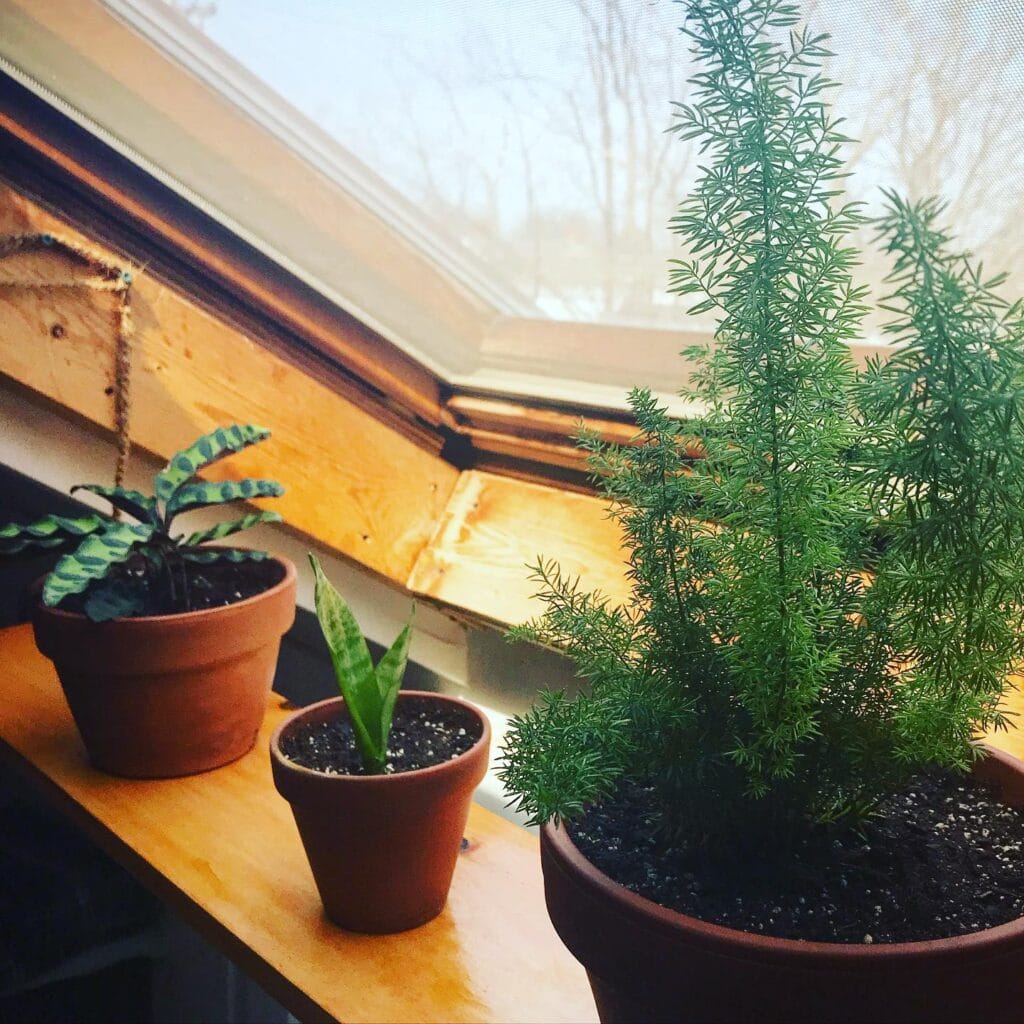
Okay so picture this — you wake up, shuffle to your windowsill in fuzzy socks, and your whole morning just shifts because the light is hitting these plants in the most golden, cozy way. That’s exactly what this setup does. Warm terracotta pots, soft natural wood shelving, and a big lush asparagus fern soaking up a skylight window — it’s giving Pinterest board energy but make it real life.
The star here is the asparagus fern (Asparagus setaceus or Asparagus densiflorus), and I need to be straight with you — this one is actually toxic to cats. I know, I know. It looks like a tiny indoor Christmas tree and you want it everywhere. But the berries and the foliage? They can cause vomiting and skin irritation in cats. So this is a hard pass for our feline friends.
And that’s the thing about plant shopping — the prettiest ones are sometimes the sneakiest troublemakers.
The good news? You can swap it for foxtail fern’s lookalike, the bottle palm or better yet a true fern like Boston fern (Nephrolepis exaltata), which gives you that same wild, feathery texture but is completely cat-safe according to the ASPCA.
The small terracotta pot in the middle holds what looks like a baby snake plant — and heads up, snake plants are also toxic to cats despite being everywhere on Pinterest. Replace it with a calathea (like the striped one on the left — Calathea zebrina), which IS cat-safe and honestly looks even more interesting.
Calatheas need indirect light, moderate humidity, and water only when the top inch of soil feels dry. They’re a little dramatic about it — leaves curl when thirsty — but that’s how you know.
Place your cat-safe plants on a solid wood floating shelf like this one, ideally at least 4–5 feet from the floor if your cat is a climber. Skylight windows like this one provide diffused, bright indirect light — which is perfect for calatheas and Boston ferns without scorching them.
One thing I started doing? Mixing perlite into potting soil at a 1:4 ratio. It keeps roots from sitting in moisture, which means fewer fungus gnats and healthier plants. Your cat will still try to dig in the soil regardless, but at least the plant survives.
📸 Photo credit: Instagram @coreyperkinstime
#8: Pilea Peperomioides (Chinese Money Plant) — The One That Looks Like It Belongs on Your Mood Board
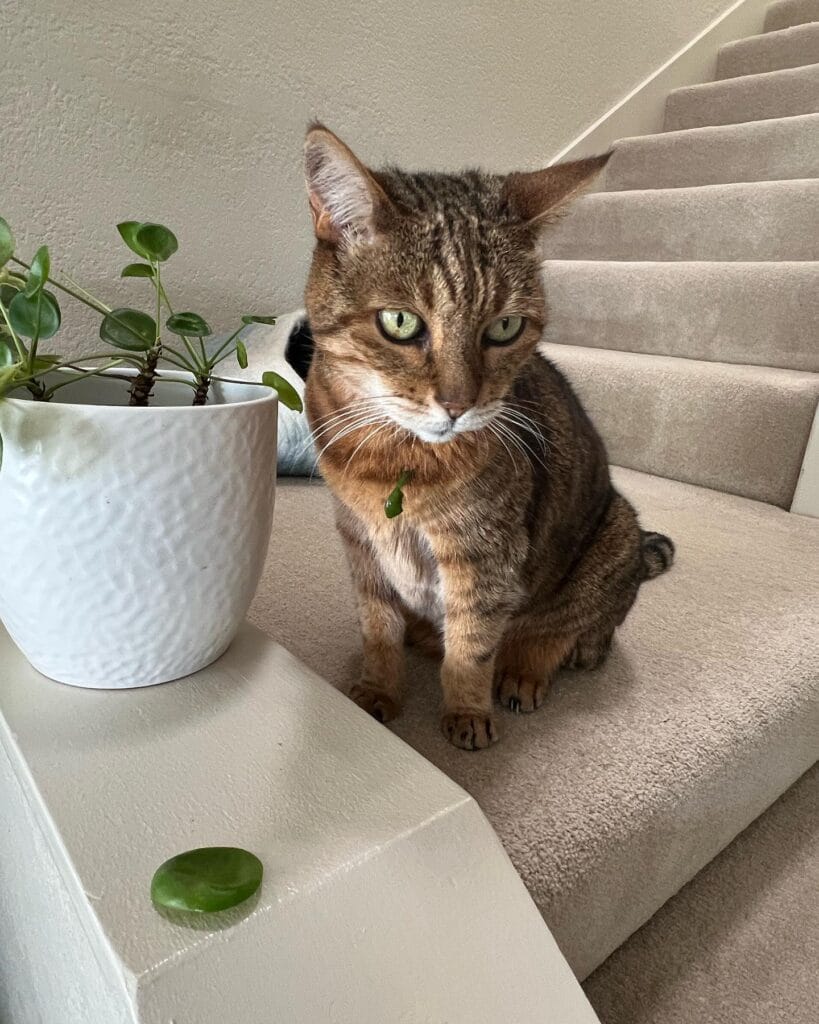
You know that moment when you walk past a plant at the nursery and you’re like, wait, that one. That’s the Pilea peperomioides. Round, coin-shaped leaves on long stems, bright green, sitting in a white textured ceramic pot — it looks like someone pulled it straight off Pinterest.
And honestly? It’s one of the safest plants you can bring home if you have a cat.
Pilea peperomioides is non-toxic to cats according to the ASPCA. So when your cat decides to knock a leaf off the pot (because of course she will), you’re not rushing to the vet at 11pm. That leaf sitting on the stair ledge in this photo? Totally fine. Annoying, but fine.
The setup here is so easy to recreate. Grab a medium Pilea in a 4–6 inch pot, drop it into a dimpled white ceramic planter — the texture adds that cozy, organic feel without competing with your other decor. Style it on a stair ledge or a slim console near natural light.
Good news: Pileas thrive in indirect bright light and only need watering when the top inch of soil is dry. They’re basically the low-maintenance best friend of houseplants.
Pileas also grow “pups” — little offsets that pop up at the base. You can repot those and share them, which is why they’re nicknamed the “pass-it-along plant.”
📸 Photo credit: Instagram @justjami27
#9: Calathea Ornata (Pinstripe Plant) — The Drama Queen That Won’t Hurt Your Cat
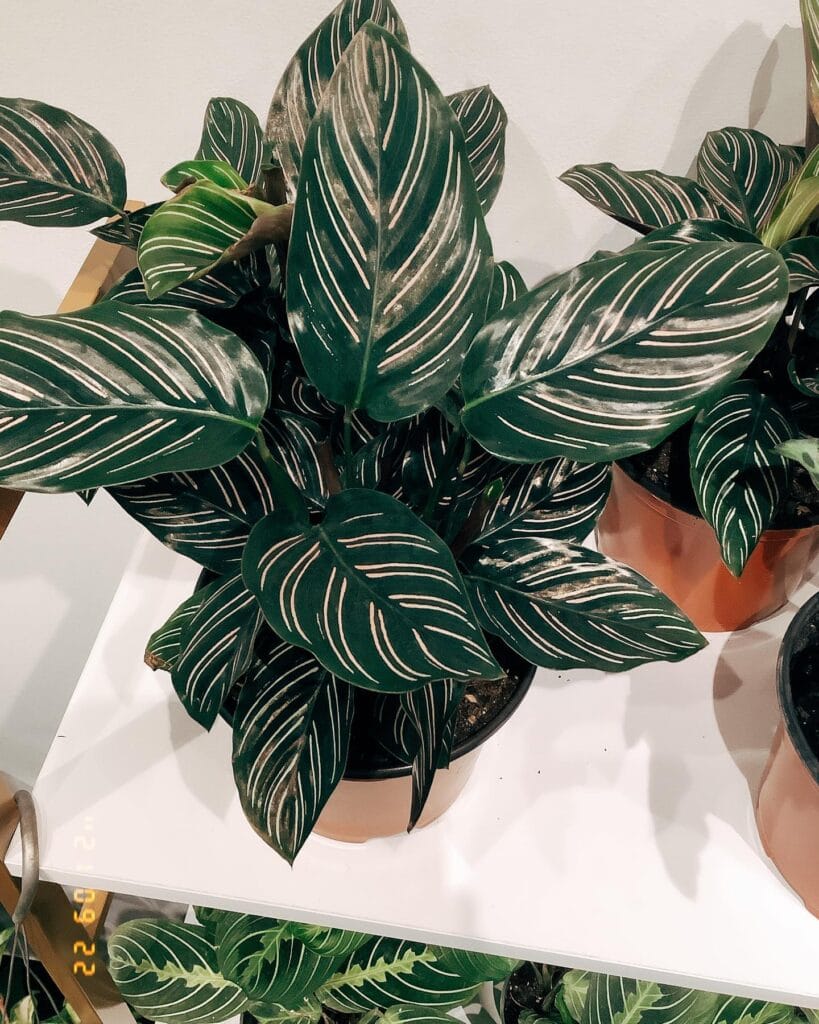
Okay, so real talk — I walked into my friend Dani’s house last fall and immediately stopped in the doorway. She had this plant sitting on a white shelf, and I genuinely thought it was fake. Like, those leaves? Dark green with these thin cream-pink pinstripes running through them like someone hand-drew every single line. I stood there for a solid minute just staring.
That’s the Calathea ornata, and it’s one of those plants that makes your whole shelf look like a Pinterest board without you even trying. And yes — completely cat-safe.
The one in this photo is potted in a terracotta-toned ceramic pot, sitting on a white lacquered shelf, and the contrast is chef’s kiss. The dark, almost forest-green leaves with those cream-white pinstripes make it look expensive. It’s not. You can grab one at most plant shops for around $15–$25 depending on the size.
To get this exact look, you want a 4–6 inch nursery pot slipped inside a matte terracotta or blush ceramic cachepot. That layered pot trick? It lets you water without worrying about drainage ruining your shelf.
Here’s something most people skip — Calatheas hate tap water. They’re sensitive to fluoride and minerals, so use filtered or rainwater and watch those pinstripes stay sharp and crisp instead of browning at the edges.
They close their leaves at night and reopen in the morning. Your cat will be obsessed with watching that happen — and that’s the whole payoff.
📸 Photo credit: Instagram @botanicalsafari
#10: Calathea (Prayer Plant) — The Striped Beauty Your Cat Can Actually Live With
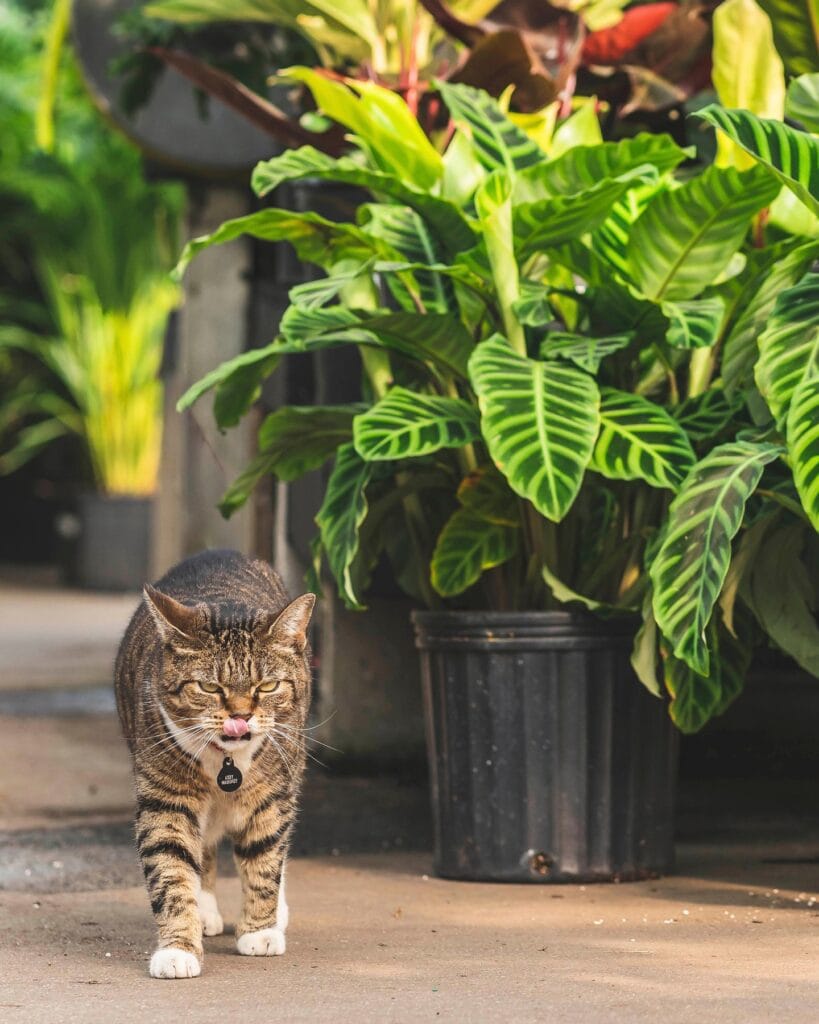
You know that moment when your golden does a full lap around the living room and somehow knocks over every single plant you own? Yeah. Now picture a lush, dark green leafy plant with pale yellow-green stripes sitting in a 3-gallon black nursery pot — totally unbothered, and totally safe for your cat.
That’s the Calathea orbifolia situation happening in this photo, and honestly? It’s giving full botanical garden energy without the anxiety spiral of wondering if your cat’s going to end up at the vet.
The large paddle-shaped leaves are the star here — each one painted with alternating light and deep green stripes that look almost too good to be real. You can grab a Calathea Makoyana or orbifolia from most plant nurseries in a standard 10–14 inch diameter pot and it’ll immediately become that corner piece you’ve been hunting for on Pinterest.
Here’s the trick: Calatheas hate direct sun. That dappled, indirect light from a north or east-facing window? Perfect. They love humidity too — a quick mist with a spray bottle every couple days keeps those dramatic leaves from curling.
And because these plants stay pretty compact even when full-grown, they work in smaller spaces without overwhelming a room.
If your cat is a serial plant-chewer, Calathea is genuinely zero toxicity risk according to the ASPCA — no alkaloids, no calcium oxalates, nothing harmful.
📸 Photo credit: Instagram @mahoneysgarden
#11: Fishbone Cactus — The Spiky Beauty That’s Actually Safe for Your Cat
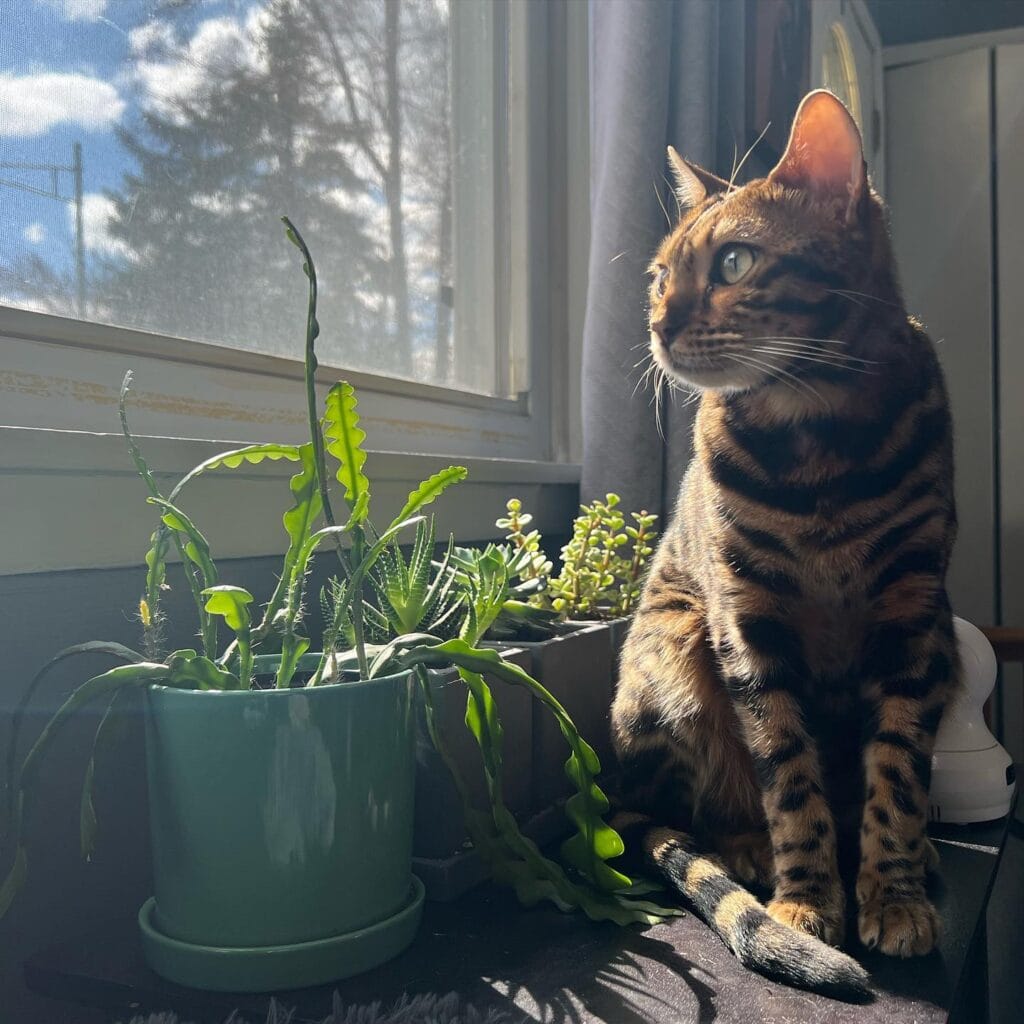
Okay so you know that moment when you’re rearranging your windowsill and your cat just plants himself right in the middle of everything like he owns the place? That’s basically what’s happening in this photo — and honestly, it’s the most relatable thing I’ve ever seen.
This sun-drenched windowsill setup is everything. Warm golden light, a mint green ceramic pot sitting on a matching saucer, and a fishbone cactus (Epiphyllum anguliger) doing its wild, zigzag thing right next to a collection of small succulents in dark planters. And the Bengal cat sitting there like a little king? Chef’s kiss.
The fishbone cactus is genuinely cat-safe — no toxins, no hidden dangers. The flat, scalloped green stems trail and reach upward in this really sculptural way that looks straight off a Pinterest board. Paired with a jade plant and what looks like a small aloe cluster in the background, the whole shelf becomes this layered, textural moment.
To recreate this: grab a 4-6 inch mint or sage ceramic pot with a drainage saucer. Plant your fishbone cactus in well-draining cactus mix and set it near a bright, indirect-light window. The trailing stems grow longer over time — longer stems mean more dramatic draping, which means your windowsill goes from boring to actually stunning.
Keep the soil mostly dry between waterings. These guys are semi-epiphytic, so they hate soggy roots. Once a month in winter, once every two weeks in summer — that rhythm keeps them thriving without drama.
📸 Photo credit: Instagram @mi_bengals
#12: Lemon Button Fern & Nerve Plant — Two Cat-Safe Picks That Actually Look Good Together
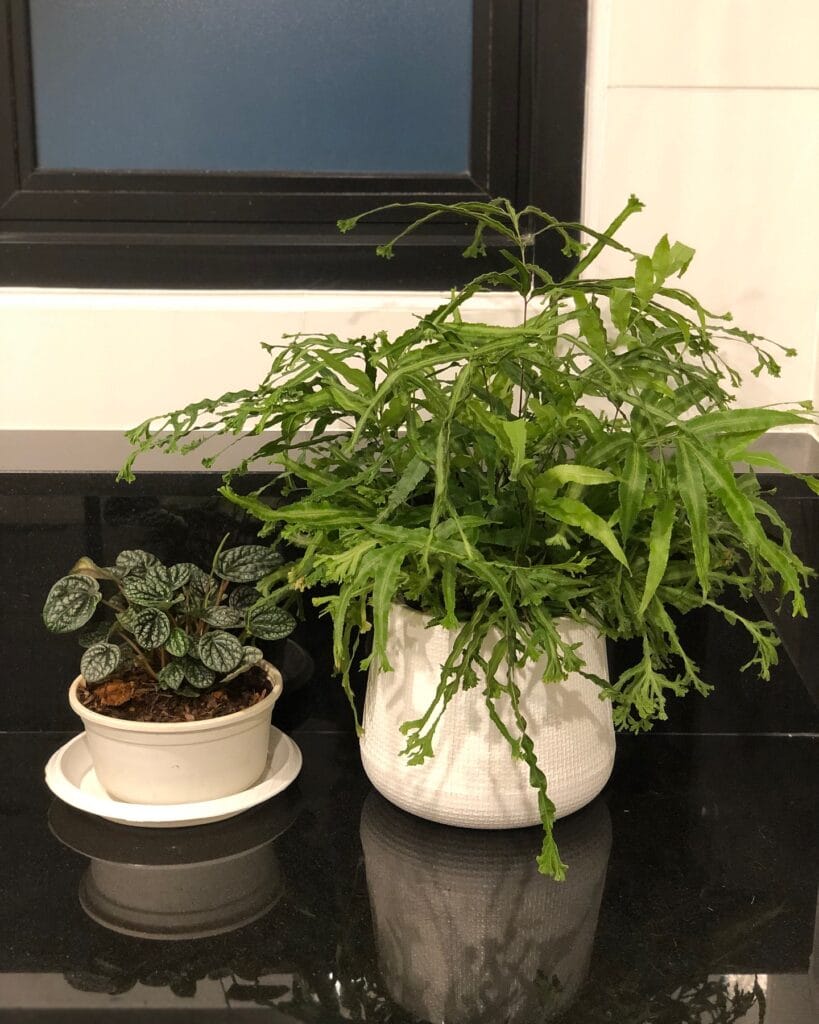
Okay so picture this — you’re sitting at your vanity or bathroom counter getting ready, your golden is sprawled across the bath mat behind you, and these two little green babies are just sitting there looking like a Pinterest board came to life on your black granite countertop. That’s the exact energy this pairing gives off. And honestly? The contrast of that dark, glossy surface against the white pots makes everything pop in a way that feels so intentional but zero effort.
The larger plant here is a Lemon Button Fern (Nephrolepis cordifolia ‘Duffii’), tucked into a white textured ceramic pot with a woven basket-style embossed pattern. Those fronds are doing the most — they cascade and fan out with these ruffled, almost lace-like edges in a deep emerald green. Completely non-toxic to cats AND dogs, which means your golden can sniff the whole situation and you won’t be speed-dialing the vet.
The little one on the left? That’s a Nerve Plant (Fittonia albivenis) in a small white plastic nursery pot with a matching drainage saucer underneath. Those silver-veined, dark green leaves are so distinctive — like nature drew a map on each one. Fittonia loves humidity, which makes it a bathroom plant through and through.
Here’s the thing about pairing these two — the Nerve Plant needs consistent moisture and indirect light, and the Lemon Button Fern wants basically the same conditions. Putting them near a window with frosted or diffused glass (like the one in this photo) means both plants get bright but filtered light without leaf burn. That shared care routine — one watering schedule, one spot — saves you from juggling two completely different plant personalities.
Keep the Fittonia away from drafts. It’s dramatic. One cold blast from an AC vent and those leaves will droop like it’s had the worst day of its life. Grouping it close to the fern actually helps because plants release moisture through their leaves, creating a little humidity bubble between them.
📸 Photo credit: Instagram @montana.twinprai
#13: Cast Iron Plant (Aspidistra elatior) — The Drama Queen That Won’t Die
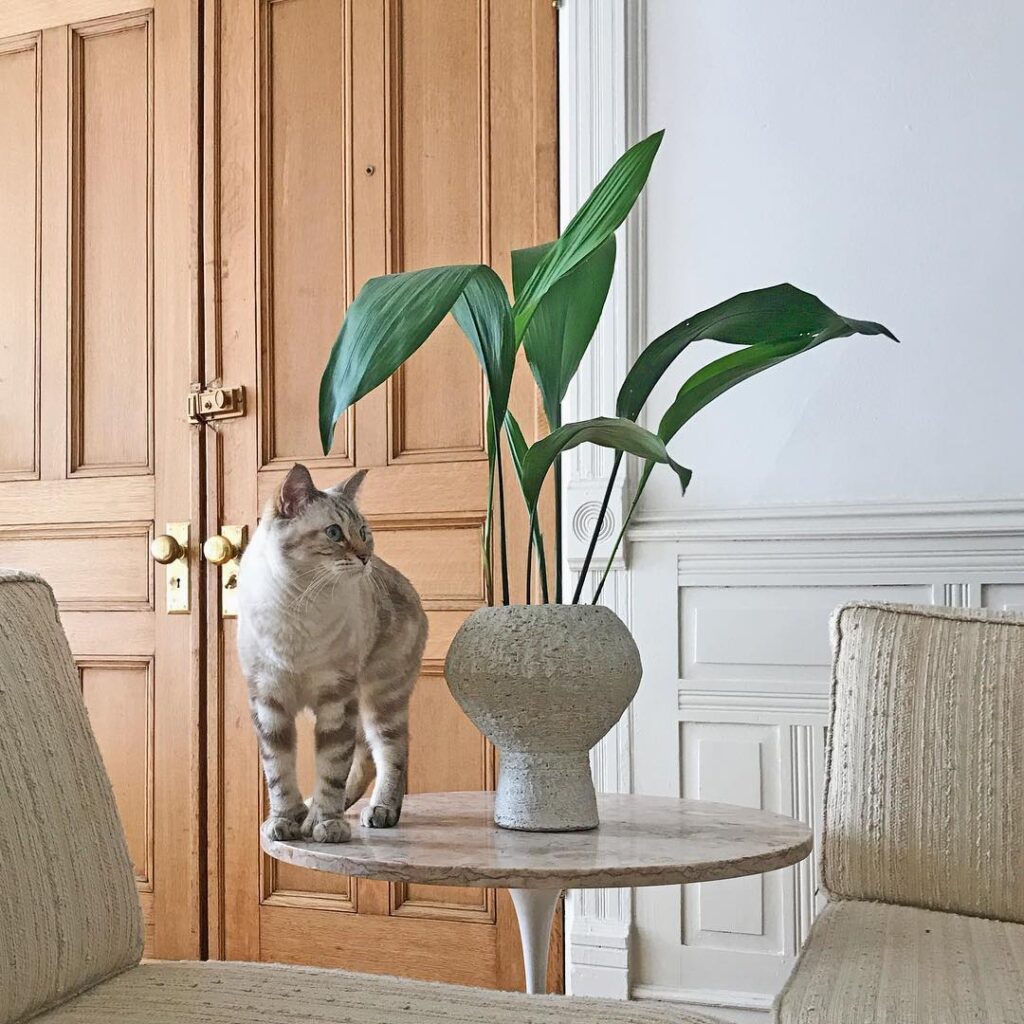
Okay so real talk — this photo stopped me mid-scroll and I literally gasped a little.
That warm honey-toned door, the round marble-top side table, the textured concrete-style ceramic vase with those tall, glossy leaves shooting up like they own the room? It’s giving quiet luxury without trying too hard. And your golden retriever sprawled between those linen chairs? Chef’s kiss.
The plant you’re seeing here is a Cast Iron Plant (Aspidistra elatior) — and yes, it’s completely cat-safe. Big deal. Because most dramatic, statement-making plants are not.
Those deep forest-green, strap-like leaves can grow up to 24 inches tall, which means real visual impact without the anxiety spiral every time your cat sniffs around the pot.
To get this exact look, you need a low, wide ceramic planter — something with that rough, stone-textured finish in warm gray or off-white. Pair it on a tulip-base marble side table (IKEA’s DOCKSTA gets close, or thrift one). Position it between two natural linen occasional chairs against white wainscoting for that editorial moment.
Cast Iron Plants thrive in low to medium indirect light — no direct sun needed. Water it every 10-14 days, let the soil dry between waterings, and it basically ignores you. That feature means zero maintenance, which pays off when life gets busy and you forget it exists for two weeks straight.
My aunt had one of these for fifteen years and repotted it exactly twice. It outlived two housecats and one very curious dog.
Keep the pot heavy or weighted at the base — cats will bump a lightweight planter off a side table like it’s their job.
📸 Photo credit: Instagram @othertimesvintage
#14: Parlor Palm (Chamaedorea Elegans) — The Cat-Safe Plant That Looks Like a Tiny Jungle in a Wire Basket
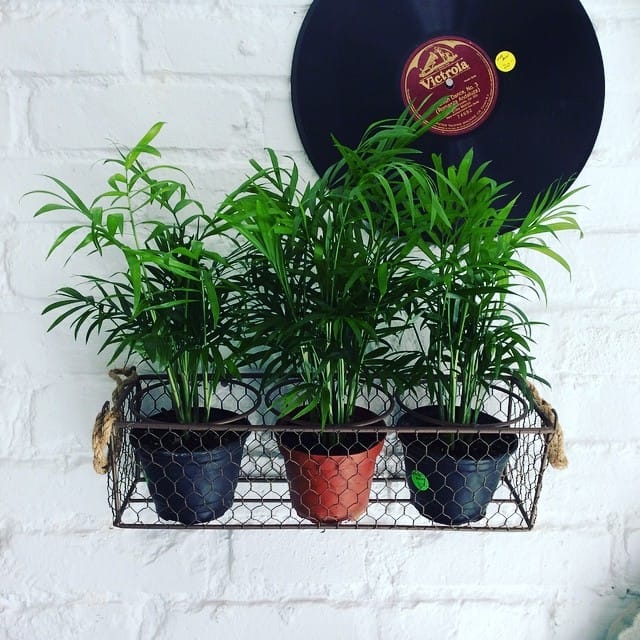
Okay, so you know that moment when you walk into someone’s house and their plant setup is so cute you literally stop mid-conversation to stare at it? That’s exactly what this trio of Parlor Palms does. Three of them, tucked into terracotta, navy, and forest green painted pots, sitting inside a wire chicken-mesh basket with rope handles — mounted against a white brick wall. And that vintage Victrola vinyl record hanging above them? Chef’s kiss.
The whole thing is built around a rectangular wire storage basket — the kind you find at HomeGoods or on Etsy for around $15–25. The pots inside are standard 4-inch nursery pots, two painted matte black-navy and one left in classic terracotta. The plants themselves are Chamaedorea elegans, which stay compact at around 2–3 feet tall — perfect for a wall-mounted display that your cat will absolutely side-eye from across the room but can’t actually harm herself with.
Mount the basket at eye level, roughly 5 feet high, using two heavy-duty wall anchors rated for at least 10 lbs. Parlor Palms thrive in low to indirect light, so a north or east-facing wall works perfectly — the plants stay lush, the pots stay photogenic, and your cat stays safe.
These palms prefer weekly watering and hate wet roots, so poke a few drainage holes in those painted pots before planting. The non-toxic, pet-safe quality means even if your golden takes a curious sniff (or a sneaky chew), you’re not calling poison control at midnight.
📸 Photo credit: Instagram @plant_mode
#15: Pilea Peperomioides (Chinese Money Plant) — The Round-Leaf Beauty That’s Safe and Stunning
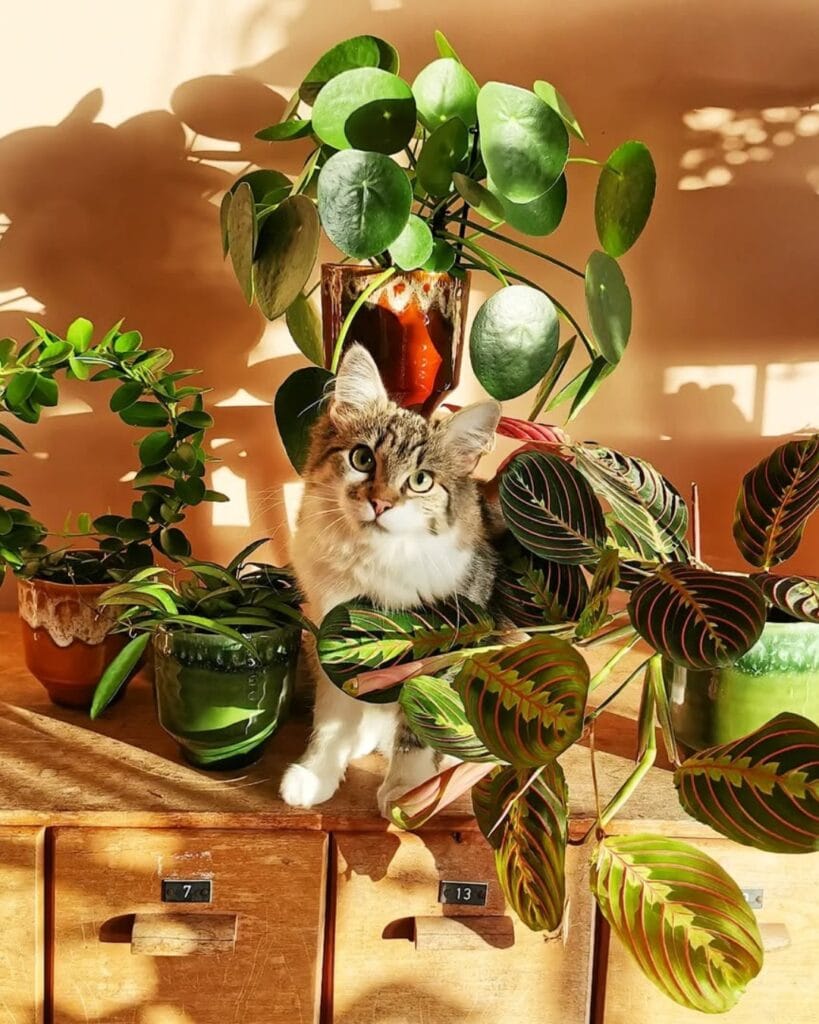
Okay, so picture this — warm afternoon light spilling across a wooden dresser, little coin-shaped leaves casting the most gorgeous shadows on a terracotta wall. That’s exactly the energy this setup gives, and honestly? It feels like a Pinterest board came to life. The best part — your cat can sit right in the middle of it all (like this fluffy baby clearly does) and you don’t have to panic.
The star here is the Pilea peperomioides, also called the Chinese Money Plant. Those signature round, pancake-shaped leaves grow on individual stems from a central stalk, giving the plant that wild, cascading shape you see spilling out of the amber-glazed ceramic pot in the image. It’s completely non-toxic to cats — so that nosy little sniff-fest your cat does with every new plant? Totally fine here.
The supporting cast matters too. That deep green glass pot on the left holds what looks like a Tradescantia or similar low-light variety — also cat-safe. And those dramatic striped leaves spreading to the right? That’s a Maranta leuconeura (Prayer Plant). Cat-safe, stunning, and the pink-veined leaves look unreal against natural wood.
To recreate this exact look, you need a solid wood dresser or sideboard — the drawer pulls and numbered labels in this image give it that vintage school-supply charm. Layer plants at different heights: tall in back, trailing in front.
Water your Pilea only when the top inch of soil feels dry. These plants hate soggy roots — terracotta pots help drain excess moisture faster than glazed ones.
📸 Photo credit: Instagram @plnts_com
#16: Spider Plant (Chlorophytum comosum) — The Cat-Safe Classic That Actually Looks Stunning
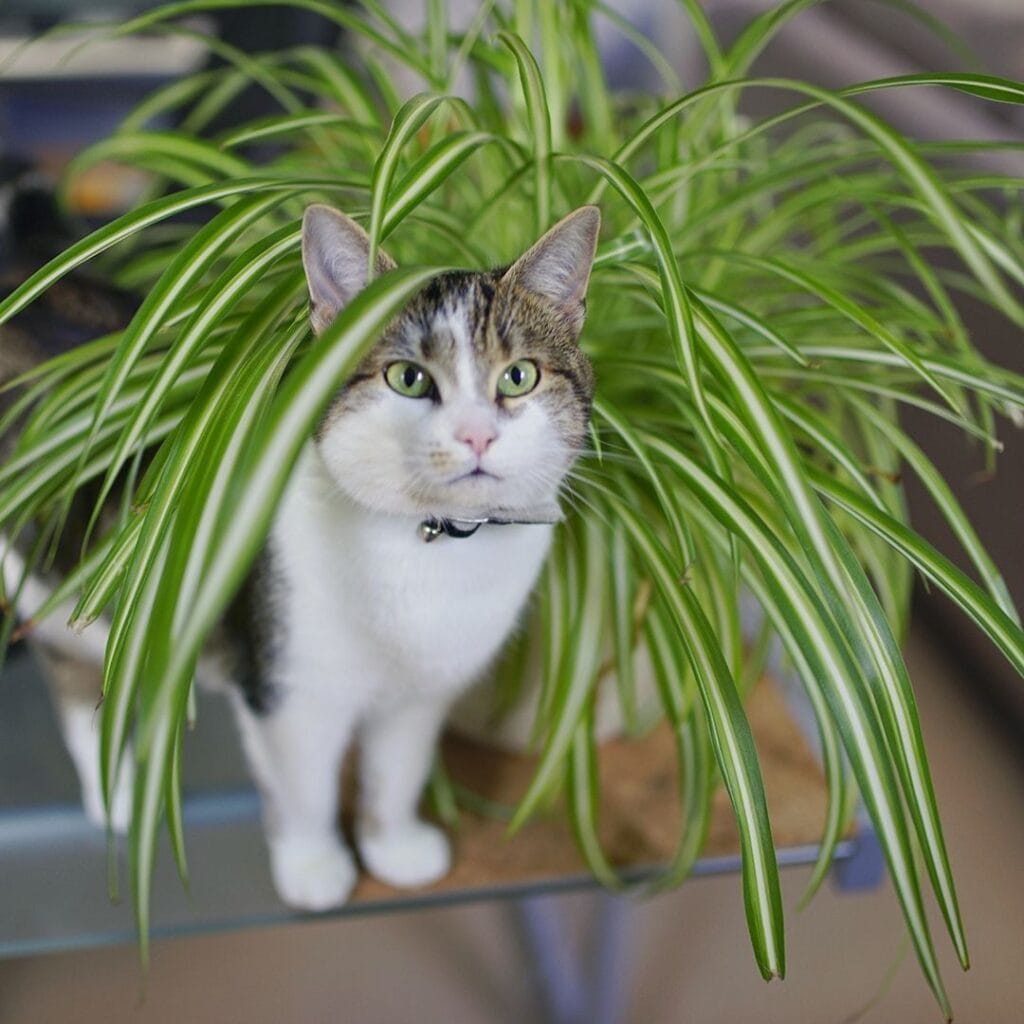
Okay, so you know that moment when your golden retrieves a muddy stick from the backyard and you’re just praying nothing in your living room is toxic if she decides to sniff around your plant shelf? Yeah, that’s the exact energy I want to talk about here.
This photo is everything. A variegated spider plant sitting on a glass shelf, its long green-and-white striped leaves cascading down like a waterfall. And that tabby sitting right underneath it? Totally unbothered. That’s the vibe.
Spider plants are genuinely one of the safest plants you can own as a cat parent. The Chlorophytum comosum produces compounds that have a mild hallucinogenic effect on cats — think catnip-lite — but here’s the thing: it’s non-toxic. ASPCA confirmed. Your cat might chew a leaf and act a little silly, but she’s safe.
The setup here is a tempered glass shelf, roughly 12 inches deep, mounted low enough that the leaves drape naturally. The pot looks like a 4–5 inch terracotta nursery pot sitting directly on the shelf. No fancy planter needed.
Spider plants thrive in indirect light and only need watering every 7–10 days. They trail up to 24 inches, which means the more they grow, the more dramatic they look — long leaves, constant visual interest, zero toxic risk.
Keep them elevated though. Not because they’re dangerous, but because cats will absolutely pull the whole plant down if they can reach it.
📸 Photo credit: Instagram @qualicocommunitieswpg
#17: Pilea Peperomioides (Chinese Money Plant) — The Round-Leaf Cutie That’s Totally Safe for Cats
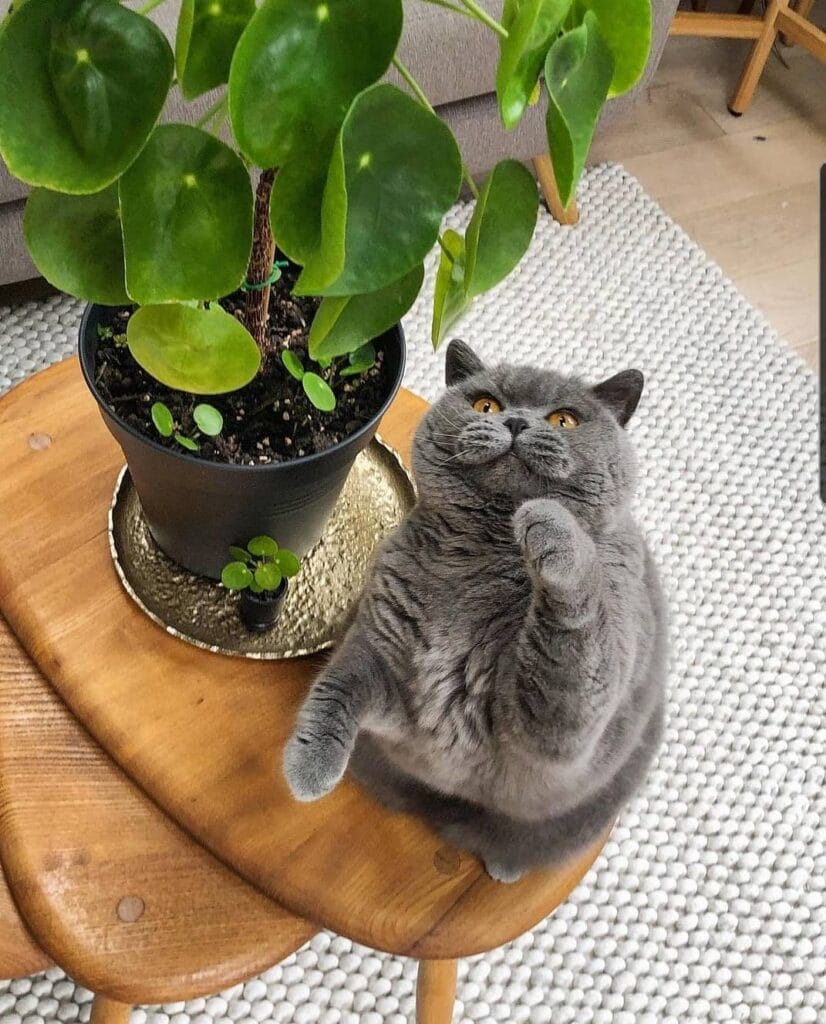
Okay, so this photo? Genuinely stopped me mid-scroll. There’s a chunky gray British Shorthair sitting on a little wooden side table, paws up, staring at this gorgeous Pilea peperomioides like he’s about to make a deal with it. And honestly, same energy.
The plant sits in a matte black nursery pot on a gold metal saucer, which gives it that warm, earthy-meets-glam vibe you’d pin in two seconds. The whole setup is on a round wood side table — looks like solid acacia or teak — against a white bobble-texture rug that ties everything together without trying too hard.
To get this exact look, grab a Pilea peperomioides (they run about $12–$18 at most plant shops). Pair it with a 3–4 inch black plastic grow pot and drop it onto a brass or gold drip saucer — that contrast is everything. Set it on a small round side table, ideally something with visible wood grain and tapered legs.
Here’s the part you’ll care about: Pilea peperomioides is non-toxic to cats according to the ASPCA. So even if your cat does the whole “paw-bat-and-chew” routine, you’re not rushing to an emergency vet at midnight.
Keep it in bright indirect light — like 3–4 feet from a south or east-facing window. Water it when the top inch of soil dries out, roughly every 7–10 days. And those tiny baby “pups” that sprout at the base? You can propagate them into new plants, which means more cat-safe greenery for zero extra cost.
📸 Photo credit: Instagram @secretgardenivy
#18: Maranta Leuconeura (Prayer Plant) — The Drama Queen That’s Totally Dog AND Cat Safe
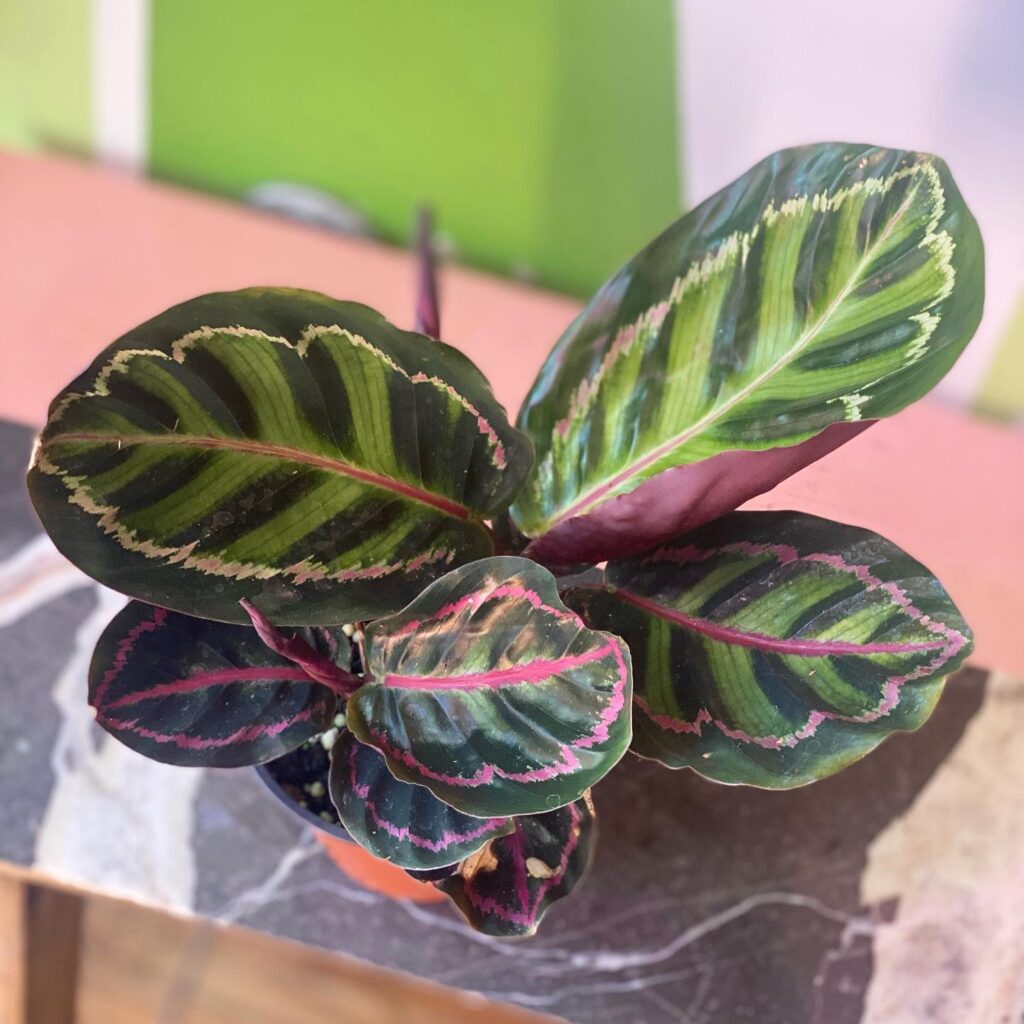
Okay so you know that moment when your golden is finally napping and you just want to sit with your coffee and stare at something pretty? This plant is exactly that thing. The Maranta leuconeura — aka the Prayer Plant — is giving full-on stained glass window energy with its deep green leaves, hot pink midrib veins, and those wavy cream-and-green brushstroke markings. It’s basically living art, and your cat can walk right past it without you panicking.
What you’re seeing here is a 4-inch potted Maranta sitting on a stone-look surface, shot from above so you get the full rosette of leaves fanned out like a little crown. The leaves show that signature two-tone pattern — dark forest green on the outer edges, lighter yellow-green racing toward the center spine, with magenta-pink veins cutting through the whole thing. Some leaves are older and deeper in color, some are fresh and almost teal. That mix of ages is what gives it dimension.
Grab a terracotta pot in a 4 or 6-inch size — the warm orange clay against those pink veins is chef’s kiss. Pair it with a shallow ceramic saucer because Marantas love humidity but hate sitting in water. Place it on a dark slate or marble tile trivet like the one in this photo for that editorial, Pinterest-board moment.
Marantas fold their leaves upward at night like hands in prayer — the feature that makes them interactive, the benefit being that kids and pets notice them, and the payoff is that no one’s bored of it in a month like they would be with a plain pothos.
Keep it away from direct sun. Bright indirect light near a north or east window keeps those pink veins saturated. Water it with room temperature filtered water — tap water with fluoride can cause brown leaf tips, and you’ll lose all that gorgeous patterning. Mist the leaves every couple of days or sit the pot on a pebble tray filled with water to bump up ambient humidity without overwatering.
And if your cat does decide to chew a leaf? Zero toxicity. The ASPCA lists Maranta leuconeura as non-toxic to both cats and dogs, so the worst thing that happens is a slightly ragged leaf.
📸 Photo credit: Instagram @softopeningplantshop
#19: Boston Fern & Friends — A Cat-Safe Plant Cluster That Actually Looks Good
Okay, so you know that moment when you walk into your living room and your golden has somehow knocked over yet another plant pot, soil everywhere, and you’re just standing there like… why do I even try? Yeah. That used to be me too — except swap the dog for my cat, Juniper, who treats every plant like a personal challenge.
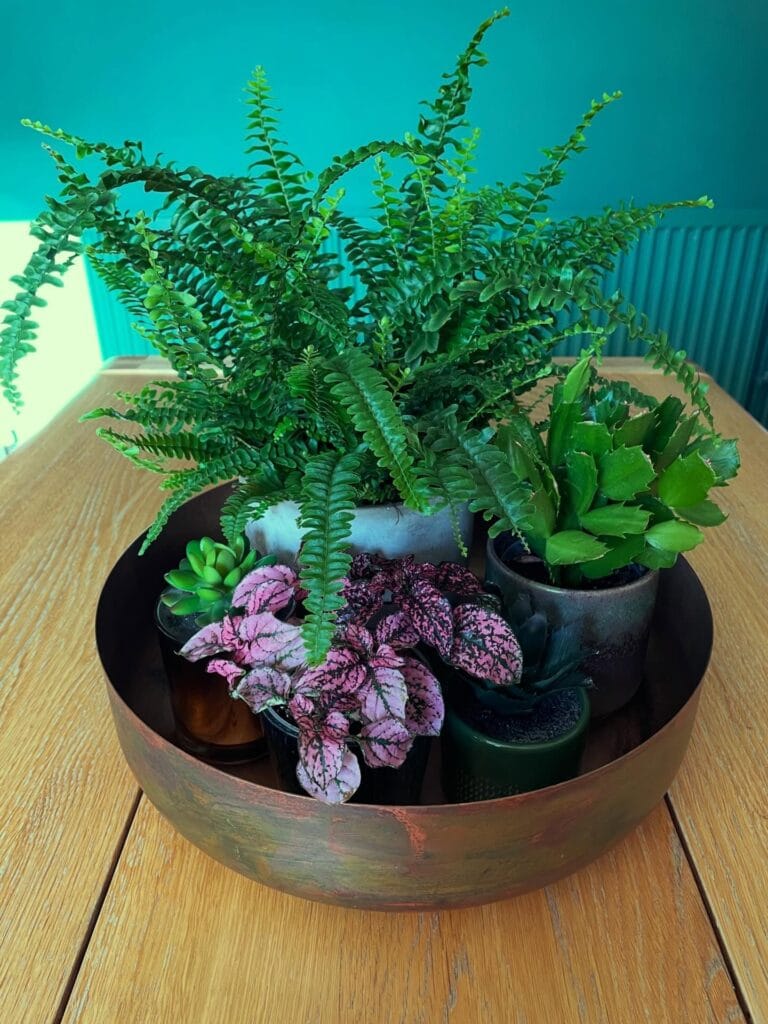
This little plant cluster is everything. A copper-toned metal tray holds a whole collection of small potted plants together — a Boston fern taking center stage, a polka dot plant (Hypoestes phyllostachya) with those pink-splashed leaves up front, a chunky succulent, what looks like a Haworthia, and a small aloe-type plant in a dark ceramic pot. The whole thing sits on a wood dining table in front of a teal-painted wall, and honestly it looks like something straight off your Pinterest board.
The Boston fern (Nephrolepis exaltata) is completely non-toxic to cats — the ASPCA confirms it. The polka dot plant is also on the safe list. And Haworthia? Safe too. So this entire tray is basically a worry-free zone for your furry babies.
Grab a round metal tray, roughly 12–14 inches in diameter — aged copper or oxidized bronze finish gives it that warm, lived-in look. Then mix pot sizes. The fern goes in a white or light gray ceramic pot, the smaller plants in matte black pots around 3–4 inches wide. Grouping them creates humidity, which the fern loves, and it also means one tray to water around instead of chasing individual pots across your shelf.
The polka dot plant front-and-center is a genius move. It’s low-growing, so it doesn’t compete with the fern height-wise — fern does the drama up top, polka dot does the color pop below. Feature: grouping plants by height. Benefit: every plant gets light. Payoff: nothing gets leggy or sad-looking within two weeks.
Keep this tray away from direct sun. Boston ferns want indirect light and hate drying out — stick your finger an inch into the soil every couple of days. If your cat starts sniffing around the tray, a light misting of water on the fern leaves often deters them since cats don’t love the damp texture on their paws.
📸 Photo credit: Instagram @violette_femme
#20: The Cat-in-the-Jungle Hideout: How to Build a Plant-Filled Perch Your Cat Will Never Leave
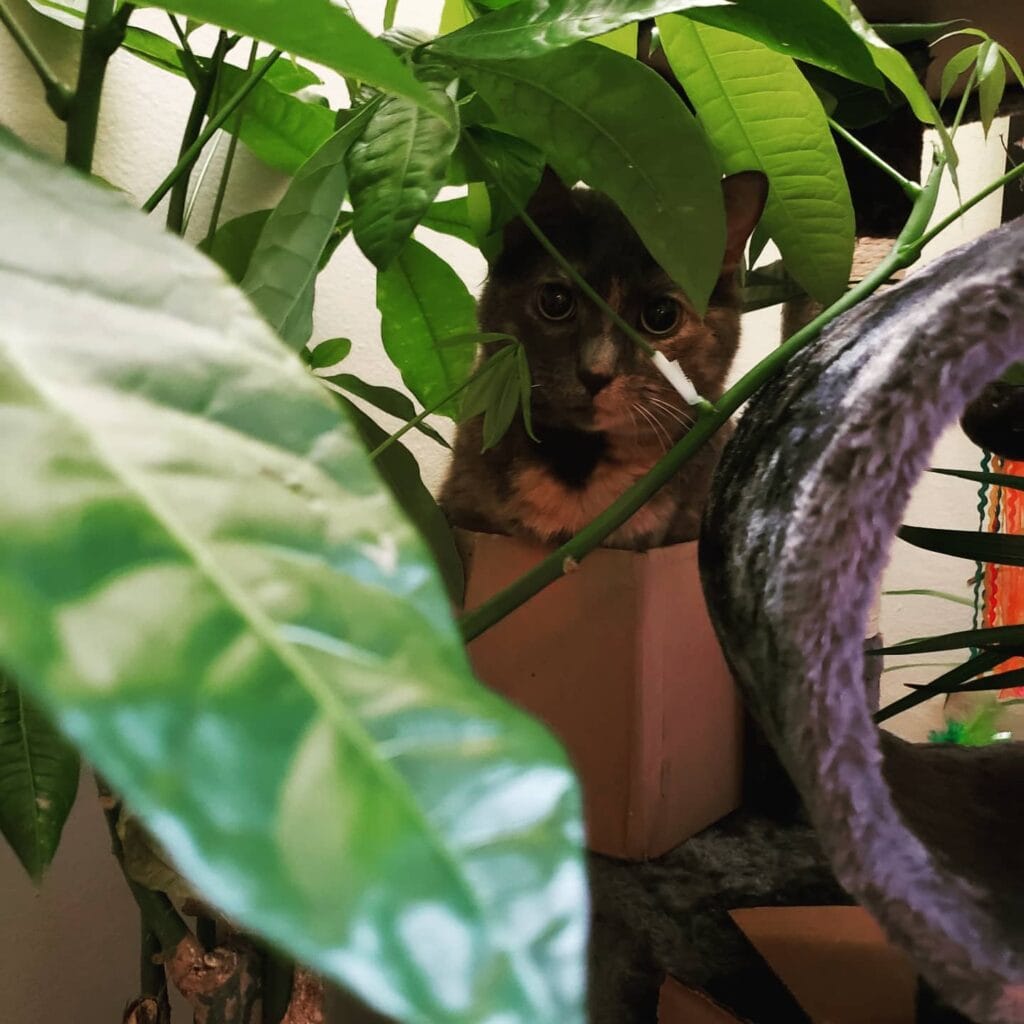
Your cat has claimed the cat tree. Again. But this time she’s tucked herself completely inside a cardboard box, surrounded by a canopy of green leaves, peeking out at you like a tiny jungle predator — and honestly? You didn’t even plan this. It just happened.
That’s the thing about cats. Give them a shelf, a box, and some trailing leaves overhead, and they’ll build their own paradise.
This setup in the photo is doing something really clever. A multi-level cat tree with a carpeted perch platform sits right next to a cluster of houseplants — what looks like a money tree (Pachira aquatica) with its braided trunk and bright green leaves, plus what appears to be a pothos or philodendron with those big, waxy, variegated leaves in the foreground. And tucked right in the middle of it all? A small cardboard box that the cat has fully adopted as her throne.
The money tree is completely cat-safe, which makes it perfect for exactly this kind of setup. Pothos, though — that one’s actually toxic to cats, so if you’re recreating this, swap it out for a heartleaf philodendron alternative like a calathea or parlor palm instead.
To get this look, you need a tall cat tree in a dark gray or charcoal carpet fabric — the one here has a curved tunnel or perch arm draped in a chunky purple knit blanket or rope wrap, which adds that cozy, Pinterest-worthy texture. Position it flush against a wall so the plant branches naturally drape over the platforms.
The plants are grouped on what looks like a wooden plant stand or shelf ledge at the same height as the cat tree’s upper level. That’s the key move here — matching the height means your cat can step from the tree straight into the plant canopy. She’s not just near the plants. She’s in them.
For the box, any medium-sized cardboard shipping box with the top flaps open works. Cats choose boxes because the enclosed sides feel secure. Slide it onto a perch platform and let the plants do the rest of the framing.
Keep the money tree trimmed so the lower branches hover just above the cat’s eye level — that creates the “hidden in the jungle” effect you’re seeing here. The braided trunk of the money tree also gives cats something interesting to look at (and occasionally chew, which is fine since it’s non-toxic).
One thing worth knowing: money trees do best in indirect bright light, so a spot near but not directly in a window works well. This also means the cat tree won’t sit in harsh afternoon sun — which is better for your cat’s nap schedule anyway.
📸 Photo credit: Instagram @wbwomack
The “Safe Label” Trap That Sends Cat Owners to the Emergency Vet
Okay, real talk — this one almost got me.
A plant can be labeled “pet-friendly” at the nursery and still wreck your cat’s stomach. Spider plants are the perfect example. They’re on every “safe list,” but they contain compounds that act like mild opiates for cats. Your cat won’t die, but she will eat the whole thing and then vomit on your Pinterest-worthy jute rug. Ask me how I know.
Here’s the pro secret nobody tells you: toxicity levels change based on the plant’s age and soil composition. A mature pothos cutting versus a fresh propagation? Different chemical concentrations entirely.
The real move is cross-referencing two sources — the ASPCA database AND your vet’s specific breed recommendations. Golden retrievers sniff everything your cat knocks down, so double-checking protects both your babies.
My personal shortlist that actually survives cat chaos: calathea, parlor palm, and peperomia. All three are sturdy, gorgeous, and genuinely non-toxic.
Bonus — keeping your cat mentally stimulated with 7 Fun DIY Cat Projects Every Owner Needs means she’s less likely to attack your plants out of boredom.
Your Floors (and Your Sanity) Deserve This
Look, golden retrievers are magic — but that mud they track in? Not so much. You’ve worked hard to make your home feel cozy and pulled-together, and one rainy walk shouldn’t undo all of that.
Pick one rug from this list and just try it. Seriously, that’s all.
I switched mine out last spring and genuinely forgot what stressed me out before. The right rug just sits there doing its job — looking gorgeous, hiding the chaos, surviving everything your girl throws at it.
So tell me — which style are you leaning toward, and does your golden have a habit of destroying everything beautiful you own? 😂

Amr Mohsen is a software engineer who traded his keyboard for a leash — at least on weekends. His love for dogs inspired him to share what he learns as a dog owner and enthusiast, bringing a detail-oriented, research-driven perspective to every article he writes. If it’s about dogs, he’s probably already looked it up twice.