Okay, so you know how cats are wild for boxes? Like, your golden retriever has his fancy orthopedic bed and your cat is literally living her best life inside an Amazon box with a hole you cut out at 11pm. Been there.
The thing is, those random boxes get gross fast. Soggy edges, scratched-up sides, and suddenly your Pinterest-perfect living room has a sad cardboard situation sitting right next to your linen couch.
I spent way too many weekends making my cat actually use the houses I built her — total trial and error, honestly. But once I figured out what works? Game changer.
These 16 cardboard cat house ideas are proof you don’t need to spend a dime to build something your cat obsesses over and something you won’t want to hide when guests come over.
#1: The Modular Cardboard Cat Castle That Actually Looks Good in Your Living Room
Okay so hear me out — you know how your golden’s dog bed is that one thing in your living room you keep trying to hide behind a throw pillow? Yeah. Cat people have the same problem, except it’s usually some giant carpeted tower that looks like it belongs in a 1997 pet store. This? This is nothing like that.
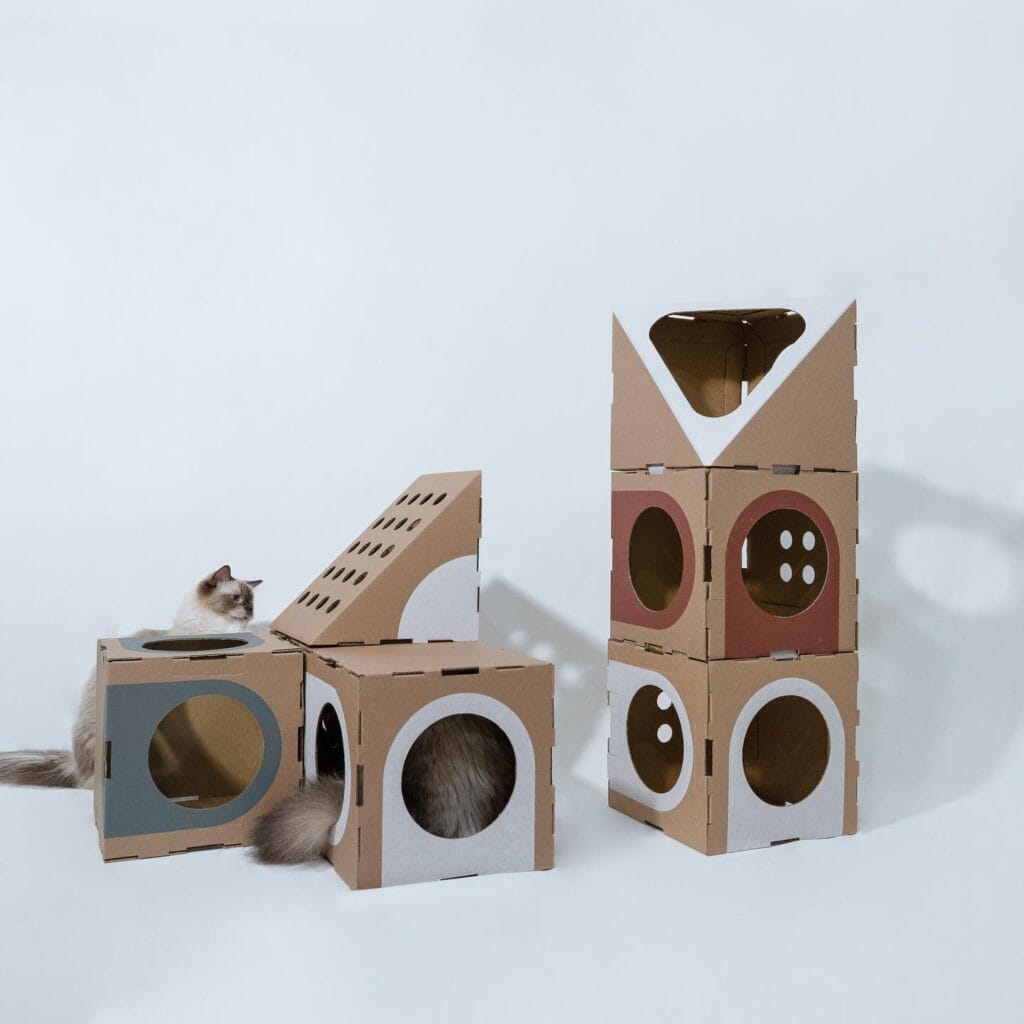
What you’re looking at is a modular cardboard cat habitat system made from double-wall corrugated cardboard in a natural kraft brown finish. Each cube measures roughly 12×12 inches, and the whole setup connects through interlocking tab-and-slot joints — no glue, no tools. The color blocking is done in muted terracotta, slate gray, and warm white, which honestly looks like something straight off your Pinterest board.
The system includes several distinct modules. There’s a flat-roof stacking cube with a large circular cutout portal (think: a cat door that actually looks intentional). A diagonal ramp unit sits low to the ground with small oval ventilation slots punched along its surface — good for airflow, great for little paws gripping on the way up. Then the triangular-opening tower unit stacks on top of the cubes to create vertical height, letting cats climb and perch without you needing a dedicated cat tree house.
The middle section features a terracotta-painted face panel with four small circle cutouts arranged in a 2×2 grid — it’s decorative, but those holes also double as peek-a-boo windows your cat will lose their mind over.
Small change, big win: stack the tower modules against a wall instead of freestanding. The wall contact keeps the structure from wobbling when a heavier cat jumps between levels, which means the whole thing stays upright and your cat stays safe.
Each module is fully replaceable, so when one cube gets scratched to pieces (and it will), you swap just that piece instead of trashing the whole setup. That’s the feature-benefit-payoff right there — modular design means lower long-term cost and a structure that grows with however many cats you end up with.
If you live somewhere with cold winters and have outdoor cats too, pairing an indoor setup like this with a proper feral cat house for cold weather covers both bases without spending a fortune.
Keep the base layer on a low-pile rug or yoga mat — it stops the bottom cube from sliding on hardwood when your cat comes flying in at full speed.
📸 Photo credit: Instagram @acatthing
#2: The Personalized Cardboard Cat Castle That Makes Your Cat Feel Like Royalty
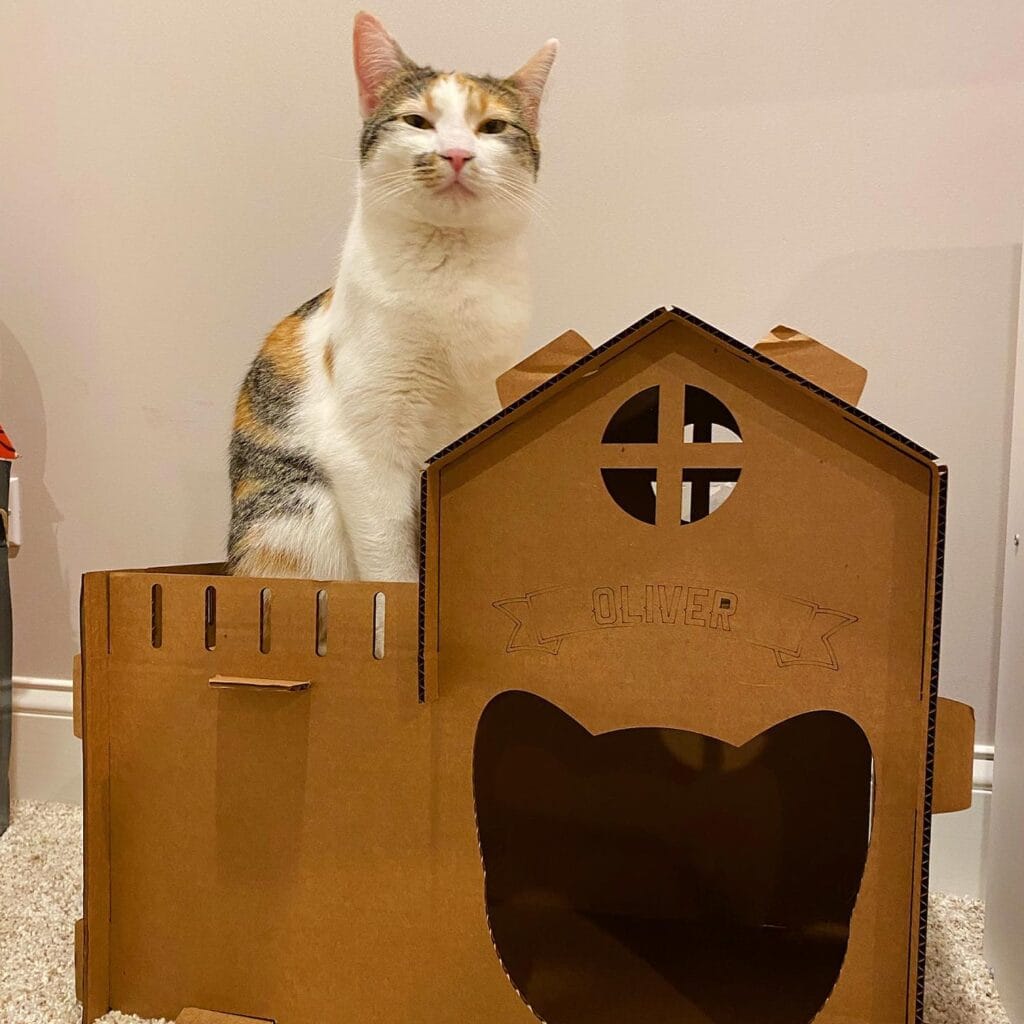
You know that moment when your golden retriever claims every single cozy spot in the house — the couch, the dog bed, the corner of the bathroom — and your cat is just done with it? Like, visibly judging everyone from the highest surface she can find?
This cardboard cat house is giving your cat her own little kingdom, and honestly, it’s adorable enough to belong on a Pinterest board.
The house in the image is a two-story corrugated cardboard structure with a laser-engraved name banner — it says “OLIVER” right above the entry arch — which makes it feel intentional and personal, not like a random Amazon box situation. The entry cutout is shaped like a cat face silhouette, and the upper level has a cross-window detail that mimics a real house facade. There’s also a side tower section where the cat is literally perched and looking like she owns the place.
The cardboard is thick, double-wall corrugated — you can see the layered edges clearly — so it holds shape under a cat’s full weight without buckling.
And the best part: the name engraving isn’t just cute, it’s a personalizing feature that makes the whole thing feel like a gift rather than a toy, which means you’ll actually want to keep it in your living space instead of hiding it.
Grab a craft knife and a metal ruler if you want to DIY a version — score along the fold lines before bending to keep the edges clean and tight.
📸 Photo credit: Instagram @_cat_named_oliver
#3: The Paw Print Cardboard Cat House That’s Low-Key a Whole Vibe
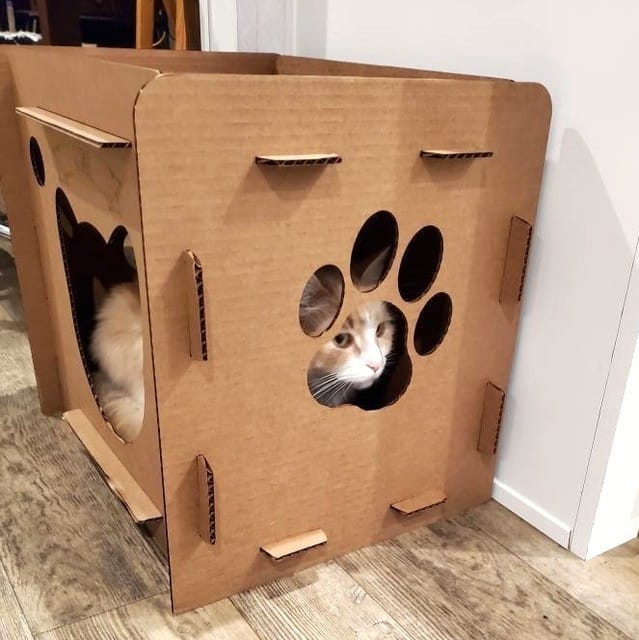
Okay so I know you came here for cat stuff, but hear me out — even your golden retriever Max would probably try to squeeze into this one. This corrugated cardboard cat house is built like a small cube, and the front panel has this cutout shaped like a giant paw print. It’s the kind of thing you see and go “wait, that’s actually adorable.”
The whole structure is made from thick brown corrugated cardboard, assembled with interlocking tab slots — no glue, no screws. The paw print opening sits centered on the front face, about 6–7 inches wide, which is just big enough for a cat’s head to peek through (as you can see in the photo, lol). A second identical unit connects on the left side, creating a two-room cardboard modular system — basically a little apartment.
Each panel locks into the next using laser-cut notch tabs along the edges. You can buy these as flat-pack kits or DIY them with a box cutter and some patience.
Practical tip: place a fleece liner or folded blanket inside to keep it warm without adding bulk. The modular design means you stack or expand it later — more rooms, zero extra tools needed. If you love this kind of cozy cat setup, 19 Clever Cat Area in House Ideas for Cozy Corners is worth a browse.
Rotate the box every few weeks so wear spreads evenly across all panels. Cardboard lasts way longer when no single side takes all the scratching damage.
📸 Photo credit: Instagram @cardboardcathomes
#4: This Cardboard Cottage Cat House Looks Like It Belongs on a Pinterest Board (And Your Cat Will Never Leave It)
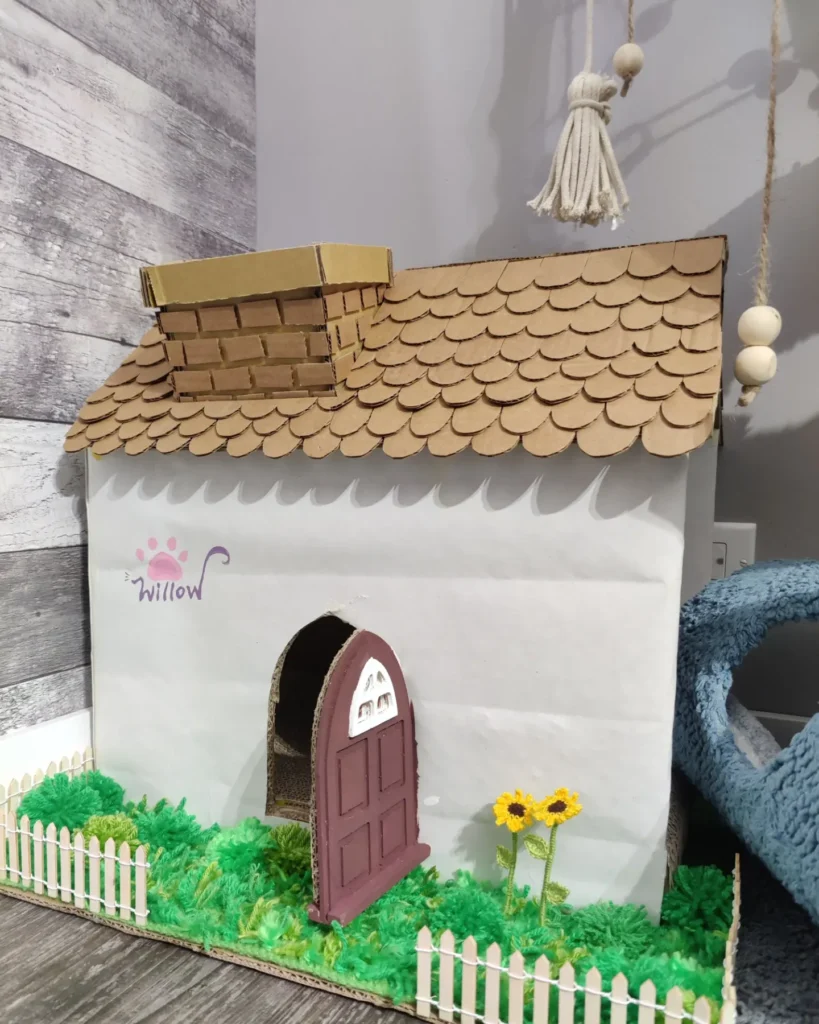
Okay so you know how your golden retriever has that one corner of the house he’s completely claimed as his own? Imagine your cat having something even better — a whole cottage built just for her.
This handmade cardboard cat house is giving full English countryside cottage energy. We’re talking scalloped cardboard shingles layered row by row across a pitched roof, a brick-textured chimney with a gold foil cap, and a rounded mauve door painted in a dusty rose-brown tone. The white walls are painted smooth, and the name “Willow” is hand-lettered in purple with a pink paw print — that personal touch hits different.
To recreate this, you’ll need corrugated cardboard sheets as your base structure. The shingles are individual semi-circle cutouts glued in overlapping rows — time-consuming but worth every minute. The chimney is built from scored cardboard strips mimicking brick texture, then capped with gold metallic cardboard.
The garden border uses green yarn pompoms or faux moss pressed along the base, framed by a small white picket fence made from craft sticks. Two crocheted sunflowers sit beside the door — if you love fiber crafts, 15 Crochet Cat House Patterns For Cozy Naps has patterns that pair perfectly with a build like this.
The arched door opening acts as the actual entry point — no hardware needed, just a cardboard panel cut and painted. Seal the interior base with packing tape so claws don’t shred the floor after one use.
📸 Photo credit: Instagram @ariel_hsieh25
#5: The Two-Story Cardboard Mansion Your Cat Will Absolutely Refuse to Share
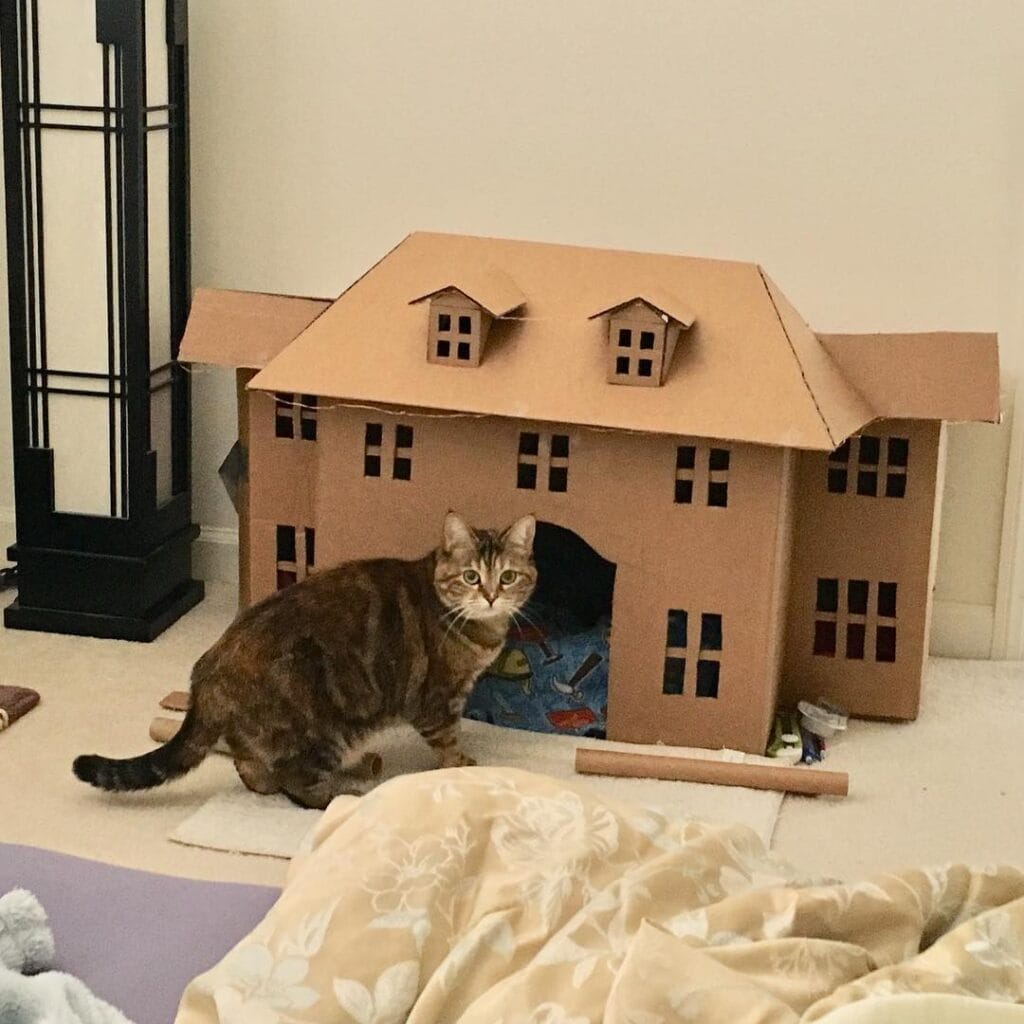
Okay, so you know how your golden retriever has that one corner of the living room she’s claimed as her whole entire kingdom? Imagine if someone built her a two-story cardboard mansion with dormers and cutout windows. That’s exactly what this cat parent did — and honestly, I’m a little jealous on behalf of every pet in America.
This thing is a full architectural moment. We’re talking a mansard-style roof with two dormer window cutouts, multiple rectangular window openings on both floors, and what looks like a three-wing layout — a center section flanked by two side wings. The whole structure sits low to the ground on beige carpet, which means it’s perfectly sized for a cat to strut in and out dramatically.
To recreate this, you’ll need several large double-wall corrugated cardboard boxes — the kind appliances ship in. The dormer details are cut from flat cardboard scraps and scored with a box cutter to fold into that pitched shape. A fabric scrap or bandana (you can see the blue patterned one tucked inside as bedding) adds a cozy floor layer.
Here’s the trick: score your fold lines with a butter knife instead of cutting all the way through — this keeps the cardboard from tearing and gives you those clean, sharp roof edges you see here.
The arched entry door is key. That rounded cutout at the base makes entry easier and gives the whole thing a cottage feel instead of a boring box.
📸 Photo credit: Instagram @emilywspeaks
#6: Pixel’s Cardboard Castle — The Two-Story DIY Cat House That Looks Like It Belongs in a Fairy Tale
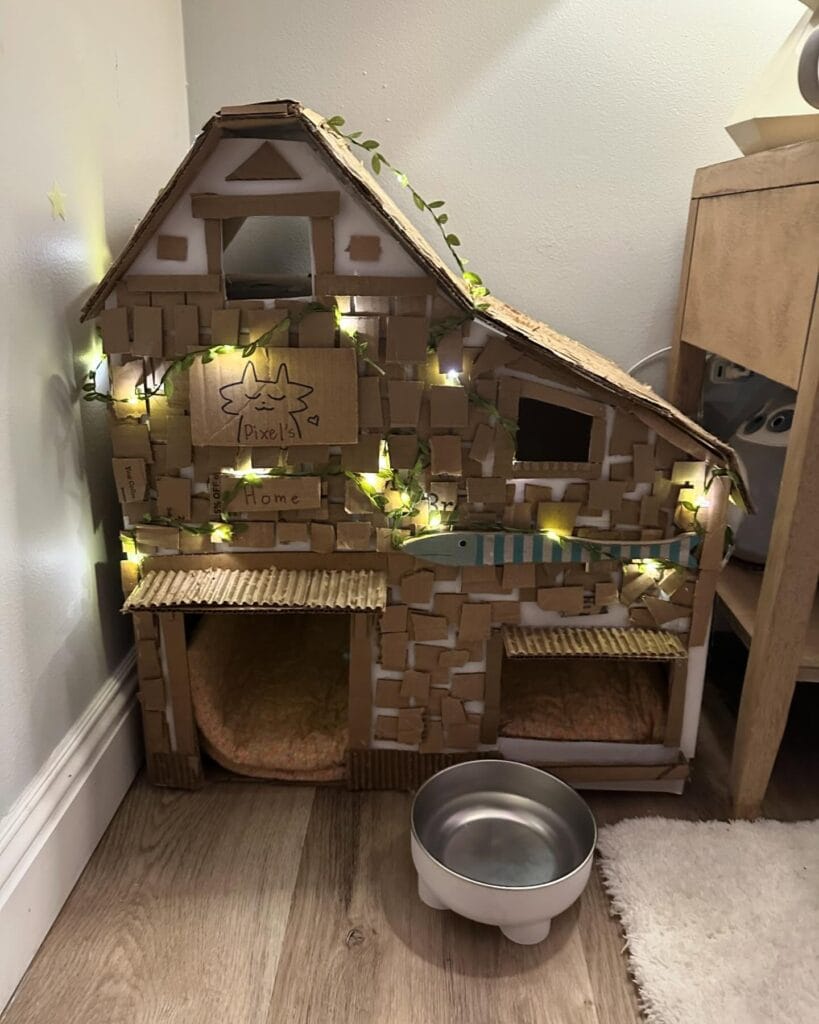
Okay, so you know how your golden probably has that one corner of the house she’s claimed as hers? The spot where she drags her blanket, knocks over your throw pillows, and just… parks herself? This is that, but make it Pinterest.
This two-story cardboard cat house is built entirely from corrugated cardboard sheets, decorated with small cardboard “stone” tiles glued in a mosaic pattern across the facade. Warm LED fairy lights weave through faux vine garlands draped over the roofline and down the sides, giving the whole thing this golden, cozy glow at night. A hand-drawn sign reads “Pixel’s Home” — and honestly? That detail alone got me.
The builder used layered corrugated cardboard strips as roofing tiles on the canopy above the lower den, which adds real texture. The lower level has a round, cushioned bed tucked inside an arched opening. The upper level has a flat scratching ledge made from stacked corrugated sheets. A painted cardboard fish hangs on the right side as wall decor — such a good touch.
To recreate this, grab white foam board for the structural walls, brown packing cardboard for the stone tile effect, and a $10 LED vine light string from Amazon. Cut your tile pieces in irregular rectangles and glue them in overlapping rows — that’s what gives it the handmade stone feel.
The triangular attic window and the pitched A-frame roof are what make this look like an actual cottage and not just a box. Build your roof panels at roughly a 45-degree angle and score the cardboard fold lines before bending — clean folds every time, no cracking.
Keep the base at least 3 cardboard layers thick for stability. Single-layer floors collapse fast under a real cat’s weight.
📸 Photo credit: Instagram @baked_cheezit
#7: The Cardboard Rowhouse Cat Castle That Will Make You Question Your Own Home
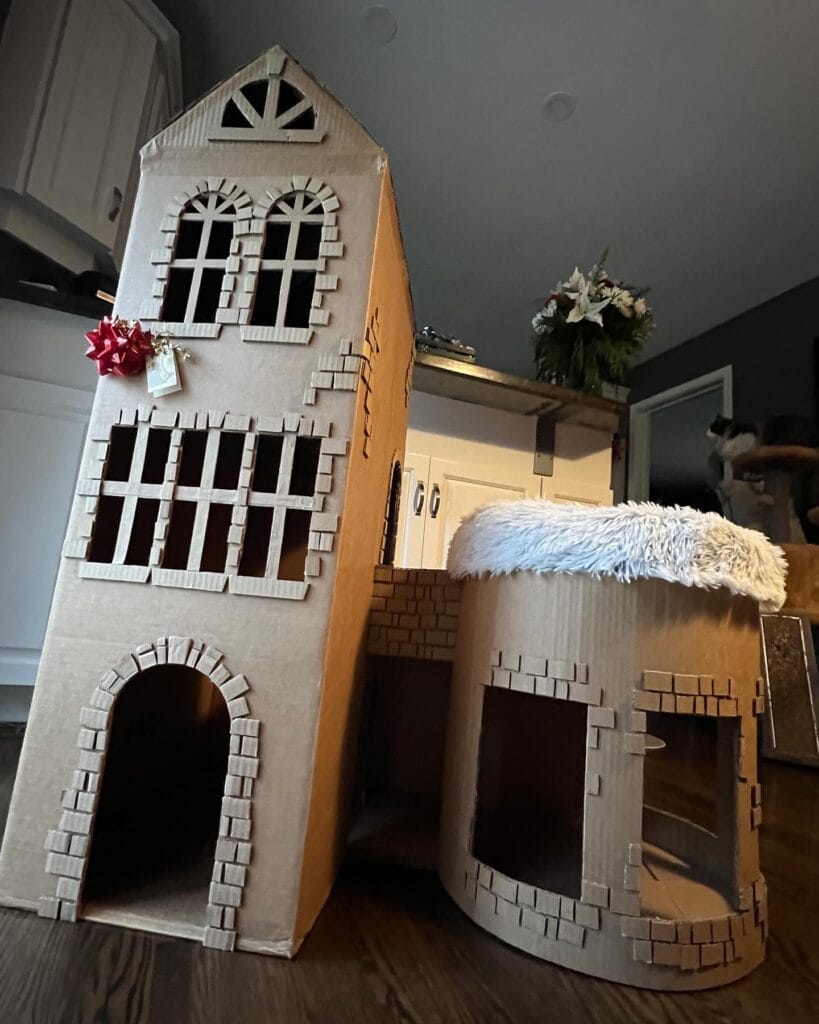
Okay, so you know how your golden leaves drool marks on literally everything you own? Imagine being a cat person with a cardboard masterpiece sitting in your kitchen that makes your whole house look like an art installation.
This thing stopped me cold the first time I saw it. It’s a multi-story cardboard cat house styled like a European rowhouse — we’re talking arched doorways, carved brick details, and Georgian-style window frames cut right into the facade. The attached circular tower with a fluffy white faux fur roof pad gives it this fairytale-meets-urban-loft energy that honestly belongs on a shelf in a design museum.
To recreate this, you need heavy-duty double-wall corrugated cardboard as your base material. The brick pattern comes from cutting small 1-inch x 0.5-inch cardboard strips and gluing them in offset rows — tedious, yes, but the payoff is insane. The arched entrance at the bottom is structural, not decorative, so you’ll score and bend the cardboard carefully around a round template before gluing.
The window grids on the upper floors use a ladder-cut technique — you score horizontal strips, leave vertical supports standing, and pull the cut pieces back. That grid pattern is what gives it the old-world townhouse look.
For the tower section, roll your cardboard into a cylinder about 10 inches in diameter, score it in tight vertical lines first so it curves without cracking. Top it with a white shag fabric circle cut slightly larger than the cylinder opening — this becomes the cat’s favorite perch.
The red gift bow detail on the facade? That’s a seasonal touch, but honestly it works year-round as a whimsical front door accent.
Use a hot glue gun with high-temp glue sticks for the brick strips — wood glue works too but takes forever to dry. And keep your cuts clean with a fresh X-Acto blade; dull blades tear the cardboard and ruin the crisp edge that makes this look intentional rather than scrappy.
If your cat ignores it at first, rub a little catnip into the faux fur pad. Works every time.
📸 Photo credit: Instagram @imagadgetgirl
#8: The Cardboard Cat Castle That Makes Your Home Look Like a Pinterest Dream
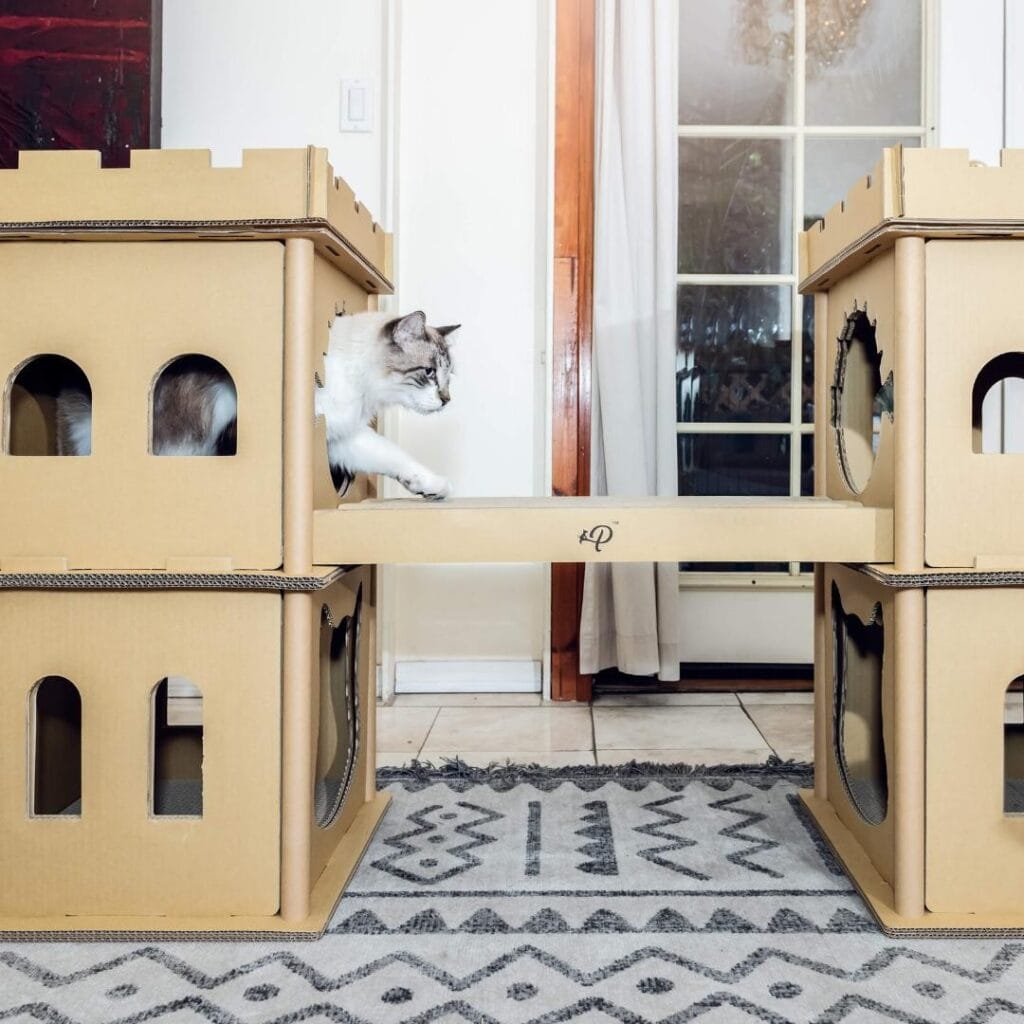
You know that moment when your golden retriever parks herself right in the middle of the living room and just owns the space? Yeah, cats have that same energy — except they want vertical real estate, tunnels, and a drawbridge. This corrugated cardboard cat castle from Petique Pets gives them exactly that, and honestly, it looks so good sitting on a patterned rug that you might do a double-take.
The whole setup is built from natural kraft-colored corrugated cardboard with laser-cut arched doorways and crenellated battlements on top — like actual castle turrets. There are four modular cube units stacked two-by-two, connected by a flat cardboard bridge plank running through the center. Each cube has its own arched window cutout, and one unit shows what happens after a few weeks of use — a cat-scratched circular hole that proves this thing actually gets lived in.
The rug underneath is a geometric diamond-pattern in grey and white, which grounds the whole structure without fighting it visually. That neutral palette is doing a lot of work here.
To pull this off, you need the Petique Cat Castle modular cardboard set (four units minimum), plus a low-pile flat-weave rug in a neutral geometric print — something around 5×7 feet works well for this footprint. Position it near a French door or large window so natural light floods through those arched cutouts. The backlighting makes the cardboard glow warm and golden, which photographs beautifully.
Real talk: the bridge connector piece is what makes this feel like a real cat habitat instead of just stacked boxes. Cats use it to patrol between towers, and watching them peer down from the upper level is exactly the kind of enrichment that keeps them off your sofa.
If you’re planning an outdoor version of this kind of cat space, 19 Outdoor Cat Room Ideas That Cats Will Love has some great setups worth stealing ideas from.
The corrugated cardboard construction means cats can scratch the walls freely — built-in scratching surface, zero separate scratcher needed, and your couch stays intact. That’s the feature-benefit-payoff right there.
Keep the bridge plank level by pressing the side tabs firmly into both cube slots before letting your cat test it. A wobbly bridge gets ignored fast.
📸 Photo credit: Instagram @petiquepets
#9: This Gingerbread Cardboard Cat House Is the Holiday Collab Nobody Asked For (But We All Need)
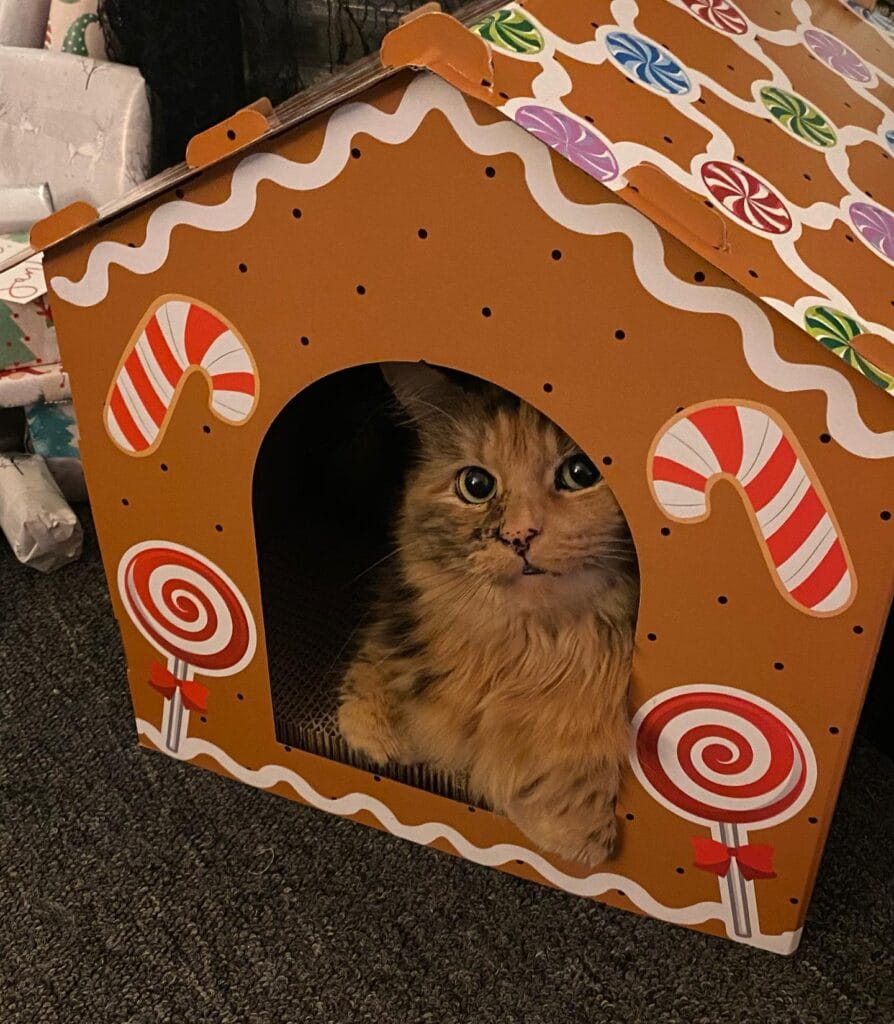
Okay, so you know how your golden has that one spot under the Christmas tree where she just parks herself like she owns the place? Your cat does the same thing — except now she has an actual house to do it in. And honestly? It’s cuter than half the holiday decor on your Pinterest board.
This gingerbread-themed cardboard cat house is printed in warm caramel brown with white icing swirl details along the roofline and walls. The roof panel is covered in illustrated candy — peppermint rounds, lollipops, and candy canes in red, green, blue, and purple. The arched front entry is sized just right for a medium cat to slip in and loaf comfortably, and the interior floor has a built-in corrugated cardboard scratch pad.
The fluffy orange tabby inside is basically the mascot this product deserves. She looks like she’s judging every gift under the tree and I respect it.
To recreate this vibe, you want the house placed near your actual holiday setup — wrapped gifts in the background, low lighting, maybe a tree nearby. The contrast between the festive cardboard and a real living room makes it look intentional, not random.
The corrugated scratch pad bottom keeps her busy, protects the cardboard walls from her claws, and saves your couch — that’s the payoff nobody talks about enough.
Flatten and store it after the holidays. These hold up for two or three seasons if you keep them dry.
📸 Photo credit: Instagram @jacqelineve_artistry
#10: This Cardboard Castle Is Giving Full Gothic Manor Energy (And Your Cat Will Lose Their Mind)
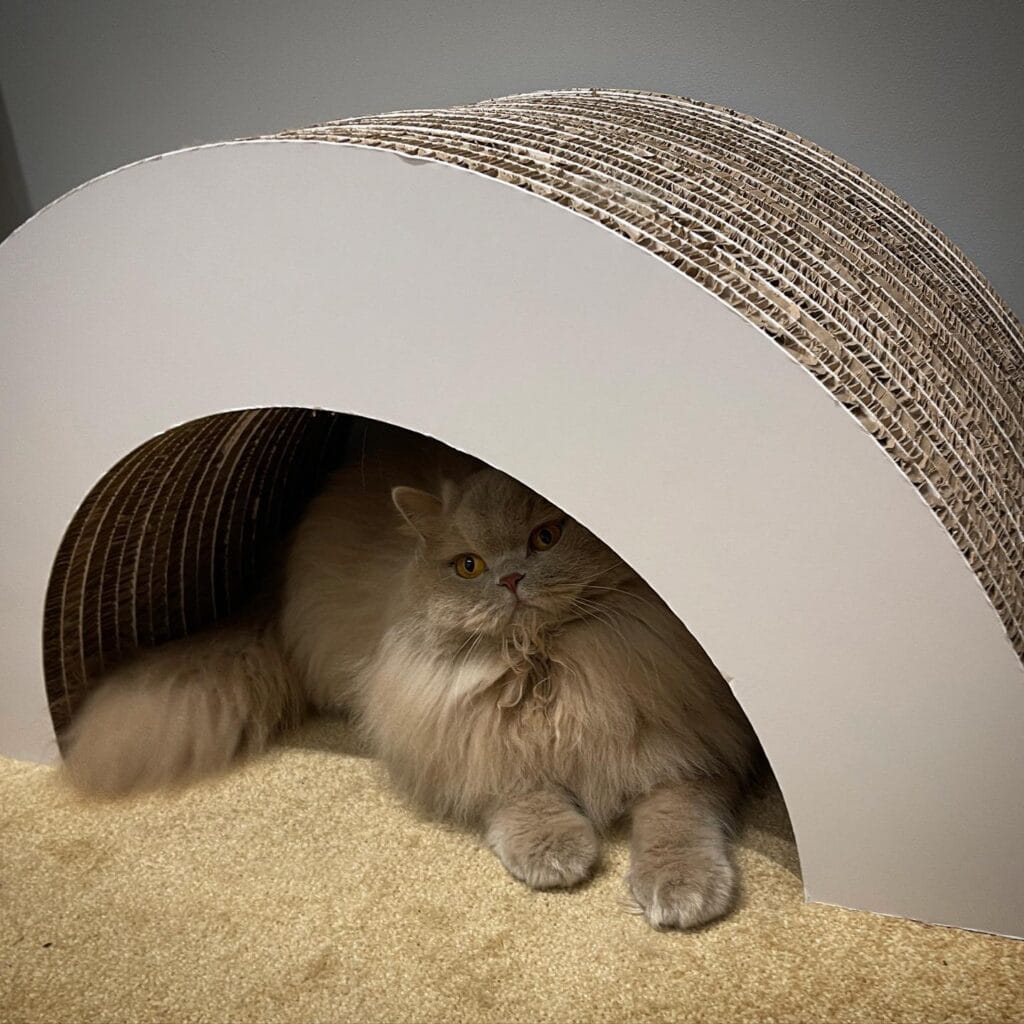
Okay, so you know how your golden is always stealing your throw pillows and making herself a little nest in the corner? Cats do the exact same thing — they want a space that feels like theirs. And this cardboard setup? It delivers that in the most extra, Pinterest-worthy way possible.
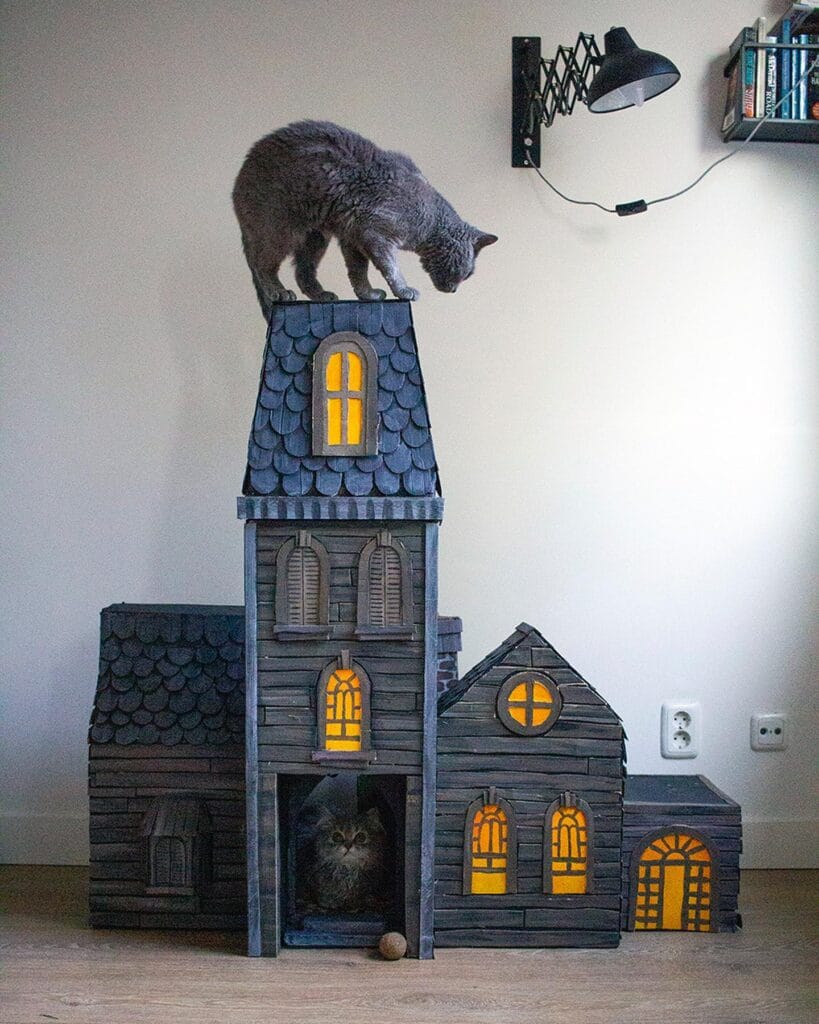
This is a multi-story corrugated cardboard cat house styled like a Gothic brownstone, standing at roughly 3-4 feet tall. The builder cut arched doorways at the base, stacked grid-pattern window cutouts across two middle floors, and topped it with a peaked roofline featuring a decorative rose window. Next to it sits a cylindrical cardboard cat tower — faux fur-lined on top, with brick-stamped side panels cut into the corrugated layers. Both pieces sit on dark hardwood floors, which honestly make the tan cardboard pop like natural stone.
To recreate this, grab large double-wall corrugated cardboard boxes — the thicker the better. A box cutter, metal ruler, and cutting mat are your best friends here. The brick texture? Just score and fold small rectangular tabs along the edges of each cutout — it’s tedious but so worth it.
The brick detailing isn’t just decoration — it reinforces the cut edges, which means the structure stays rigid longer and your cat won’t collapse a wall mid-nap.
Hot glue the window frames from the inside so the exterior stays clean. And size that arched ground-floor entrance at least 5–6 inches wide — cats are sneaky about squeezing in but hate feeling trapped.
📸 Photo credit: Instagram @your_meowjesties
#11: The DIY Cardboard Cat House That Looks Like a Real Home (And Costs You Almost Nothing)
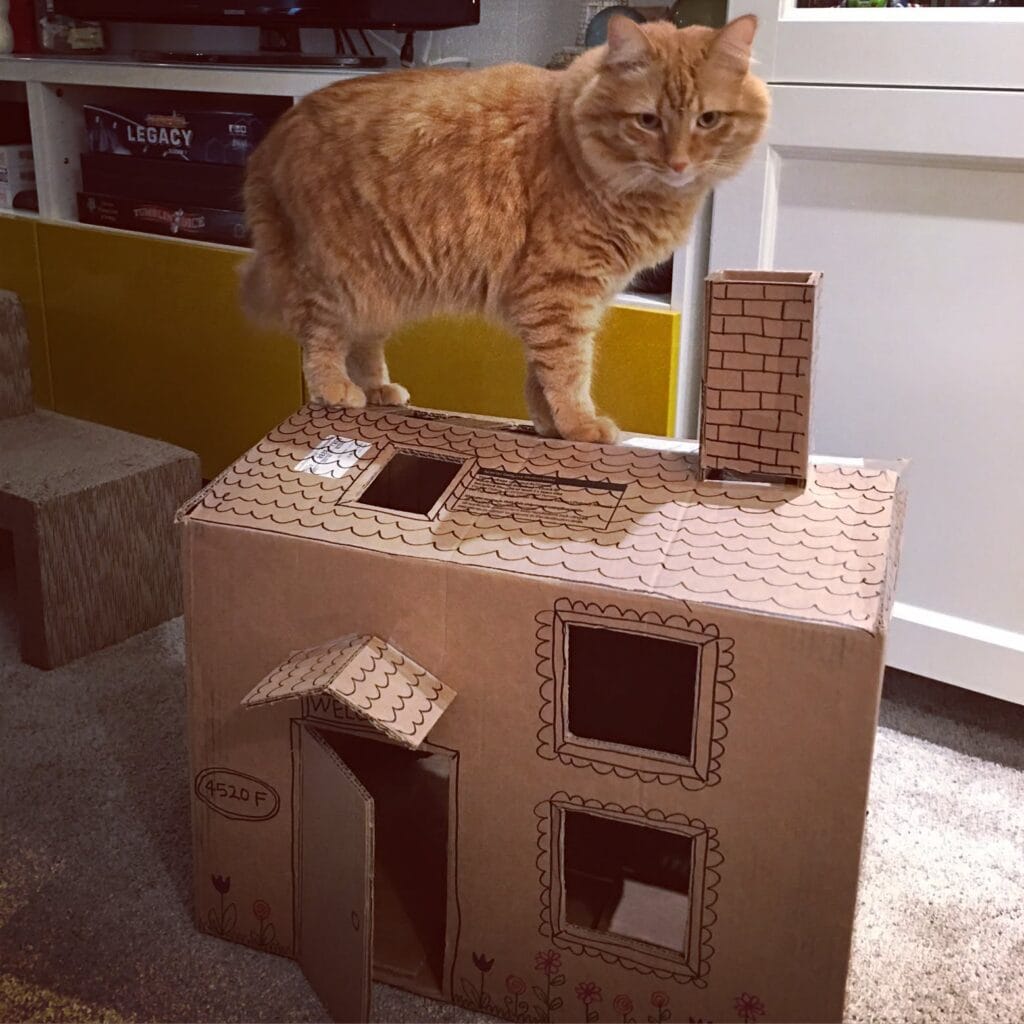
Okay, so you know how your golden has that one cardboard box she claimed from an Amazon delivery and just refuses to leave? This is basically that, but make it Pinterest. This handmade cardboard house has roof shingles drawn on, a working door, a chimney, windows with frames — the whole thing looks like a tiny neighborhood home sitting in someone’s living room.
The box itself is a large, double-wall corrugated cardboard box — probably around 24″ x 18″ x 18″. The roof detail is done in marker, with scalloped shingle patterns drawn across the top surface. Someone added a small chimney made from a separate cardboard tube, brick-pattern drawn on the sides with a black Sharpie. The door is cut open and hinged so it actually swings. The address “4520 F” is written near the front, and little flower doodles run along the base — that’s the detail that gets me every time.
To recreate this, grab a big moving box, a black fine-tip Sharpie, a box cutter, and some patience. Cut your windows first, then score (don’t cut through) the door so it stays hinged. Draw your shingles starting from the bottom edge of the roof and working up, overlapping each row like real tiles.
Keep this in mind: cats prefer entry points around 6–7 inches wide — small enough to feel safe, big enough to not feel trapped. And that skylight cutout on the roof? Genius. It lets light pour in without opening up the whole structure.
📸 Photo credit: Instagram @stanley_theorangetabby
#12: The Southwest Adobe Cat House That Makes You Go “Wait, That’s Cardboard?!”
okay so you know that moment when your golden retriever drags their muddy paws across your Pinterest-perfect rug and you just stand there, coffee in hand, questioning every life choice? Yeah. Now imagine your cat watching all of that chaos from inside what looks like a tiny adobe villa. Unbothered. Regal. Living their best life.
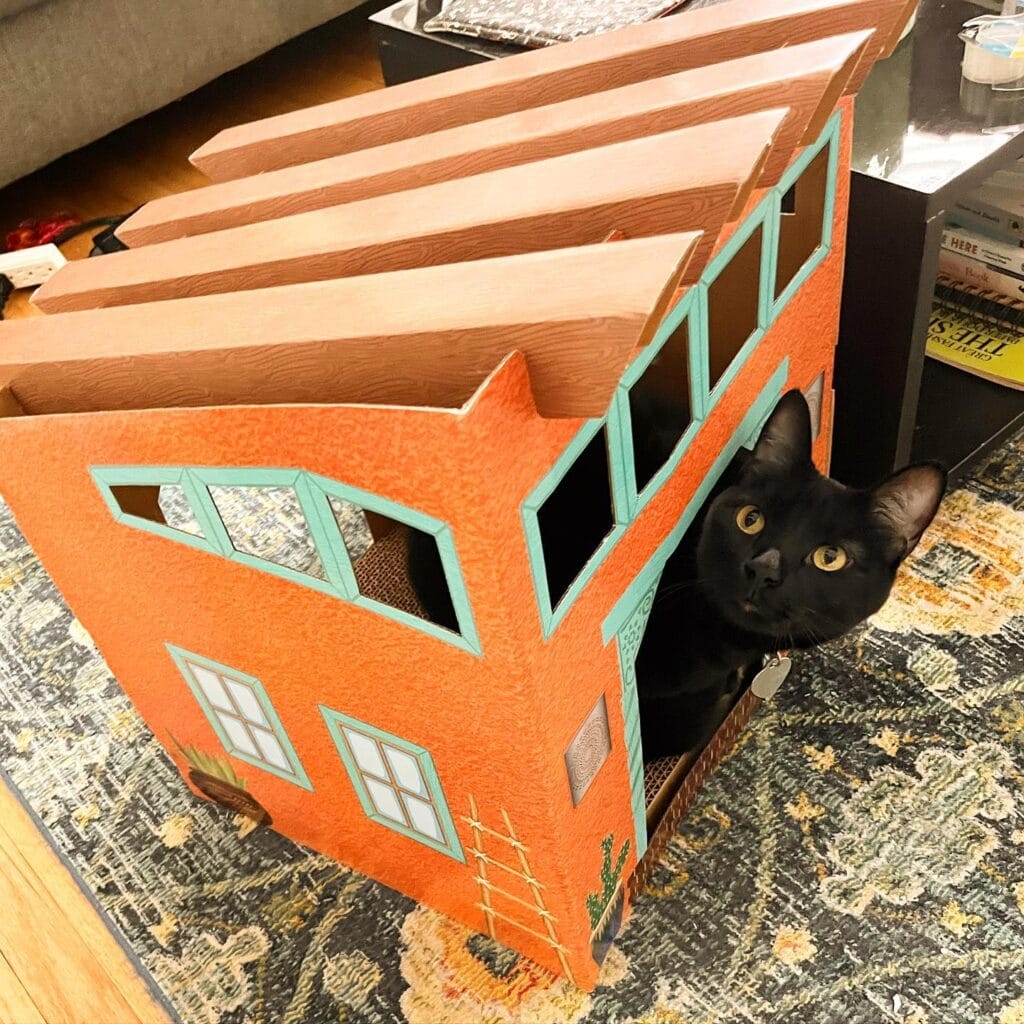
This orange and turquoise cardboard cat house is giving full Southwest desert vibes, and honestly it looks way too good to be sitting on a living room floor.
The whole thing is printed with terracotta orange walls, teal/turquoise window frames, and little painted details like a cactus and a ladder near the front door. The roof panels are designed to look like wood-grain planks and they’re layered and tiered, which means your cat gets extra surfaces to scratch. That’s the feature. The benefit? Your actual couch survives another week. The payoff? You stop finding claw marks on your armchair at 7am.
The cutout windows on the side panels aren’t just decorative. They give your cat a peek-hole to stalk things from, which cats genuinely need mentally.
Assembly sits flat, no tools required, and the corrugated cardboard base doubles as a built-in scratch pad inside.
For a cohesive look next to your decor, pair it with a terracotta plant pot and a woven rug nearby.
📸 Photo credit: Instagram @llcoolscharf
#13: The Pet and Pets Cardboard Cat House — A Cozy Hideout That Looks Good in Any Room
You know how your golden has that one corner of the living room he’s claimed as his? Cats are the exact same way — they want a spot that’s theirs, tucked away but still in the action.
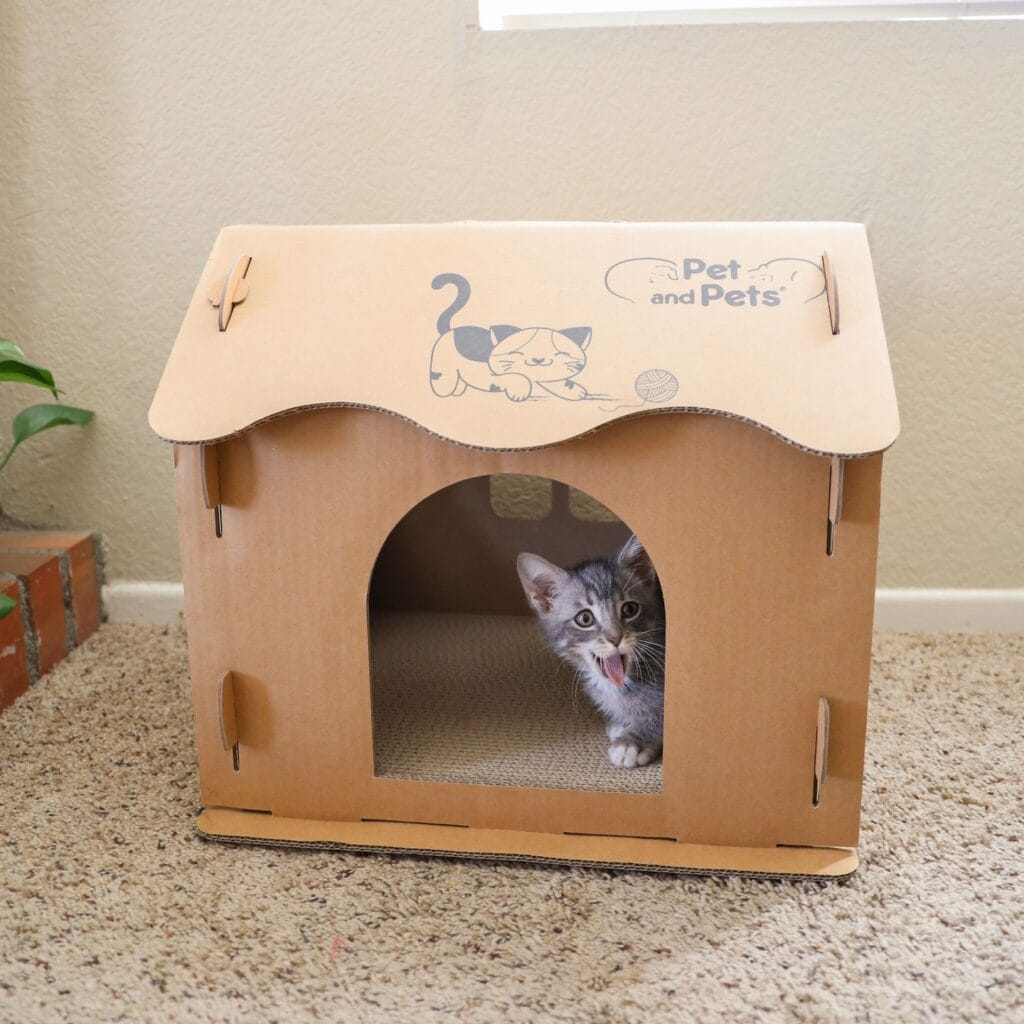
This corrugated cardboard cat house from Pet and Pets sits right on a beige carpet floor, and it genuinely looks like a little neighborhood cottage. The scalloped roofline, the arched entryway, and the printed cat-and-yarn-ball graphic on the front panel give it this storybook charm that doesn’t scream “cheap pet stuff” — it actually blends into a Pinterest-friendly living room without a fight.
The build uses double-wall corrugated cardboard panels that slot together without glue or tools. You get a built-in corrugated scratcher floor inside the house — that textured flat pad your cat will go absolutely feral over. The roof sits separate from the walls, held in place by tab-and-slot connectors at the four corners, which means the whole thing breaks down flat for storage or moving day.
To get this exact setup, grab the Pet and Pets Cat House and place it near a window with natural light — cats are sun-chasers, and the positioning in this photo is doing everything. Set it on a low-pile or looped area rug so the base doesn’t slide when your cat darts in and out. And honestly? Leave the front open like this image shows. A kitten who can peek out while staying tucked in is a happy kitten.
Rotate the scratcher insert every few weeks — flip it to the unused side and you double its lifespan before you need a replacement. The cardboard construction means it’s 100% recyclable, so when it’s done, the whole thing goes in the bin guilt-free.
📸 Photo credit: Instagram @petiquepets
#14: The Jungle Hideaway — A Laser-Cut Cardboard Cat House That Looks Like Actual Art
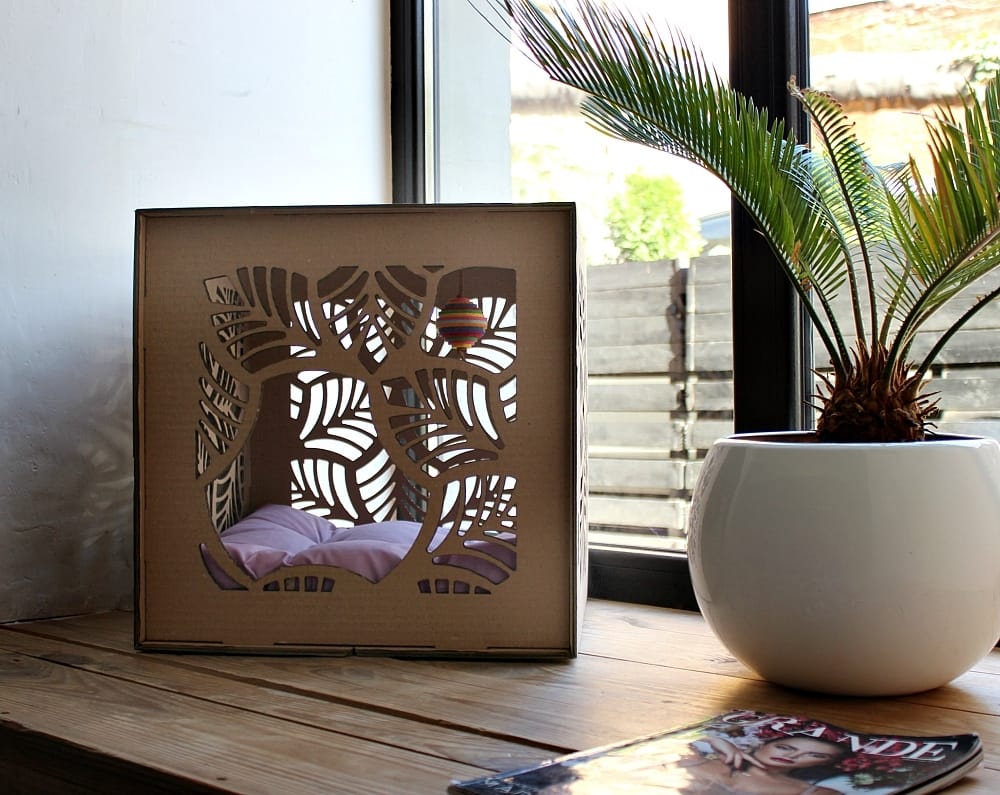
You know that moment when your golden plops down right in the middle of your living room, completely blocking the path you just styled for your Instagram shot? Yeah. Your cat deserves that same “I own this space” energy — just, you know, contained.
This piece is giving tropical rainforest meets modern gallery wall. The laser-cut cardboard panels feature an intricate monstera and palm leaf pattern cut straight through natural kraft brown cardboard, and the whole thing sits inside a square frame box that’s roughly 12×12 inches. Inside, there’s a soft blush pink cushion that tucks right into the base — it’s the kind of cozy that makes even your dog side-eye it with envy.
The dangling multicolored striped ball toy hangs from the interior ceiling, which honestly makes this feel less like a cat product and more like a tiny curated room.
To recreate this, you need a laser cutter (or order custom-cut panels from Etsy sellers who work in 3mm kraft cardboard), a square shadow box frame in natural or black, and a small square pillow insert in blush, dusty rose, or cream. The toy ball is just a wooden bead ball wrapped in colorful embroidery thread — you can DIY it in under 10 minutes.
Style it on a light wood shelf or windowsill next to a white ceramic round planter with a sago palm. That natural backlight? Chef’s kiss. The transparency of the cut panels lets light filter through — this feature creates shifting shadows that keep your cat mentally stimulated, which means less 3am chaos for you. That’s the real payoff.
Size your cushion tight. A loose cushion shifts and your cat abandons the whole setup on day one — been there, watched my cousin’s cat completely ghost a house she spent two weekends building. Measure the interior base before you cut any fabric.
If you love the idea of cozy, handcrafted sleeping spots like this one, 16 Easy Cat Bed Pattern Ideas For Beginners has some really good starting points for the DIY version.
📸 Photo credit: Instagram @catplayfurniture
#15: The Two-Story Cardboard Cat Castle That Makes Your Cats Forget Your Couch Exists
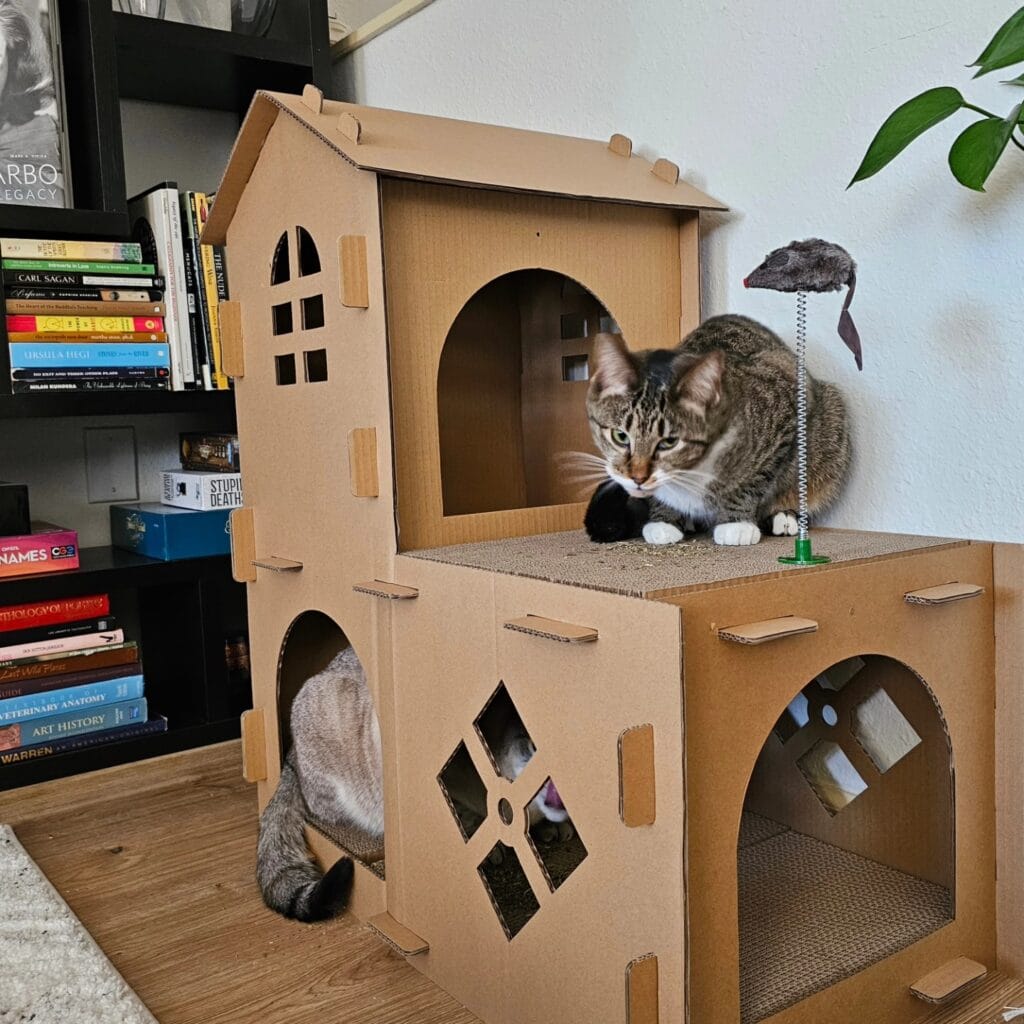
You know that moment when your golden retriever has claimed every single couch cushion and you’re sitting on the floor wondering how this became your life? Yeah. Cat people have their own version of that — except it’s claws in the armrest and cats launching themselves off bookshelves at 3am.
This two-story corrugated cardboard cat house is genuinely one of the coolest things I’ve seen in a cat setup. It’s got a full arched-roof upper level with a round entry cutout, diamond and square window cutouts on the lower level, and what looks like double-wide side arches that make the whole thing feel like a tiny townhouse. The cardboard is that thick, sturdy, multi-layer corrugated construction — not the flimsy Amazon box kind that collapses if your cat sneezes near it.
Two cats are actively using it at the same time in this photo — one tabby on the upper scratching platform (that flat corrugated surface on top is built-in, which is genius), and a grey cat half-disappeared into the lower left tunnel entrance. That’s the payoff right there: two levels means two cats, zero territorial drama.
The spring-loaded grey mouse toy attached to the upper deck is a small touch that makes a big difference — cats can bat it between nap sessions without you lifting a finger.
To recreate this setup, you need the cardboard cat house kit itself (this style assembles with tab-and-slot connections, no glue or tools needed). Pair it with a corrugated cardboard scratcher insert for the flat roof platform — it doubles as a scratch surface and a lounging spot. Position it close to a bookshelf like in this photo so cats feel like it’s part of their territory, not an island in the middle of the room.
Keep a small spring toy or wand toy clipped to the upper level. It keeps cats engaged with the house itself instead of wandering off to find your curtains.
If you want your cats coming back to this instead of ignoring it after day two, rub a little dried catnip into the corrugated scratching surface when you first set it up. The texture holds the scent and keeps them drawn to it. And if you love making your own cat entertainment, 7 fun homemade cat toys kitties can’t resist has some ridiculously easy ideas you can attach right to this house.
📸 Photo credit: Instagram @iver.and.ingrid
#16: The Two-Story Cardboard Cat Castle Your Cat Will Never Leave (And You’ll Kind of Want to Live In Too)
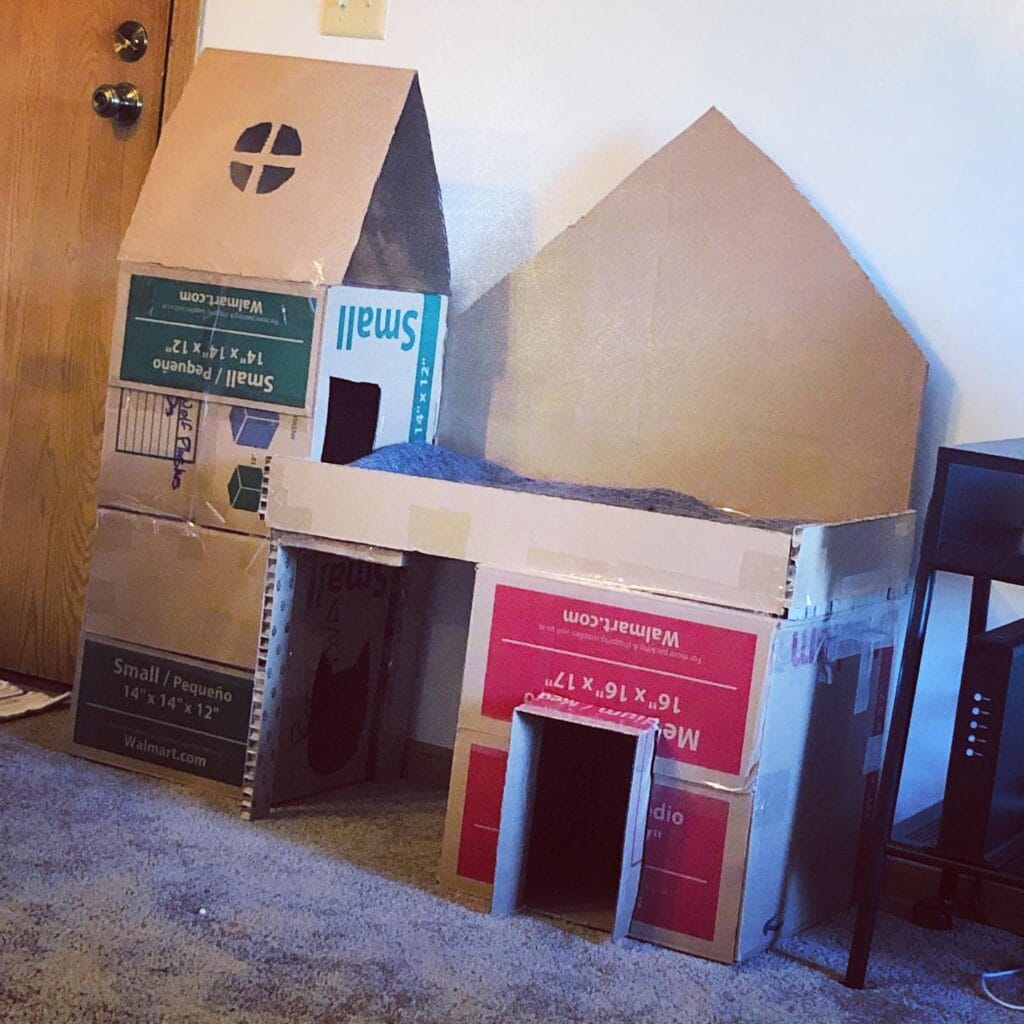
Okay, so you know how your golden retriever has that one corner she’s claimed as her own? Cats do the exact same thing — except they want the whole vertical space, floor to ceiling, all theirs.
This cardboard build is genuinely one of the most impressive DIY cat houses I’ve seen floating around. Someone took Walmart “Small” (14″x14″x12″) and “Medium” (16″x16″x17″) shipping boxes — the brown kraft ones with the teal and red labels — and constructed a full two-story structure with peaked rooflines on both towers. The left tower sits taller, with a hand-cut circular window painted in dark charcoal, and the right tower fans out wider with a sloped pentagon-shaped roof. It’s leaned against a living room wall, sitting right on carpet, and somehow it looks intentional.
The first floor has two entry points — a large arched doorway cut into the left section and a smaller rectangular door on the right tower base. The second floor connects both towers with a flat platform, and there’s a fluffy gray filler material (looks like poly-fill or shredded packing foam) spilling out from the upper level, giving it that cozy, lived-in feel. The roofs are separate flat pieces scored and folded into triangles, then taped with what looks like clear packing tape along the seams.
To recreate this, grab at least four to six Walmart or U-Haul moving boxes in small and medium sizes — don’t flatten them first. You want the structural integrity of the pre-formed box shape. A box cutter or X-Acto knife, a metal ruler, packing tape, and black acrylic craft paint for the window details are your core supplies. The poly-fill stuffing you can grab from any craft store for under five dollars a bag. And honestly? If you want to take it up a notch, 7 Modern Cat Furniture DIYs for Stylish Homes has some killer finishing ideas that could make this look way less “moving day” and way more intentional decor piece.
The builder reinforced the connection between towers by overlapping box panels horizontally — that flat bridge piece between the two rooflines is a full separate sheet of cardboard taped underneath. That’s what keeps the second floor from caving when a cat sits up there. Cut your doorways before assembling the towers, not after. It’s so much easier to score and push out a clean arch when the cardboard is flat on the floor.
Reinforce every interior seam with double-layered tape strips, not single strips across the outside. The structure lasts two to three times longer that way, and your cat won’t collapse the whole thing mid-nap. If you want the roofline to hold its peak without drooping, slip a folded strip of cardboard inside the triangle like a spine — it acts as a ridge beam and keeps the shape crisp. For cats who like to scratch, lightly score the outside walls in horizontal lines. It gives them a built-in scratch surface and actually keeps them off your furniture.
📸 Photo credit: Instagram @swearonmygrave
The Cardboard Trick Most Cat House Builders Get Wrong
Okay, so here’s something I learned the hard way — and I really wish someone had told me sooner.
Most people build their cardboard cat house and just… leave it flat. Single-wall cardboard feels sturdy enough at first, but your cat sits on the roof twice and the whole thing caves in. Not cute.
The pro move? Always use double-wall corrugated cardboard. Feel the edge of the cardboard piece — you should see two distinct fluted layers inside. That extra layer handles your cat’s weight and actually keeps the structure standing for months.
Here’s the other thing nobody talks about — direction matters. The corrugated ridges should run vertically on the walls, not horizontally. Vertical ridges resist compression way better. My cousin built three houses before figuring this out, and honestly her cats kept looking at her like “really?”
Also, if your cat is a scratcher (and whose isn’t?), reinforce the corners with extra cardboard strips. It doubles the lifespan without costing anything extra.
Pair this with a dedicated DIY cat scratcher and your furniture might actually survive the week.
Your Golden Deserves a Clean Couch Too
Pick one mat. Start there. You don’t need to overhaul your whole entryway this weekend — just grab the one that fits your space and let it do the work.
I told my cousin the same thing last spring, and she texted me two weeks later like, “why did I wait so long??” That’s exactly the energy I want for you.
Your home can look Pinterest-perfect AND survive a golden retriever — those two things aren’t fighting each other anymore.
So tell me — which mat style are you eyeing first, and does your pup have a signature “I just ran through a puddle” look? 🐾

Amr Mohsen is a software engineer who traded his keyboard for a leash — at least on weekends. His love for dogs inspired him to share what he learns as a dog owner and enthusiast, bringing a detail-oriented, research-driven perspective to every article he writes. If it’s about dogs, he’s probably already looked it up twice.