Your cat is losing it indoors. Pacing the window, knocking stuff off your shelf, giving you that look — you know the one.
And you get it. She wants out. Fresh air, birds, all of it. But letting her roam free? Yeah, no. Not happening.
Here’s the thing though — you don’t have to choose between keeping her safe and letting her actually live.
I built a little outdoor setup for my cat last spring, honestly just a few shelves and some mesh. She went from destroying my throw pillows to spending entire afternoons outside. My house finally stayed cute. My cat finally chilled out.
That’s exactly the fix these outdoor cat room ideas deliver. These 19 ideas give your cat her own outdoor world — so she stops treating your Pinterest-perfect living room like a jungle gym.
#1: Wall-Mounted Cat Shelves with Scratching Posts and LED Lighting
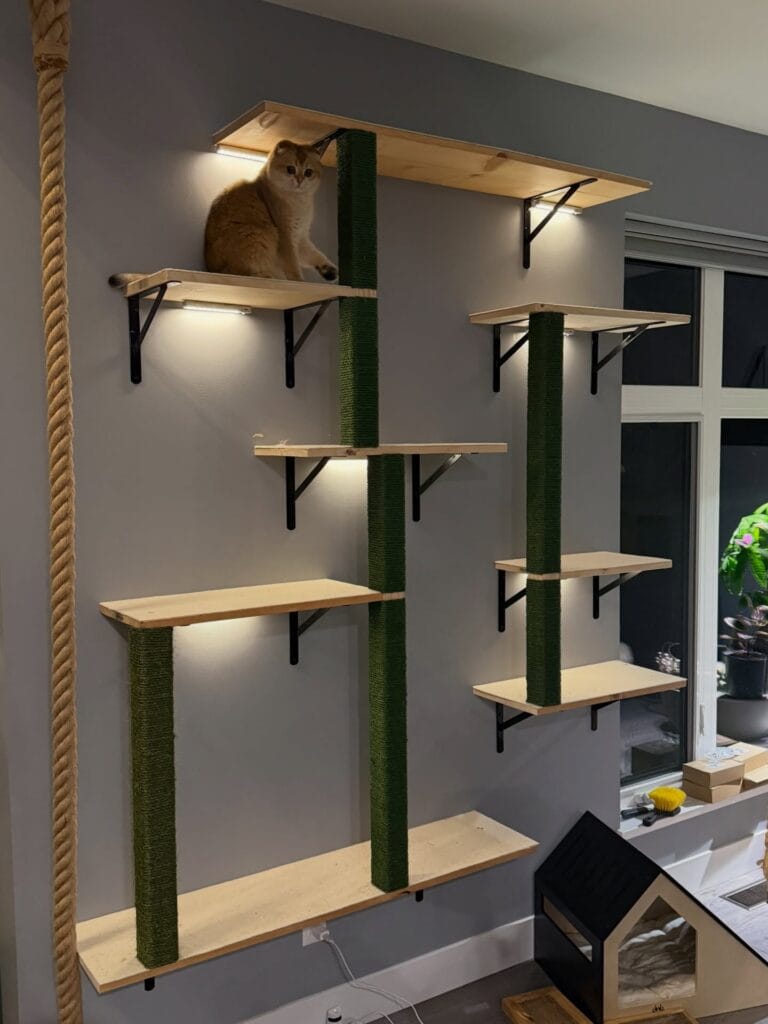
Okay, so you know how your golden retriever has basically claimed every inch of your living room floor? Picture your cat getting the same energy but vertically — that’s exactly what this wall setup does.
This is a full cat climbing wall built right into the living room, and honestly it looks like something straight out of a Pinterest board you’ve been saving for two years. The natural pine wood shelves sit against a matte gray wall, connected by green sisal-wrapped scratching posts that run floor to ceiling. Little LED strip lights are tucked under each shelf, and the warm glow they throw makes the whole thing look intentional — not like a pet store exploded in someone’s house.
The bones of this build are wall-mounted metal brackets in matte black, the kind you’d grab at any hardware store for a few dollars each. The shelves themselves look like standard pine boards, roughly 24–36 inches wide, cut and sanded smooth. The scratching posts aren’t separate towers — they’re sisal rope-wrapped vertical posts bolted directly into the wall, which is what gives this the clean, built-in look instead of the wobbly plastic tower vibe.
And the LED strips? Game changer. Tucked under each shelf, they pull double duty — [feature: under-shelf lighting, benefit: highlights the structure, payoff: makes it look like a design feature instead of a pet accommodation].
If you’re thinking about DIYing this, anchor those posts into wall studs — not just drywall. Cats hit those posts hard when they’re scratching, and a loose post at height is a real hazard. For the sisal, dark green jute rope wraps tighter and holds longer than natural tan rope, and it photographs so much better against a gray wall.
Space your shelves in a staggered staircase pattern rather than straight rows — cats need that diagonal path to actually climb, not just jump shelf to shelf. If you want more outdoor-inspired builds like this, 7 Secure DIY Cat Enclosure Ideas for Outdoors has some solid inspiration for taking the whole concept outside.
📸 Photo credit: Instagram @catdaddy.dan
#2: Floor-to-Ceiling Wall-Mounted Cat Playground With Scratch Posts and Bubble Pods
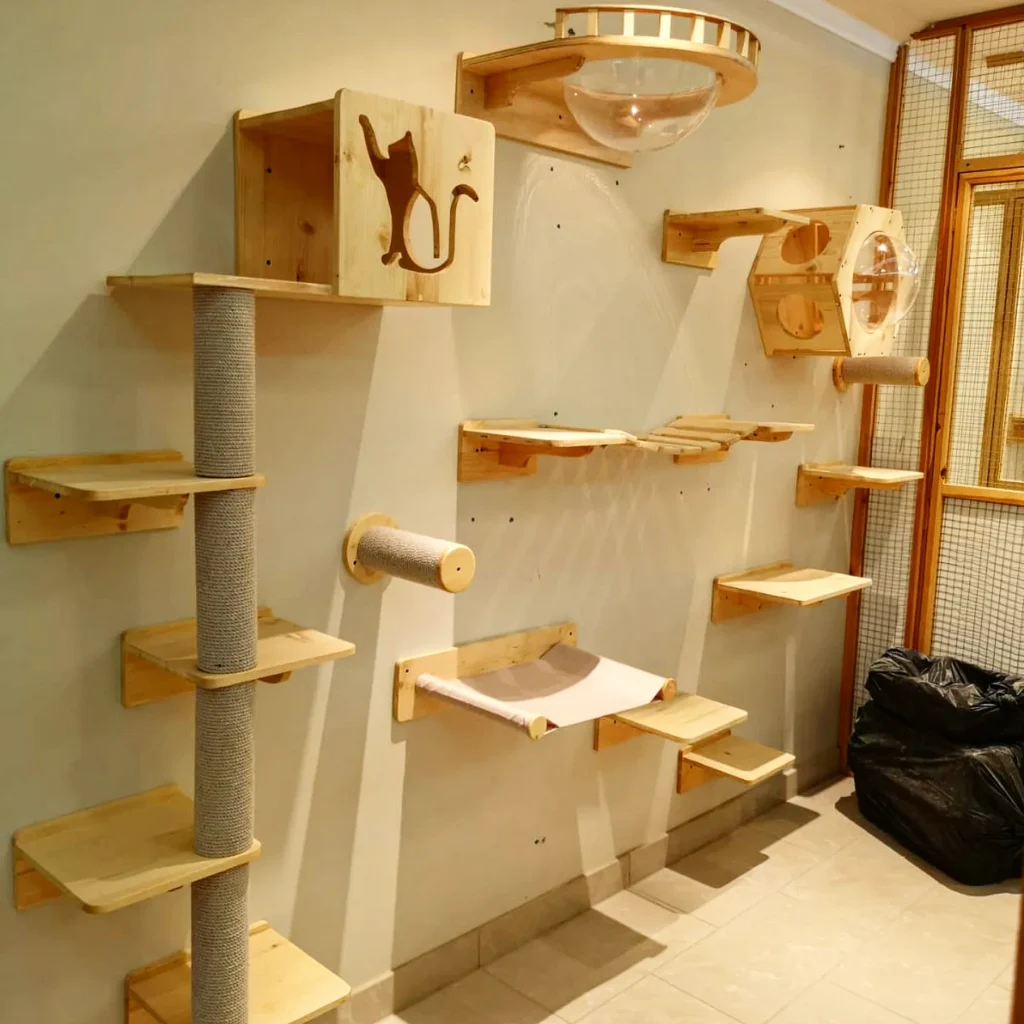
Okay, so picture this — your cat completely ignoring that expensive tree you bought and instead parkour-ing across your couch like a tiny chaos agent. That was my life before I found wall-mounted cat room setups like this one, and honestly, it changed everything.
This room is built entirely on natural pine wood wall shelves, scratch posts wrapped in sisal rope, and those clear acrylic bubble pods that cats absolutely lose their minds over. Everything mounts flush to the wall, so the floor stays open and clean — which, if you’ve got a golden retriever sharing the space, means no tripping hazards and zero territorial standoffs.
Start with wall-mounted pine shelves in staggered heights — you want them spaced roughly 12 to 16 inches apart vertically so cats can step up without jumping too hard. Add a floor-to-ceiling sisal scratch post anchored at both ends, which gives cats a full-body stretch and keeps them off your furniture. The acrylic bubble pod mounts near the ceiling and works as a lookout perch — cats love high vantage points, and it keeps them mentally engaged all day.
Grab a fabric hammock insert between two shelves for a nap spot. The one in this photo uses a soft canvas sling, which is easy to remove and wash.
Mount your heaviest elements — the tunnel cube and bubble pod — into wall studs, not just drywall. A stud finder plus 3-inch wood screws will hold even the chunkiest cat without budging.
📸 Photo credit: Instagram @furnature.ae
#3: The Golden-Walled Cat Playground That Makes Every Inch Count
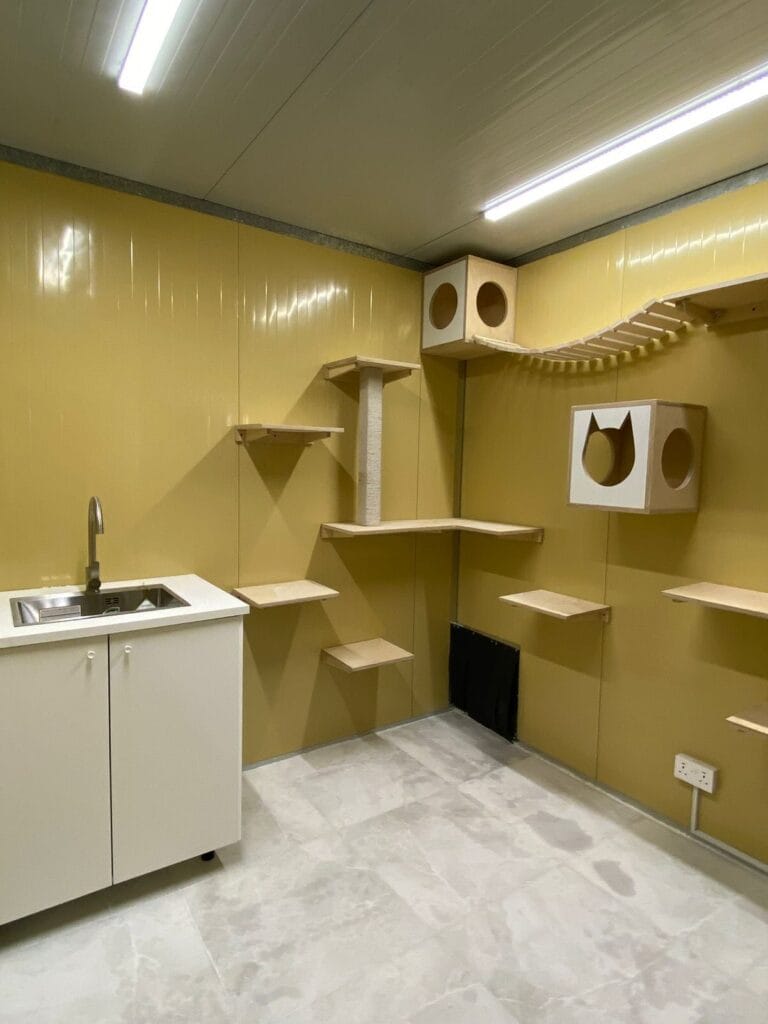
That moment when your golden retriever flops on the couch and takes up every single inch — yeah, cats do the same thing, except vertically. This setup gets it.
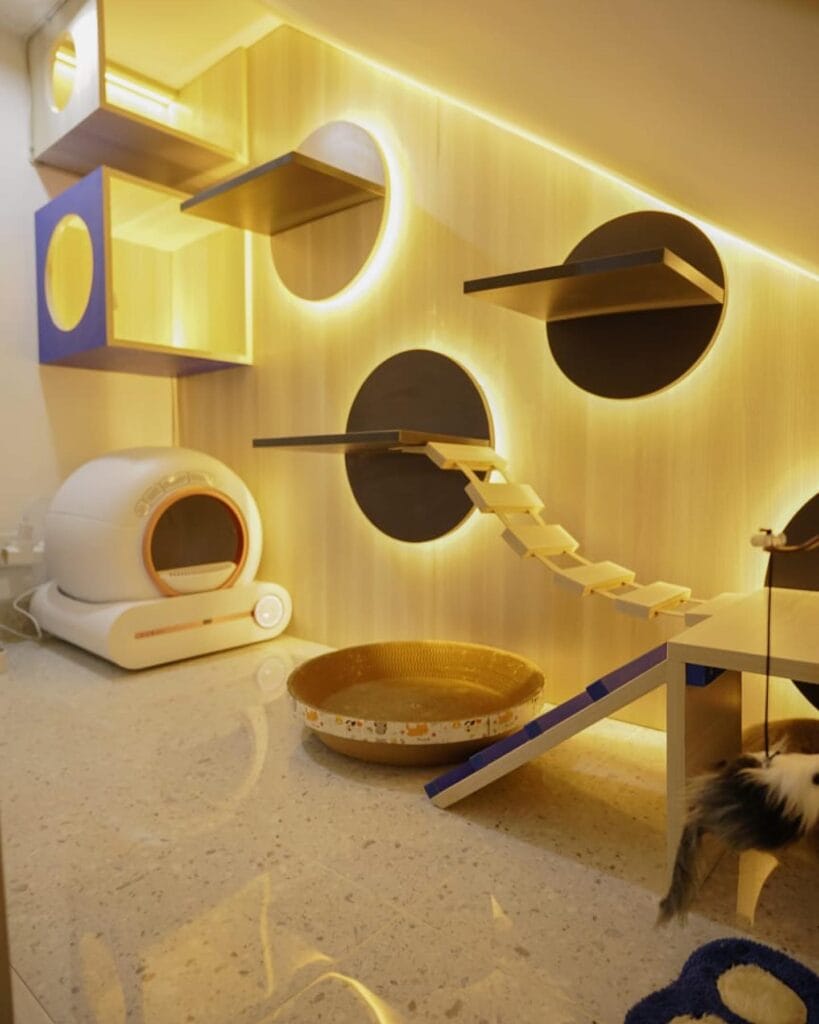
Walk into this room and the first thing that hits you is that warm mustard-yellow wall paneling — it wraps the whole space and makes it feel intentional, like someone actually designed this for their cats, not just threw a scratching post in a corner. The light maple wood shelving zigzags up two walls in a staircase pattern, giving cats multiple routes to a corner hideout box mounted near the ceiling. It’s cozy and functional at the same time.
The wall-mounted sisal rope scratch post sits at the center of the climbing system — this is the main trunk cats push off from. Pair that with L-shaped corner platforms, a slatted rope bridge connecting the two walls near the top, and two wooden hideout cubes (one with circular holes, one with a cat-ear cutout in white) and you’ve got a full vertical world. The white base cabinet with a stainless steel sink on the left keeps grooming and feeding in the same room — no running back and forth.
The gray marble-look tile flooring ties everything together without competing with the yellow walls. It’s easy to mop, which you know matters.
Start here: anchor every shelf into wall studs, not just drywall. Cats jump hard and fast. Use L-brackets rated for at least 50 lbs even if your cat weighs 10.
The black vent panel near the floor? That’s climate control — genius in an enclosed outdoor room. If you’re building one of these, adding a small vent or mini split keeps the space comfortable year-round without propping a door open.
If you love this kind of dedicated pet space, 15 Creative Pet Room Ideas for Your Furry Friends has even more room layouts worth stealing.
📸 Photo credit: Instagram @habicat _ae
#4: Floor-to-Ceiling Cat Tree Inside a Fully Enclosed Catio
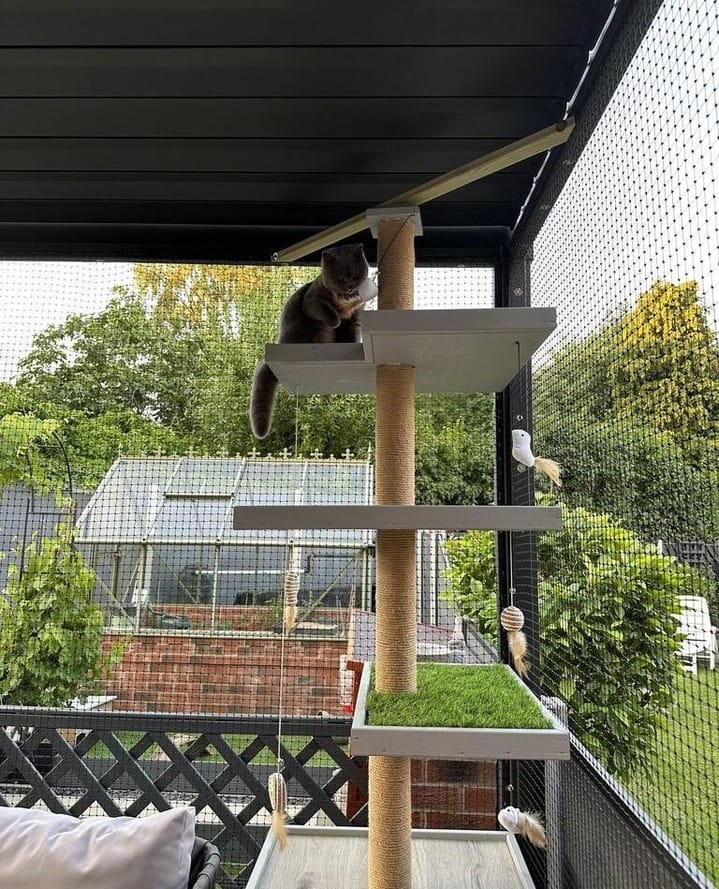
Okay so this one stopped me mid-scroll and I genuinely had to send it to my cousin who has three cats. It’s giving everything — a full outdoor enclosure with black mesh panels, lush garden views, and a tall multi-level cat tree that goes all the way up to the ceiling. The whole setup feels like a tiny luxury resort for cats, and honestly? It’s the kind of thing you pin and then actually build.
The star of this space is a floor-to-ceiling sisal-wrapped cat tree in a warm white/grey finish, with three flat wooden platforms at staggered heights. The base platform sits over a small patch of real grass turf, which is such a clever touch — cats get that outdoor texture without actually being loose in the yard. Dangling from the structure are rope and feather toy attachments, a small bird decoy, and a macramé-style ball toy. The enclosure itself uses black powder-coated metal framing with fine mesh netting on all sides and the ceiling.
The mesh ceiling is doing so much heavy lifting here. It keeps birds and debris out while still letting in full airflow and natural light — the feature-benefit-payoff being: enclosed structure + full ventilation = your cat gets fresh air with zero escape risk.
Cut the cat tree post to fit snug against your ceiling. That pressure-fit keeps it stable without drilling into your deck floor.
📸 Photo credit: Instagram @catnetsnz
#5: The All-White Cat Colony Enclosure with Artificial Turf and Covered Shelter
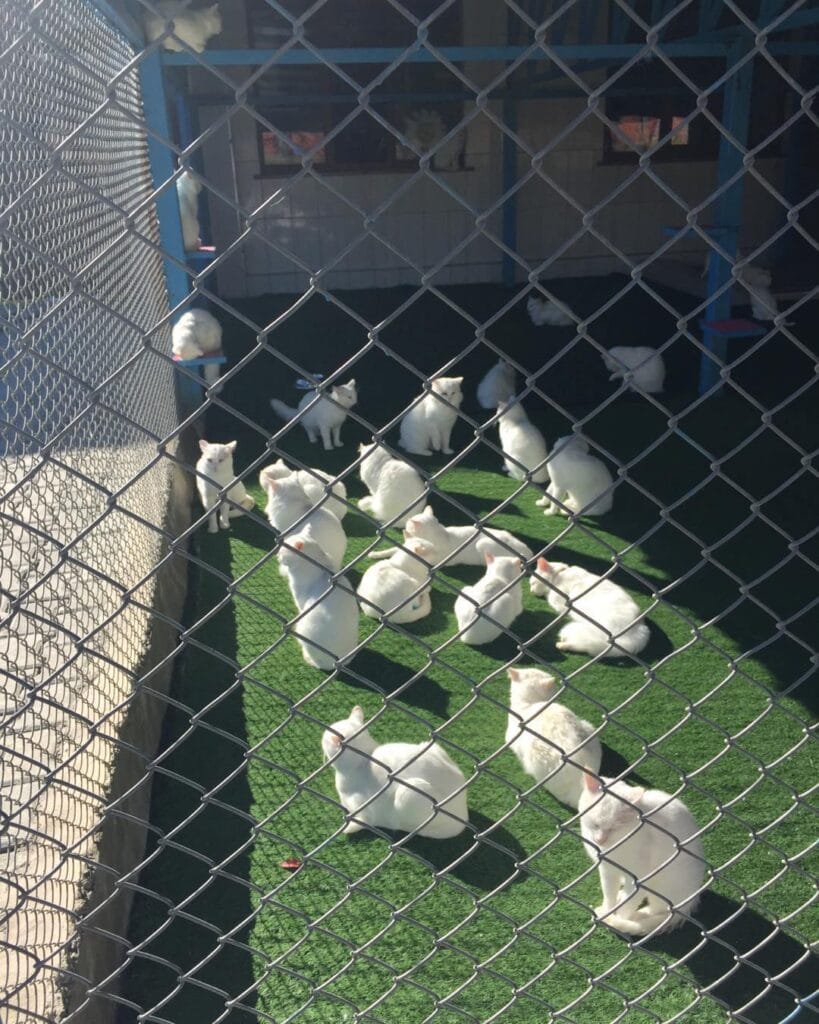
Okay, so picture this — you open your back door and instead of muddy paw prints tracking across your Pinterest-perfect floors, your cats have their own world out there. This setup is giving full outdoor sanctuary vibes, with a chain-link enclosure stretched over artificial turf and a covered wooden shelter tucked at the back. It’s structured, it’s contained, and honestly? It looks like something you’d pin immediately.
The bones of this space start with a galvanized steel chain-link fence — the kind rated for at least 6 feet in height to prevent any escape artist situations. The floor is synthetic green turf, which is the real hero here. It drains, it doesn’t turn into mud soup, and it stays clean between hosings. No dirt. Zero mess tracked back inside.
That covered shelter in the back? It’s built like a lean-to with blue-painted wood framing and what looks like a solid roof overhang — giving cats shade and a dry spot when the weather gets moody. You’ll want elevated shelving units inside that covered section too, because cats want vertical space the same way you want good cabinet storage.
One thing to remember: artificial turf with a drainage backing keeps bacteria from building up underneath — which means fewer odors and a healthier space for a big group of cats.
If you’re housing multiple cats like this, stagger feeding stations across the turf so no one gets territorial over one bowl.
📸 Photo credit: Instagram @igmeoww
#6: Wall-Mounted Cat Shelves With a Catio Enclosure
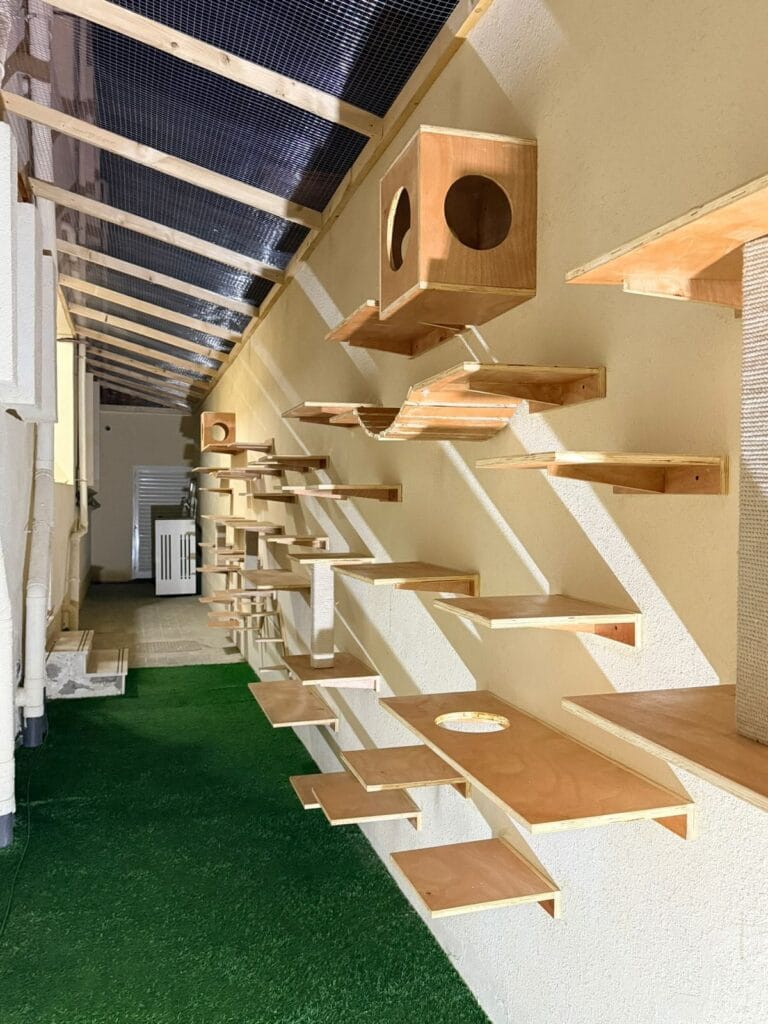
Okay, so you know how your golden probably has that one corner of the yard she’s claimed as her own? Cats need that too — just vertically. This setup is basically a cat’s dream come true, and honestly, it’s the kind of thing you’d screenshot on Pinterest at 11pm.
The whole space runs along a long, narrow outdoor corridor with artificial grass turf flooring and a corrugated polycarbonate roof held up by natural pine wood framing. The walls are lined with plywood shelves in a light birch finish, mounted at staggered heights so cats can jump from level to level without touching the ground.
The big statement piece is a wall-mounted cat cube — basically a wooden box with two circular cutout holes on the sides — anchored near the ceiling so it becomes the highest perch in the whole room. Below it, the shelves cascade down like a diagonal staircase, some solid, some with circular peek-through holes cut right into the platform surface.
You’ll want to grab L-bracket shelf supports with a clean finish so they don’t steal the look. The sisal scratch post tucked into the corner keeps claws off the walls. And the black mesh netting stretched across the ceiling frame keeps everything escape-proof without blocking the light.
Keep your shelf spacing between 12 and 18 inches apart vertically — that’s the sweet spot for most cats to jump comfortably without straining.
📸 Photo credit: Instagram @habicat_ae
#7: The Foldable Mesh Enclosure That Keeps Your Cat Safe Without Wrecking Your Space
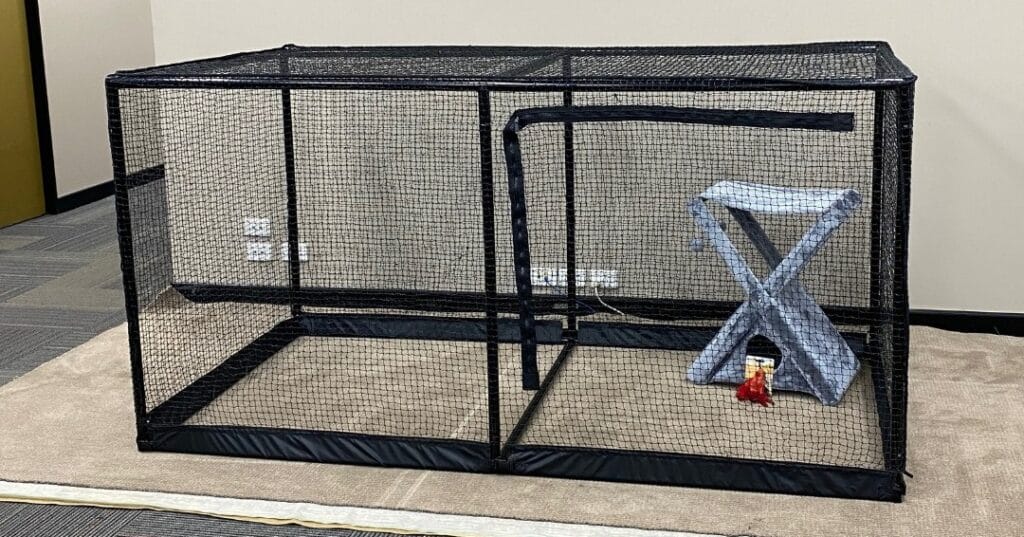
You know that moment when your golden has just tracked mud across your freshly vacuumed rug and you’re standing there thinking — I cannot keep living like this? Cat owners get that feeling too, but it’s less about mud and more about claws on furniture and midnight escapes through cracked doors.
This black mesh enclosure is giving me all the structured-but-stylish vibes, and honestly it works exactly the way a cat parent needs it to.
The setup features a large rectangular mesh cage built from a powder-coated steel frame wrapped in fine black netting. Inside, there’s a mid-level platform shelf running along the left wall — cats love that elevated perch for watching everything below. The standout piece is that X-shaped hideaway tunnel in gray fabric, sitting right on the sandy-beige base mat. And that little pop of red near the tunnel entrance? That’s a dangling toy keeping things playful.
The whole enclosure sits on a foam-padded base border that protects your flooring — no scratches, no stress.
Grab a collapsible pet playpen in this style (most come in 48″ x 24″ x 24″ configurations), add a freestanding cat shelf insert, and DIY an X-tunnel from foam board covered in felt.
Size your shelf at exactlyhalf the enclosure’s width so your cat has room to turn around comfortably. That shelf-to-space ratio keeps cats moving instead of just sitting — which means less destructive behavior when they’re back inside your home.
📸 Photo credit: Instagram @somerzby
#8: The Indoor Cat Tower Setup That Doubles as a Cozy Catio Corner
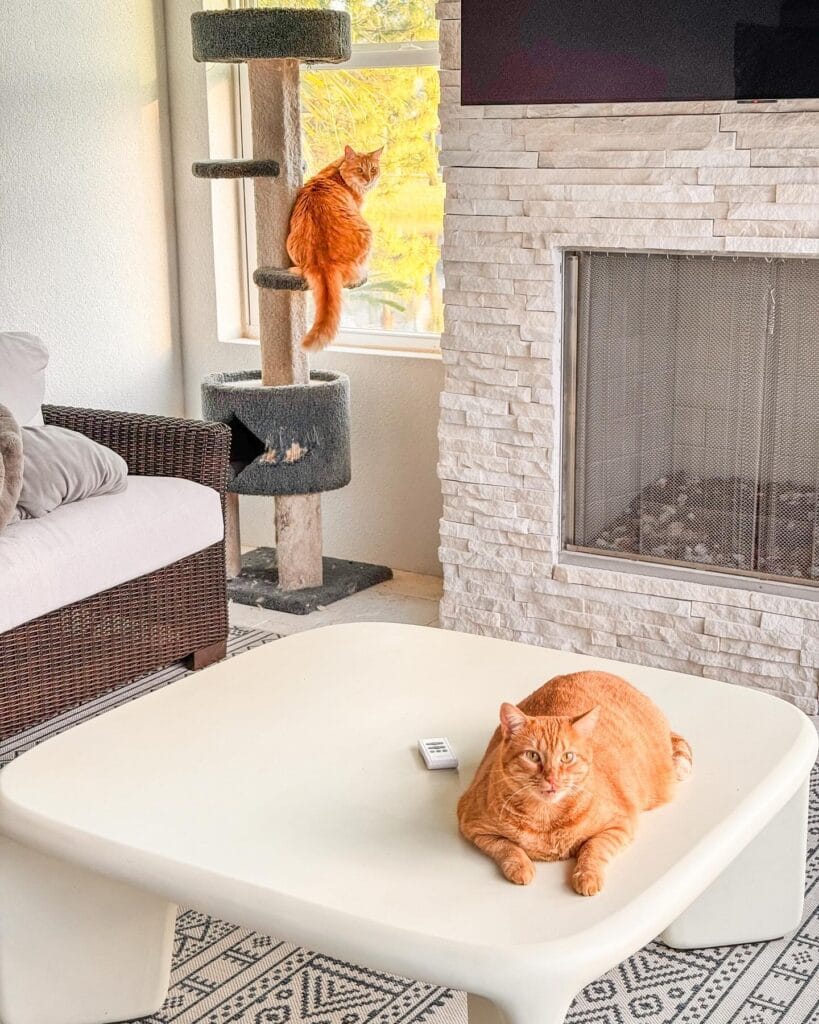
Two orange tabbies claiming every surface in the living room — one sprawled across the coffee table like he owns it, the other perched up high on the cat tower watching the whole world through the window. This setup is giving full “my cats run this house and I’m okay with that” energy, and honestly? It works because everything in the room actually complements each other.
The star here is a multi-level gray cat tower — think carpeted platforms, a hideaway pod, and sisal-wrapped posts — positioned right next to a large window so your cat gets that bird-watching moment without ever stepping outside. It’s placed in the corner where the wall meets the window, which cuts down on wobble and gives the tower natural stability.
The white concrete-finish coffee table is low and wide — perfect for a chunky cat to stretch out on without knocking things over. Pair it with a woven rattan sofa with gray cushions to keep the neutral palette going. The stacked stone fireplace in cream and white ties the whole room together without competing with the cats’ ginger color pop.
Here’s the trick: if your cat tower looks worn (and they always do), tuck it beside the window so the natural light draws the eye outward instead of to the scratched sisal.
The window placement does real work here — cats get visual enrichment, sunlight, and warmth without needing an outdoor enclosure. If you want to take this further, a 19 Cozy Cat House Ideas for Every Season round-up has some great companion ideas for expanding this kind of setup.
Choose a tower with a base plate at least 24 inches wide — it won’t tip when your heavier cat launches off the top platform.
📸 Photo credit: Instagram @mackandmango
#9: Hanging Plant Ladder Window Setup That Doubles as a Cat Paradise
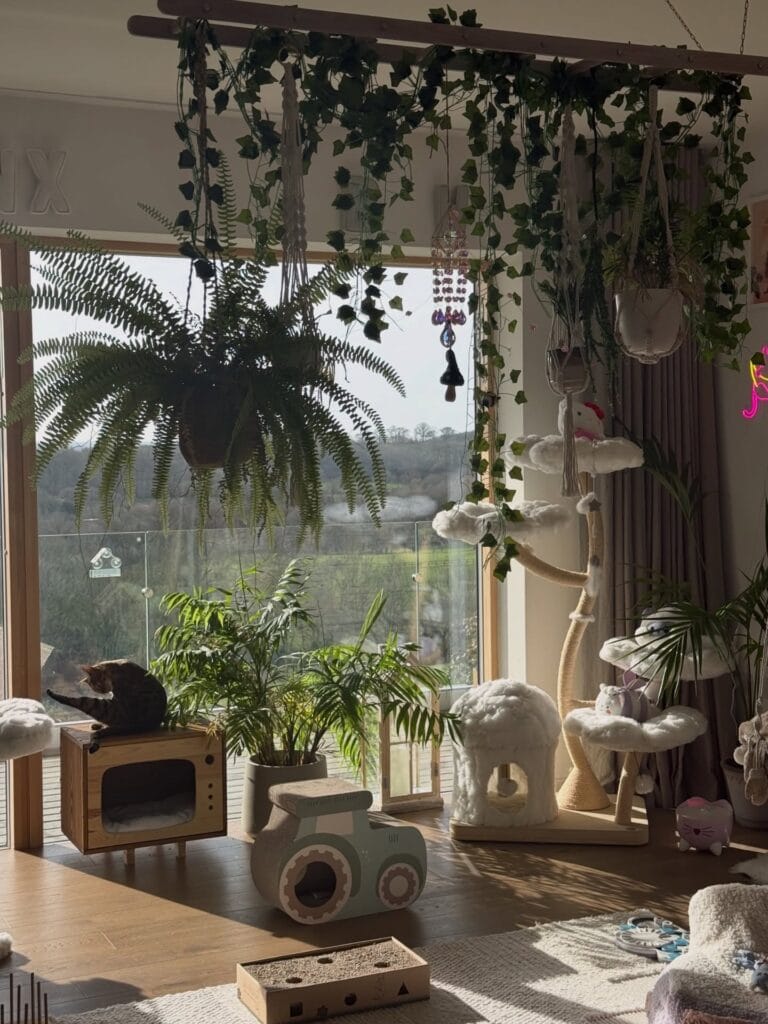
Okay so picture this — you walk into your living room and your golden has already claimed the sunny spot by the window, but your cats? They’re living their absolute best life up in this lush, layered plant situation that honestly looks like something straight out of a Pinterest board you’ve saved seventeen times.
This setup uses a wooden ladder rail mounted horizontally near the ceiling, draped with trailing ivy and macramé hangers. The large window behind it does all the heavy lifting — natural light pours in and makes every leaf glow.
Start with a ceiling-hung wooden dowel or ladder beam (aim for at least 48–60 inches wide) secured with heavy-duty hooks. From it, hang macramé plant hangers in natural cotton rope holding trailing pothos or ivy. Add a Boston fern in a woven basket at the side for that full, jungle-y canopy feel.
On the floor, place a areca palm in a concrete pot, a cloud-shaped cat tree in white plush, and a TV-shaped wooden cat house — yes, that’s a thing and it’s adorable.
Real talk: ivy is toxic to cats, so swap decorative faux trailing vines for the hanging strands closest to the cat tree. Use real plants only on the highest, unreachable rungs. For more inspiration on cozy enclosed cat spaces, 15 Warm Feral Cat House Ideas for Cold Weather has some brilliant setups worth stealing.
The sisal-wrapped cat tree gives cats a scratching surface — that feature protects your furniture, which means zero claw marks on your sofa.
📸 Photo credit: Instagram @jasminelondonn
#10: The Moody Jungle Cat Room With a Mural That Stops You Mid-Scroll
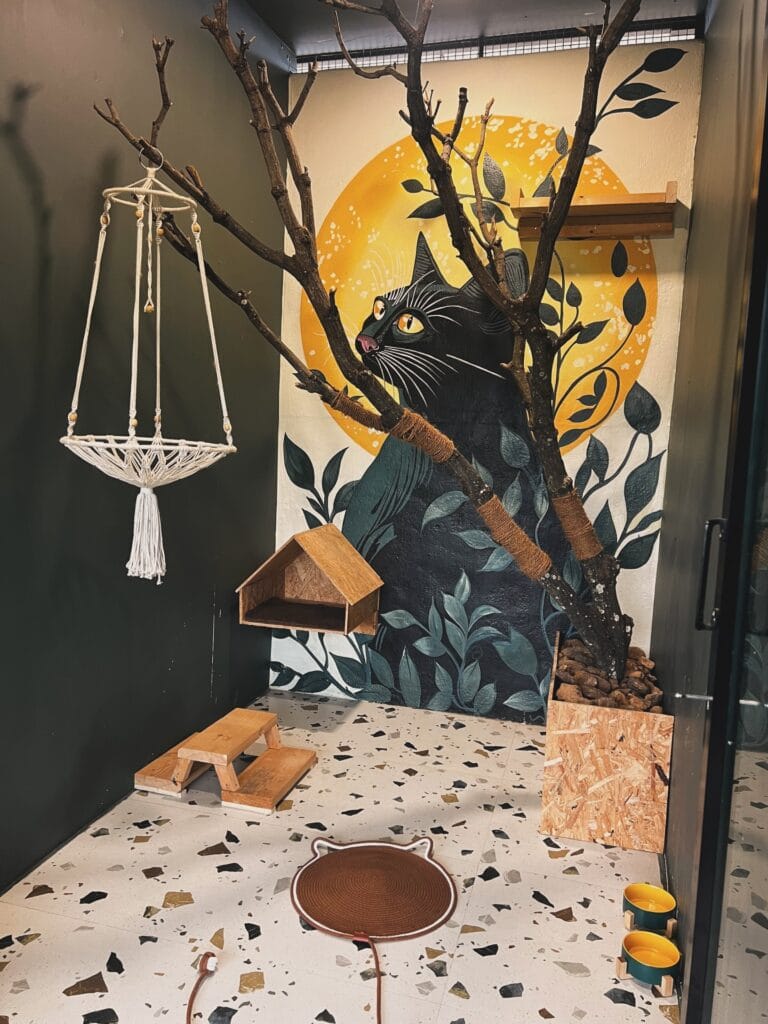
Okay, so picture this — you walk into a cat room and there’s a massive hand-painted black cat staring back at you from the wall, framed by a golden sun and dark botanical leaves. It’s moody, it’s artsy, and honestly? It hits different. This isn’t your average cat enclosure. It’s got real tree branches, a macramé hanging basket, and terrazzo floors — the whole thing looks like it belongs on a Pinterest board you’ve been saving to for two years.
Start with the mural. A local muralist or even a skilled friend can paint a black cat botanical mural directly onto the back wall using exterior-grade acrylic paint. The color palette here is dark teal, cream, and a warm golden yellow for that sun circle — it ties the whole room together without needing much other decor.
The tree is a real dried branch anchored to the ceiling grid with metal eye hooks and heavy-gauge wire. Some sections are wrapped in natural jute rope for grip — cats use it to climb without slipping. A wooden wall-mounted house shelf (that little A-frame box on the branch) gives cats a hideout spot mid-climb.
The floor is terrazzo tile, which looks stunning and cleans up in seconds. On the floor you’ll spot a round cat heating pad, small wooden step stools, and two ceramic food bowls in mustard and teal — both functional and color-coordinated.
The macramé hanging basket on the left is a game-changer. It hangs from a ceiling hook, holds a cat’s weight, and adds that boho-chic texture without taking up floor space — so the room feels open even when your cat is lounging right in the middle of it.
Keep the ceiling as a wire mesh panel instead of solid material. It lets natural light pour in and keeps the space from feeling like a cage. And if you want the mural to really pop, paint the side walls in a deep forest green — it makes the artwork feel intentional, not random.
📸 Photo credit: Instagram @thebarkhouse.in
#11: Wall-Mounted Catio With a Carabiner Door Latch and Built-In Shelf Levels
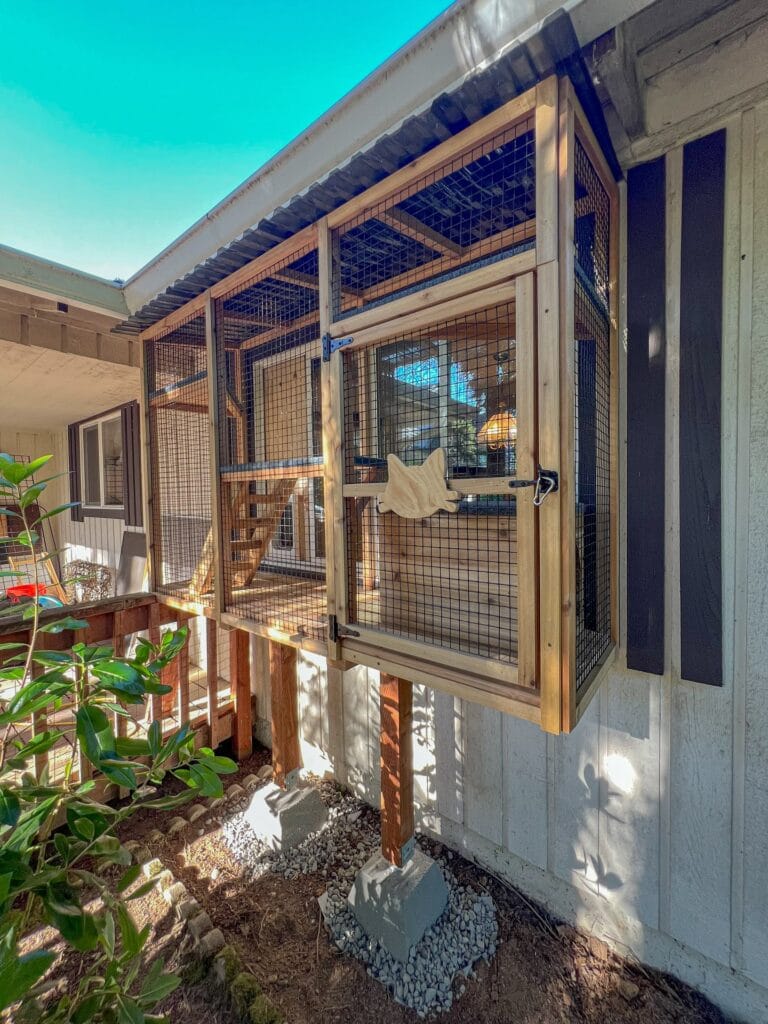
Okay, so you know how your golden has that spot by the back door where she just stares at you until you let her out? Cats have that same energy — they want outside without actually being outside. And this wall-mounted catio gives them exactly that.
This one is built flush against the side of the house using fresh cedar lumber and black welded wire mesh panels. The whole thing is elevated off the ground, mounted to the exterior wall with what looks like post-support concrete footings, and topped with a corrugated polycarbonate roof panel that lets sunlight filter through. The door has a carabiner clip latch — simple, secure, and way harder for a cat to figure out than a basic hook.
To build this, you need 2×4 cedar framing for the main structure, 1/2-inch black hardware cloth stapled tight into the frame, a hinged access door with heavy-duty strap hinges, and at least one interior horizontal shelf platform for lounging. The wooden cat silhouette mounted on the door is a cute touch — totally DIY-able with a jigsaw and some scrap wood.
The shelf inside acts as a landing platform — cats jump up, survey the yard, actually relax — which means less zooming around your furniture at midnight.
Attach the catio directly under an existing roof overhang if you can. It cuts down on the lumber you need for roofing and keeps the whole build cleaner. Also, stain the cedar with a water-based exterior sealant before assembly — it doubles the lifespan of the wood without the toxic fumes.
📸 Photo credit: Instagram @thecatiocompany
#12: The Full-Length Cedar Catio That Runs Along the Whole Side of the House
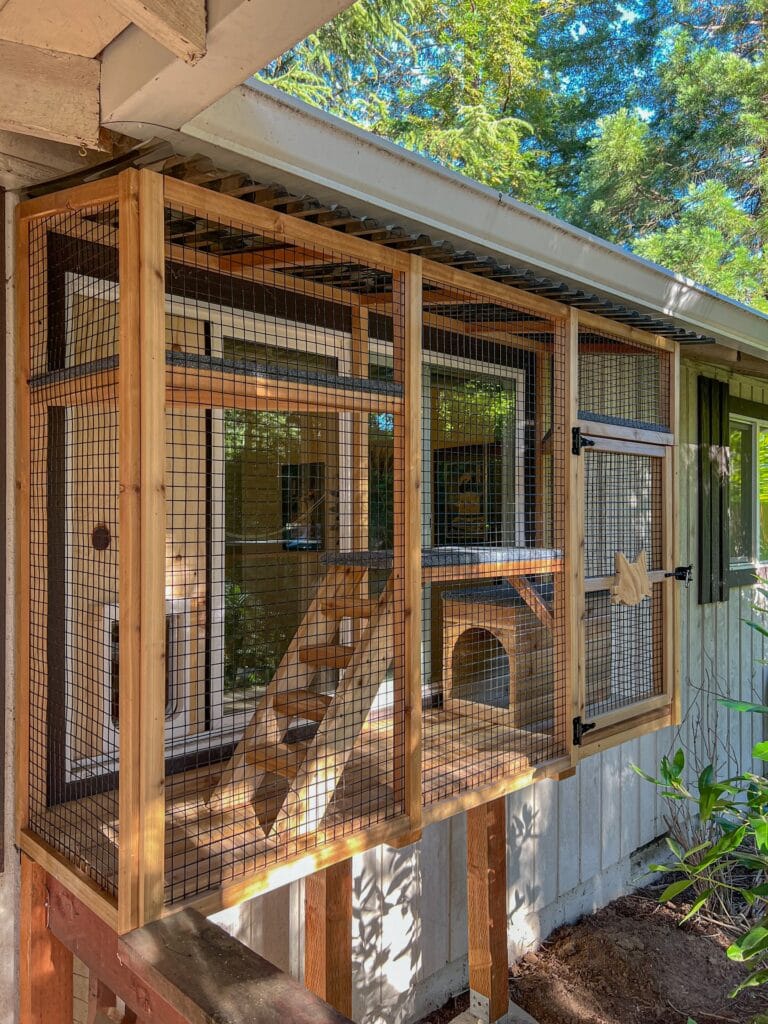
Okay, so picture this — you’re sitting on your back porch watching your golden retriever Daisy sniff every inch of the yard, and you’re thinking, why can’t my cat have that same kind of freedom? That’s exactly the energy this catio gives off. It’s a long, lean, cedar-framed outdoor enclosure that runs flush against the exterior wall of the house, and it looks less like a cage and more like a sunroom your cat earned.
The whole frame is built from natural cedar wood — those warm honey tones are doing a lot of heavy lifting here. The mesh panels are black powder-coated hardware cloth (looks way more polished than silver wire), and the roofing is corrugated metal sheeting that tucks right under the existing home overhang. That detail alone keeps rain out without adding bulk.
Inside, there are multi-level platforms covered in what looks like gray indoor-outdoor carpet for grip and comfort. Wooden cat-shaped cutouts act as decorative shelf brackets — such a fun touch. A small arched tunnel or hideaway box sits on the lower level, giving cats a cozy retreat when they want to disappear. The access door uses black gate hardware with a slide latch, which means the whole thing stays secure even with a curious dog nosing around outside.
Each section has its own hinged access panel, so cleaning is actually manageable instead of a full-body workout.
If you’re building this yourself, use 2×4 cedar lumber for the frame and attach your hardware cloth with galvanized staples plus metal furring strips on top — that edge detail prevents sharp wire ends from catching on cat fur or little paws. The carpet on the shelves? Cut it slightly oversized and wrap it under the shelf edge for a cleaner look that also lasts longer.
📸 Photo credit: Instagram @thecatiocompany
#13: The Sunroom-Style Catio With Built-In Cat Walls and a Clear Roof
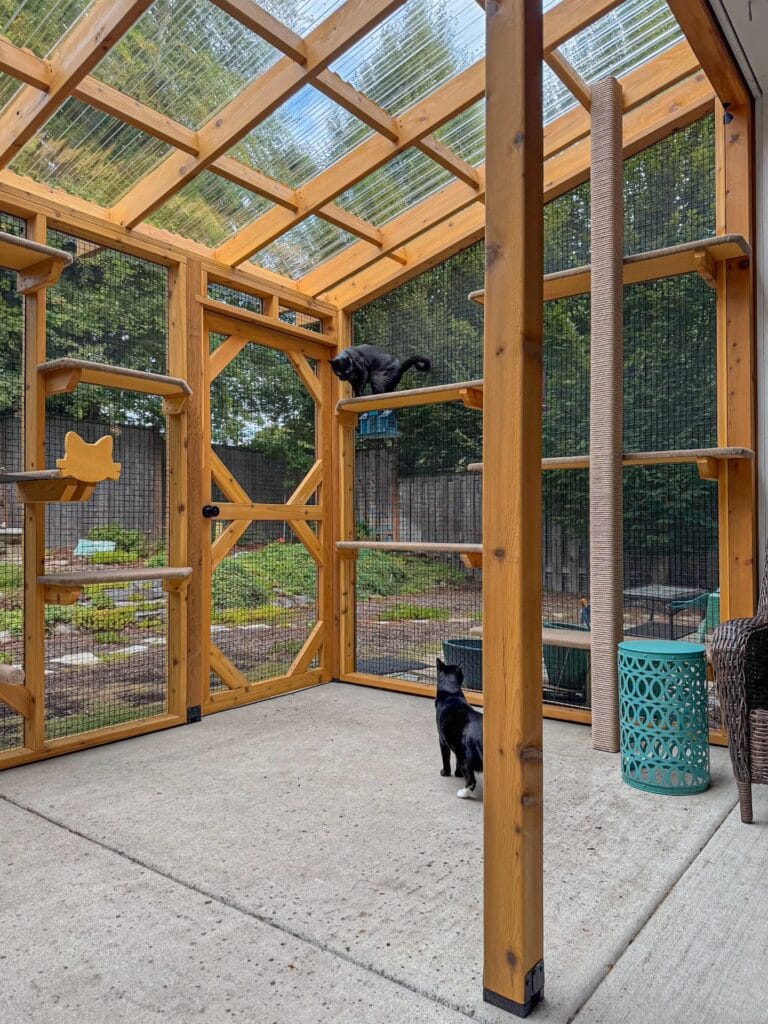
Okay, so you know how your golden has that one spot by the back door where she just stares out the window, tail going crazy because a squirrel dared to exist in your yard? Your cats have that same energy — and this catio gives them a whole room built around it.
This setup is giving full sunroom vibes with natural cedar framing, a clear polycarbonate roof, and wire mesh panels on every wall. The warm honey-toned wood makes it feel like a real room, not a cage. And that arched door detail with the decorative cross-bracing? It looks like something straight off your Pinterest board.
To recreate this, start with 4×4 cedar posts as your main structural frame — cedar resists rot and bugs without chemical treatment. The roof uses corrugated clear polycarbonate sheets layered over 2×4 rafters, which floods the space with natural light but keeps rain out. The cat wall system runs along the interior perimeter using wall-mounted sisal-wrapped shelves at staggered heights, plus flat carpeted platforms for lounging. That teal garden stool in the corner? It doubles as a side table and adds a pop of color that photographs so well.
For the mesh, use 19-gauge galvanized hardware cloth with ½-inch openings — it’s strong enough to keep wildlife out and holds its shape over years of a cat leaning on it.
Build your platforms at 18-inch vertical intervals so even older or less agile cats can move between levels without big jumps. Seal all wood with a food-safe outdoor stain before assembly so it stays that warm amber color through every season.
📸 Photo credit: Instagram @thecatiocompany
#14: The Cedar Catio Box With a Built-In Cat Door (And a Ramp Your Pets Will Actually Use)
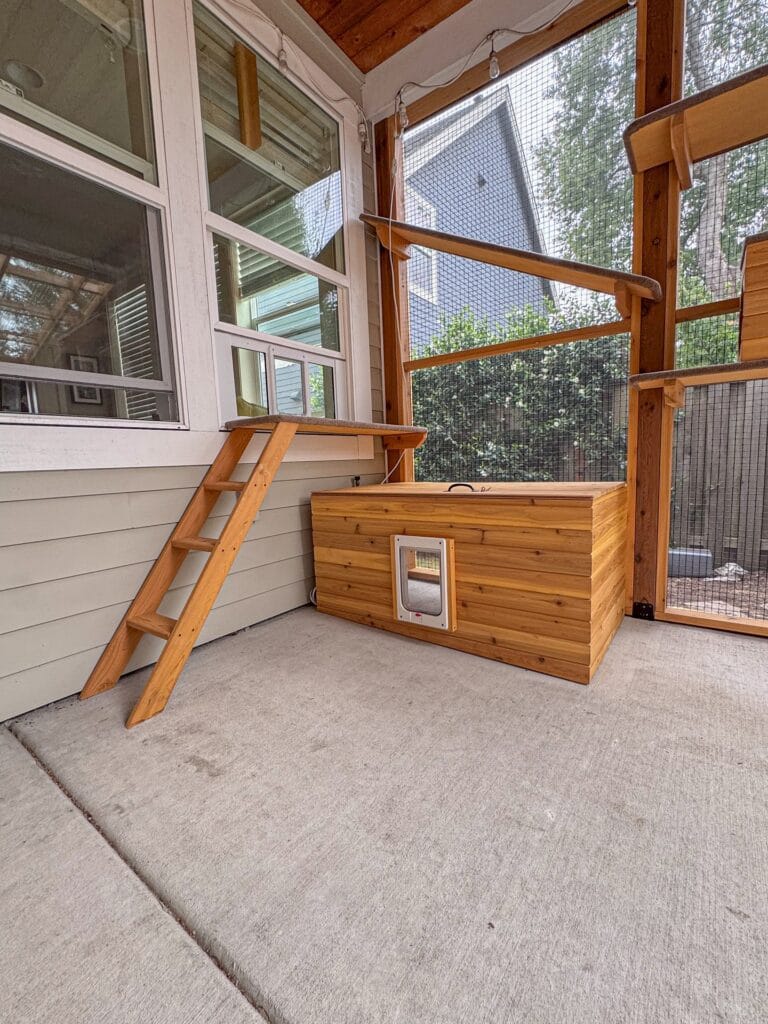
Okay, so picture this — you’re sipping your morning coffee on the screened porch, and instead of your golden pushing her nose through the door for the hundredth time, your cat has her own private entrance. That’s exactly the energy this setup gives. It’s a cedar wood catio box tucked right against the house wall, with a small pet door built into the front panel and a wooden ramp with steps leaning against the window for entry access.
The centerpiece here is a horizontal cedar plank enclosure, roughly chest-height, sitting flush on a concrete porch floor inside a screened outdoor structure. The wood has that warm honey-brown tone — no paint, just natural cedar. A cat flap door (the white-framed kind with a magnetic closure) sits centered on the front face of the box, giving your cat independent access. The ramp is freestanding, built from matching cedar with evenly spaced rungs, and topped with a carpet or sisal pad for grip.
Cedar is your best friend here — it naturally resists moisture and bugs, which means this box holds up through humid summers without warping. The ramp’s carpet-covered platform at the top doubles as a perch, so your cat gets a lookout spot and a path inside.
For more ways to let your cat enjoy fresh air safely, 7 Safe DIY Cat Patio Ideas for Fresh Air shows how to build the full surround structure you see framing this whole space.
Sand the cedar before assembly and apply a food-safe tung oil finish — it deepens the wood color and adds a water-resistant layer without any toxic fumes near your pet.
📸 Photo credit: Instagram @thecatiocompany
#15: The Two-Story Catio With a Cat Tree Tower and Ramp System
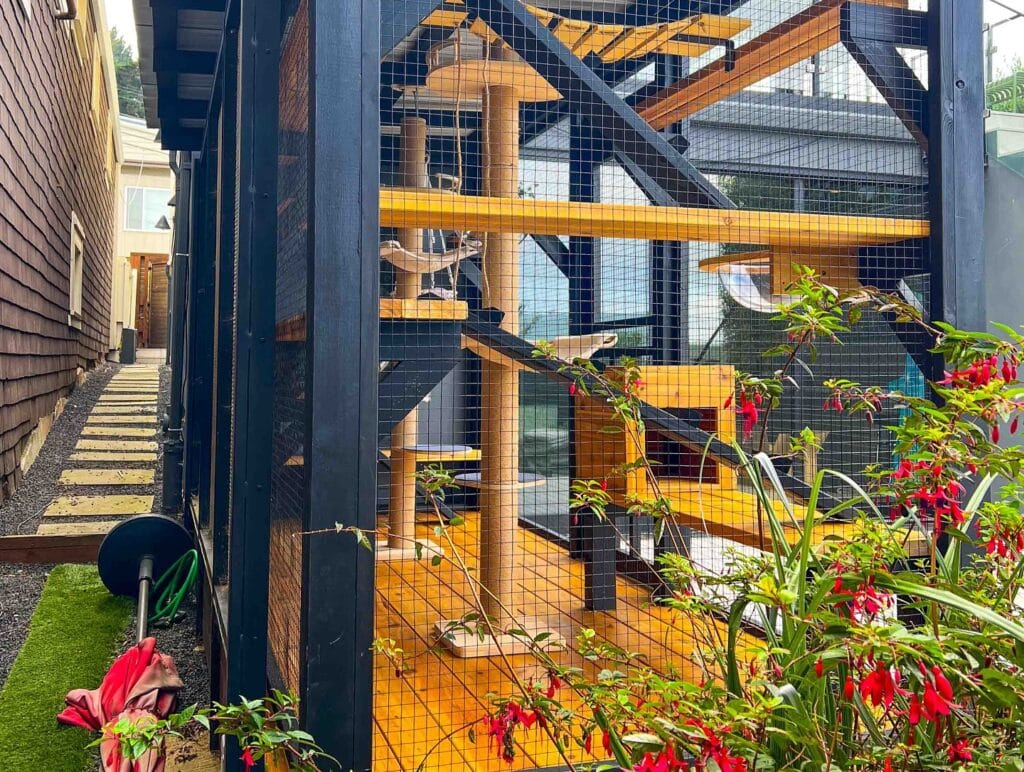
Okay, so picture this — you’re standing in your backyard with your golden, and next to you is this absolute beast of a catio. Black-painted 2×6 lumber framing, warm honey-toned cedar decking, and welded wire mesh panels stretched across every wall and ceiling. It’s giving luxury treehouse energy, not “I threw together some chicken wire” energy.
The bones of this build start with black-stained Douglas fir posts, at least 4×4 inches thick, anchoring the structure at every corner. Inside, a floor-to-ceiling sisal cat tree tower sits dead center — that’s the focal point. Wrap-around horizontal ramp shelves in natural wood finish line the upper walls, creating a full loop path near the roofline. A bench-height wooden platform with open-frame legs sits along the back wall, giving cats a lower landing zone before they shoot back up the ramps.
For the mesh, use 16-gauge galvanized welded wire with 1×2 inch openings — it’s rigid enough to resist pressure and small enough to keep even kittens in.
Fuchsia plants right outside the mesh wall? That’s not just pretty. It pulls the garden into the catio visually, so your cats feel surrounded by nature without actually being in it.
If you’re going full DIY on a build like this, pairing it with a 7 Warm DIY Outdoor Cat Shelter Winter Designs plan gives you a solid weatherproofing roadmap for the roof framing.
Add a cat door at floor level — an 8×8 inch magnetic flap built into the house wall — and your cats can flow in and out on their own schedule.
📸 Photo credit: Instagram @thecattopia
#16: The Two-Story Backyard Catio With Ramps, Hammocks, and a Metal Roof
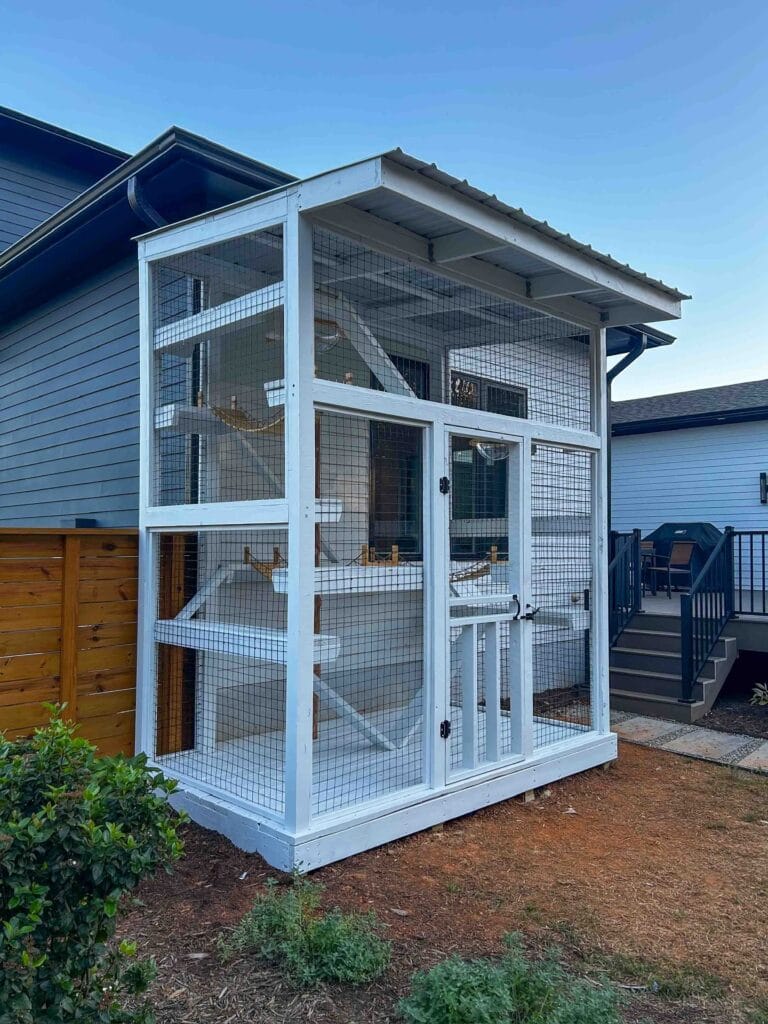
Okay, so hear me out — this one stopped me mid-scroll and I had zero regrets. It’s a full, two-story outdoor catio built with a white-painted wood frame, welded wire mesh panels, and a corrugated metal roof that gives it this clean, almost farmhouse-shed energy. It sits right up against the house, which is smart because it means your cats can move between inside and outside without you having to prop doors open all day.
The frame itself is built from 2×4 lumber, painted white to match the trim on the house. The mesh is welded wire hardware cloth — not the flimsy chicken wire stuff — which means it holds its shape and keeps predators out. Inside, there are angled wooden ramps connecting the lower and upper levels, a couple of rope hammocks strung in the upper section, and what looks like small wooden perch platforms with little fence-style railings. The door situation is a double-door entry system — a larger top door and a smaller bottom access panel, both with black metal latch hardware. That design means you can reach in for cleaning without letting anyone escape.
The whole thing sits on a raised wooden base platform, which keeps the floor off the damp ground. That base extends the life of the whole structure because moisture is what kills wood builds fast.
If you’re DIYing this, build your frame first, then attach the mesh from the inside of the frame — it looks cleaner and the edges won’t snag anyone. Go with 1/2-inch welded wire mesh over anything larger; it blocks small paws from getting stuck and keeps out snakes in warmer climates. The corrugated metal roof overhangs the frame by at least 4 to 6 inches, which channels rain away from the mesh walls and keeps the interior dry even during a heavy downpour. That overhang-to-dry-interior feature means your cats actually use this space year-round instead of avoiding it after every rain.
My neighbor built something similar last spring and she said the biggest mistake people make is not adding enough levels. One flat platform is boring. Cats want the vertical movement, so plan for at least two tiers with a ramp connecting them.
📸 Photo credit: Instagram @thecattopia
#17: Use Natural Tree Trunks as Structural Columns Inside Your Catio
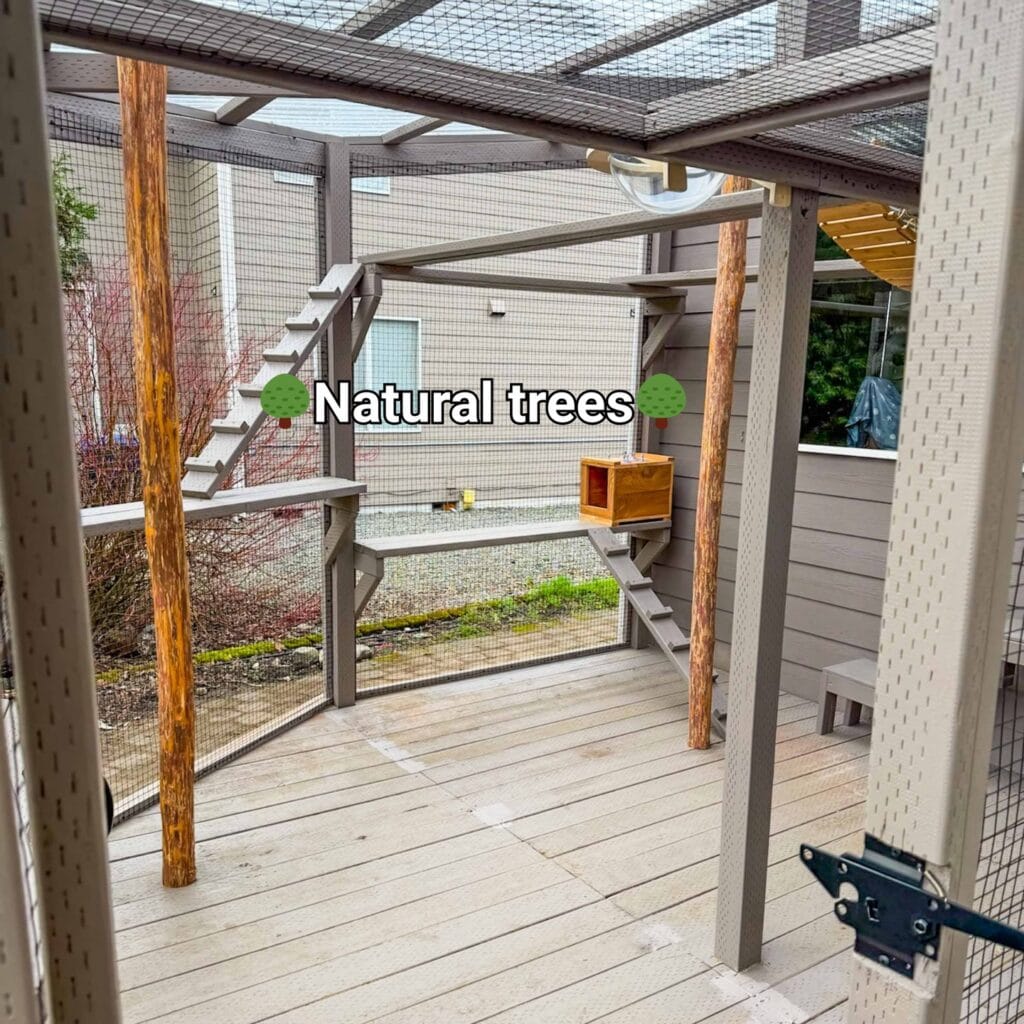
Okay, so you know how your golden girl rubs against every single wooden post in your backyard like it’s her personal scratching station? Cats do the exact same thing — and this catio leans all the way into that instinct.
Two raw cedar log columns anchor the entire structure here, bark still on, warm amber tones running through them. They’re not decorative — they’re load-bearing, which means your cats get something to claw, climb, and scent-mark while the whole enclosure stays structurally solid.
The rest of the build uses grey composite decking boards for the floor, wire mesh panels on the walls and ceiling, and painted grey timber for the ramp stairs, platforms, and lower shelving. A small wooden feeding station box — looks like unfinished pine, roughly 12×12 inches — sits centered on a mid-level platform. One acrylic bubble window insert is mounted near the roofline for that classic “cat surveillance” moment.
When sourcing your log columns, go with kiln-dried cedar or pine at least 4 inches in diameter — they resist rot and don’t splinter the way raw green wood does. Seal the base where it meets the deck with exterior waterproof caulk so moisture doesn’t wick up and rot it from the inside out.
Keeping two columns spaced 6-8 feet apart gives cats a natural circuit to run between perches without the space feeling cramped.
📸 Photo credit: Instagram @thecattopia
#18: Full Patio Cat Enclosure That Turns Your Whole Backyard Into a Safe Cat Paradise
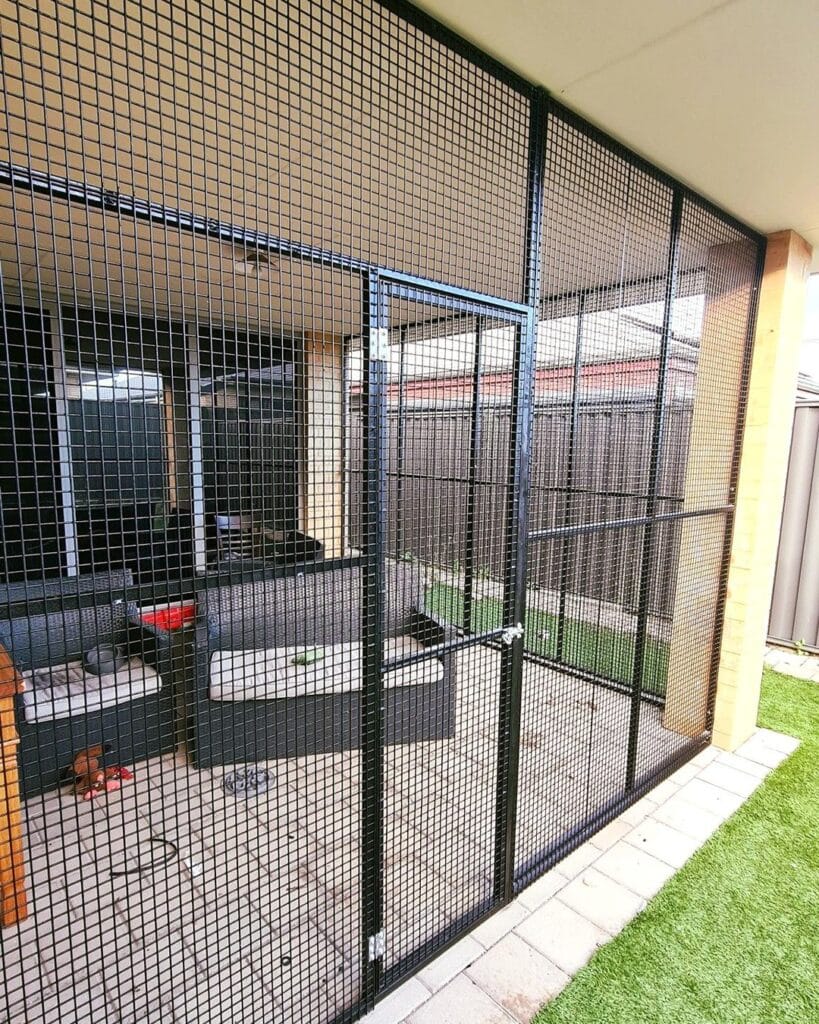
Okay so picture this — you’re sitting on your patio with your golden, and your cat is right there with you, not bolting into traffic or terrorizing the neighbor’s bird feeder. That’s exactly the energy this full-patio enclosure is giving. It wraps around the entire alfresco area with black powder-coated steel mesh panels, creating this sleek, almost invisible barrier that keeps cats fully contained without making your backyard look like a prison yard.
The whole setup uses welded wire mesh with approximately 1-inch x 1-inch square openings — tight enough to stop escapes, open enough for airflow and visibility. The frame is built from heavy-duty black steel tubing, secured to the existing home structure and a brick column on the right. And that hinged access door in the middle? It has a latch-style lock mechanism that makes coming and going easy for you while staying secure for them.
Inside, there’s a separate connected run on the right side with what looks like artificial turf panels laid on the ground — a smart texture swap that’s easy to hose down. The left section flows directly into the covered patio area, giving cats a shaded retreat during hot afternoons.
Run the enclosure along your existing roofline and attach it using L-bracket anchors into the fascia board — this keeps the top sealed without needing a freestanding frame, which saves you serious money on materials and installation time.
If you’re building this yourself, use 16-gauge galvanized welded wire mesh before spraying it with flat black Rust-Oleum for that clean look. The payoff? Your cat gets full outdoor freedom, and you get zero vet bills from outdoor injuries.
📸 Photo credit: Instagram @westcoastenclosures
#19: Outdoor Cat House With a Porch — The Cutest Backyard Setup You’ll Want to Copy
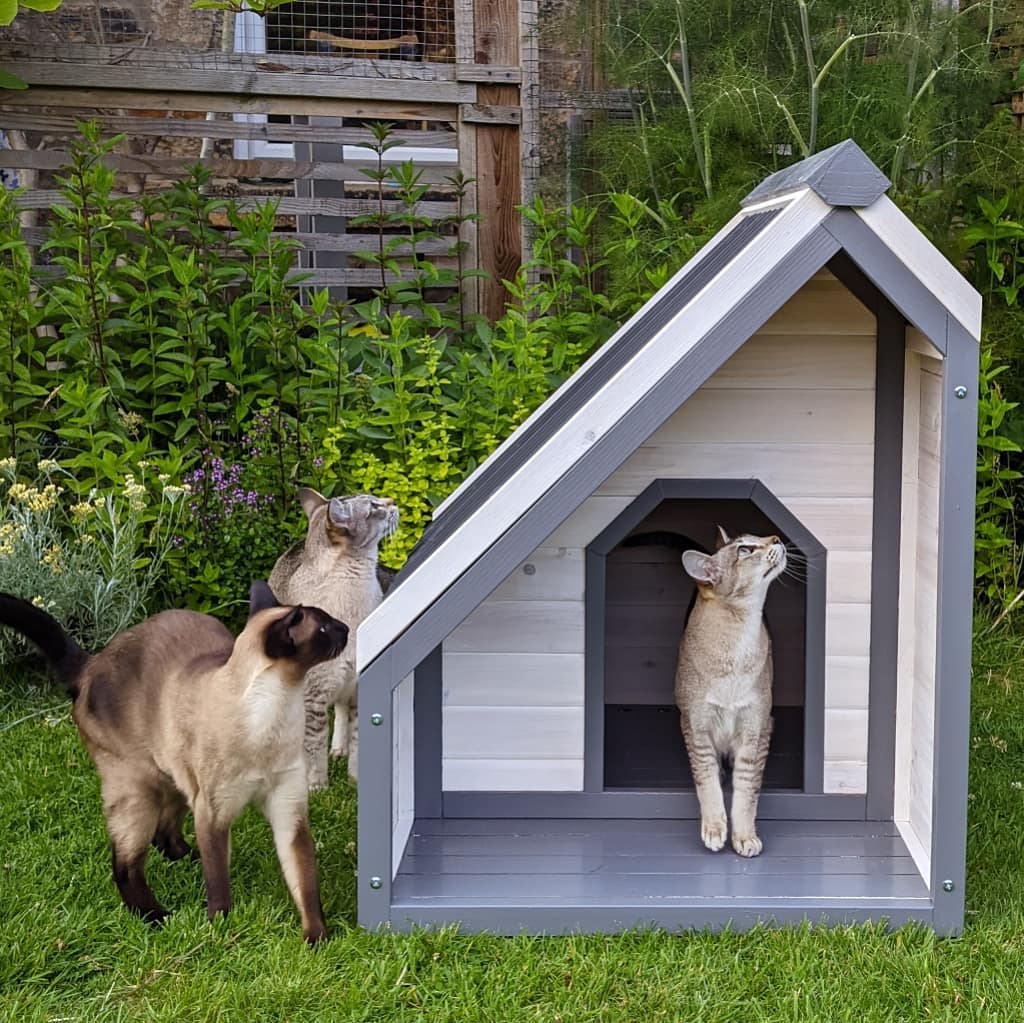
Okay so this one genuinely stopped me mid-scroll. Three cats, one little wooden house, and a garden that looks like something straight out of a cottagecore Pinterest board. The setup is giving cozy cabin in the woods energy, and honestly? If your golden retriever doesn’t try to squeeze into this thing the second you put it out, I’ll be shocked.
The star here is a wooden cat house with a gray and white painted exterior, peaked A-frame roof, and a small arched entryway that opens onto a built-in front porch platform. The walls are horizontal shiplap-style planks in a weathered white finish, with charcoal gray trim along the roofline, base, and door frame. It sits directly on the grass — no elevation, which makes it easy for cats to step right in.
To recreate this, you want an outdoor cat house with a covered porch (around 24″ x 24″ interior is a good size), a gray exterior-grade wood stain, and stainless steel corner screws for durability. Surround it with lush perennial plants like lavender, salvia, and catmint — they look gorgeous AND cats genuinely love rubbing against them. The catmint especially is like a free entertainment system.
Paint the trim a dark charcoal gray to match the roofline — this detail is what makes it look intentional instead of just a random pet box in your yard. And if you’re DIY-ing this, use cedar wood because it resists moisture naturally, which means it lasts through rain seasons without warping.
One time I helped my cousin set up something similar for her two outdoor cats and we skipped sealing the wood — big mistake. By spring it looked rough. Seal every surface with exterior-grade polyurethane before you even place it outside.
📸 Photo credit: Instagram @yoshitonks
The One Mistake That’ll Make Your Outdoor Cat Room a Disaster (And How to Skip It)
Okay, real talk — most people build their outdoor cat room and forget about airflow entirely. They pick a corner spot that looks cute on Pinterest, enclose it on all four sides, and then wonder why their cat won’t go in during July. Heat traps. That’s the problem.
Here’s what I learned after helping my cousin redo her catio twice: orient your structure so at least two sides face opposing directions. You want cross-ventilation working for you, not against you.
Also — and this is the tip nobody talks about — skip the pressure-treated lumber for any surface your cat will scratch or chew. The chemicals in that wood aren’t cat-safe. Cedar is your best friend here. It’s naturally pest-resistant, smells gorgeous, and holds up against weather without the toxicity risk.
One more thing. Layer your vertical space intentionally. Cats don’t actually want just “high spots.” They want escape routes — shelves that connect like a path, not random perches floating in space. Build with that logic and your cat will actually use the whole room.
Your Dog’s Space Is One Good Idea Away
Honestly? The hardest part is just starting. Pick one corner, one spot your golden already gravitates toward, and build from there. A cozy bed, a little nook, something that actually looks good — it doesn’t have to be complicated.
And if you want some real inspiration before you shop, these creative dog nook ideas for your furry friend are chef’s kiss for making a space feel intentional, not like an afterthought.
Your home can be beautiful AND dog-friendly. Those two things aren’t fighting each other anymore.
So tell me — what’s the one spot in your house you’re ready to finally give your pup?

Amr Mohsen is a software engineer who traded his keyboard for a leash — at least on weekends. His love for dogs inspired him to share what he learns as a dog owner and enthusiast, bringing a detail-oriented, research-driven perspective to every article he writes. If it’s about dogs, he’s probably already looked it up twice.