
You know when your golden retriever does that little tilt of the head and his ears flop sideways and you stop breathing because it’s just so cute? Yeah, that moment needs to live forever.
That’s basically what dog animation captures, and to be honest it’s way more fun than I thought when I first fell down this rabbit hole.
There I was sitting on the couch one night, searching on Pinterest for some living room inspo, and somehow ended up watching hand-drawn dog animations for two hours. No regrets.
But if you’re struggling to find the right dog animation ideas that feel truly personal and soulful, then read on.
Good news: From beginner-friendly sketches to full-on character concepts, these ten ideas will help you bring your pup’s personality to life in a way that’s so him.
#1: Fishing Dogs — The Charming World of Character-Driven Dog Animation
You know that moment when your golden retriever is running around the backyard and spots a fish in a puddle and goes absolutely feral? That’s what this series of illustrations makes me laugh so hard about.
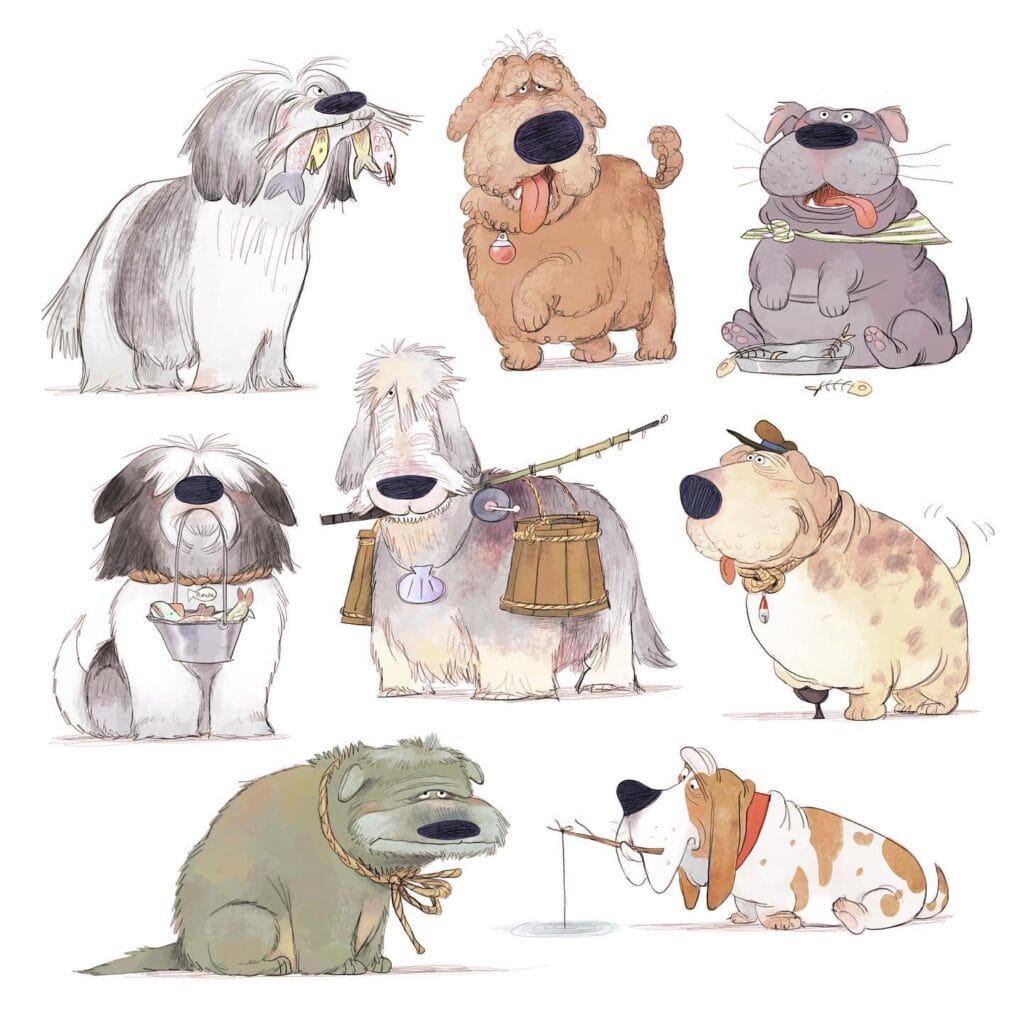
Spanish illustrator Alex Exposito created this set of 8 character studies, each featuring a dog drawn in watercolor-style ink washes, and with a fishing prop — bamboo rods, wooden buckets, tin pails — tied around the neck with rope details that feel slightly rough to the touch.
What I like about the pug pose above is the intentional weight distribution – the chubby spotted hound balanced on tiny stilted legs is the perfect pose to let his personality shine.
Each dog has an exaggerated black nose as a visual anchor, and that’s basically it. It’s a group of the most different looking dogs I could find under the loose, sketchy linework that layers under the watercolor wash to give each character an organic, hand-made feel.
And the fish? The chef’s kiss. The gray shaggy dog clutching a small golden fish in his mouth is peak storytelling through props alone.
If you love character design and dogs that have the personality of the best family dog breeds, dogs with these expressive faces may be the dogs for you!
📸 Photo credit: Instagram @aexposito.drawings
#2: The Golden Retriever Mood Board — Rolling, Stealing Socks, and Looking Like an Angel (We Know the Truth)
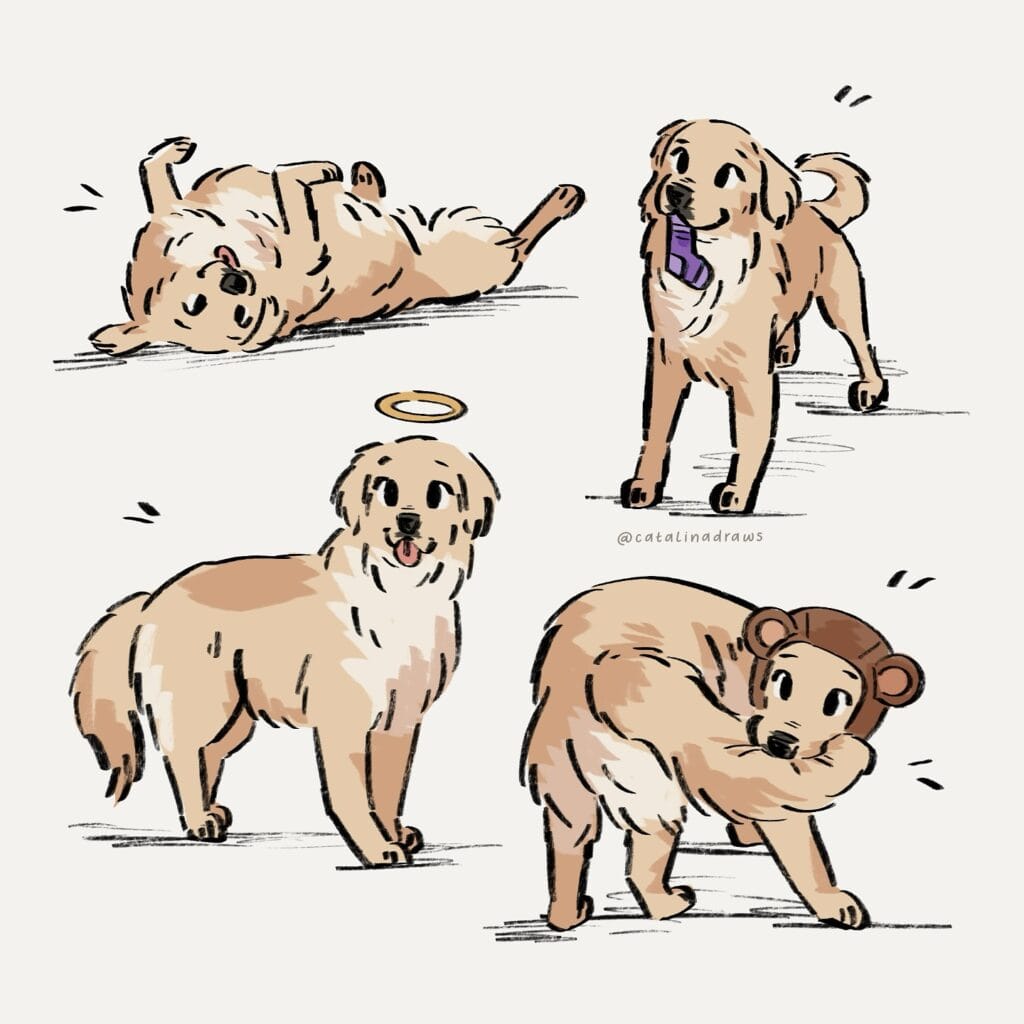
Let’s face it, you know this picture. Four poses, one dog, and your life story captured in a cartoon. The rolling on their backs wiggle, the stolen sock held as a trophy, and the halo that is most certainly a lie, but my dog @catalinadraws nailed the golden retriever personality.
the style is done with loose ink outlines and soft brush shading. there are no hard fills, just more layers of strokes to give the pose a loose and energetic feel. i just wanted to share that brown bear helmet in the bottom right. its my chef’s kiss, because all my golden owners like to put something ridiculous on their dogs’ heads.
What I find funny about this is the body language is over the top to the point of facial expressions. The flailing legs, the sock hanging off the mouth. This is where the personality in this is. And the halo is tilted a bit, doing all the work for the comedy.
Here are some great tips to recreate your dog’s most chaotic moment. Do not start with their face, start with their body. A golden mid-zoomies tells more of their story than any portrait ever will.
Keep your palette tight: two to three warm browns, pretty much all analogous, a single accent colour (the purple sock is the only pop in the whole piece) and your linework should be loose on purpose.
📸 Photo credit: Instagram @catalinadraws
#3: Max from The Secret Life of Pets — The Scruffy White Terrier Who’s Always Side-Eyeing You
You know that look your golden gives you when you grab the leash but then don’t actually take her out? The betrayal and low-key judgment? Max has that look permanently locked in.
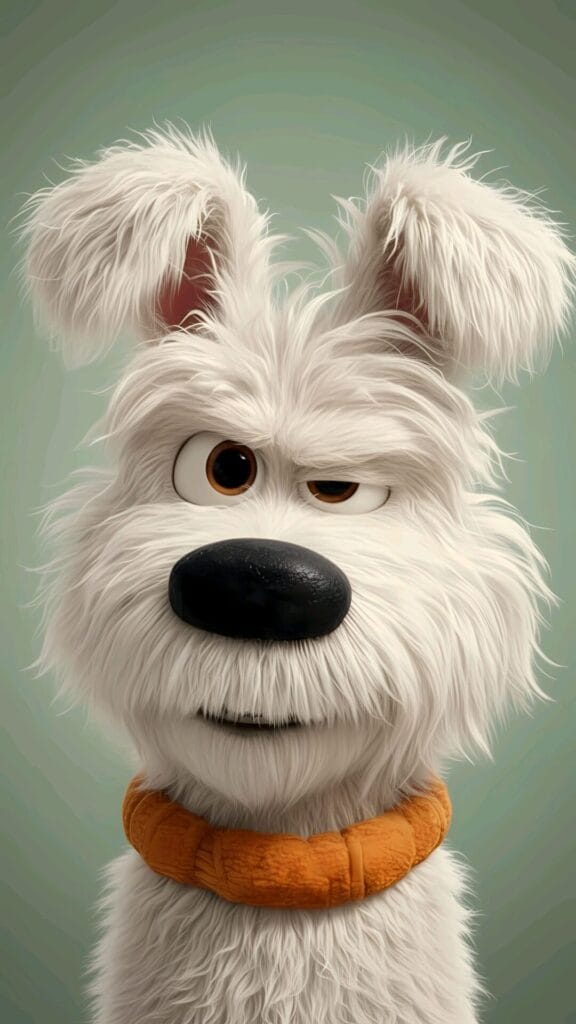
This friendly looking pup is a fluffy white terrier mix. He is slightly unkempt with layered shades of bright white and cream, and has the signature floppy ears of his breed that curl slightly at the tips. He looks at you with his amber-brown eyes half closed with a “I’m not mad, I’m disappointed” look in his eyes and a big black nose.
i think my favourite detail of this jumper is the burnt orange leather collar! i’d definitely recreate this part if i were to make my golden a jumper too, it looks so nice against the white fluff.
Though Maximus has several palettes to choose from, what really makes him shine is his fur texture. The animators at Illumination Entertainment used strand-by-strand rendering to make each clump of fur move individually, giving Max his perfectly disheveled, just-rolled-out-of-bed look that somehow still feels expressive and alive.
But what makes him unforgettable is his face. Before he’s even opened his mouth, his face is telling us jokes. Every skeptical squint or reluctant smirk is meant to be funny.
If your golden dog ever stares at you in a slow, unblinking manner from across the room, then you might have your very own Max.
📸 Photo credit: Instagram @kaizen.illustre
#4: The Superhero Dog — Four Expressions That’ll Make You Snort-Laugh Every Time
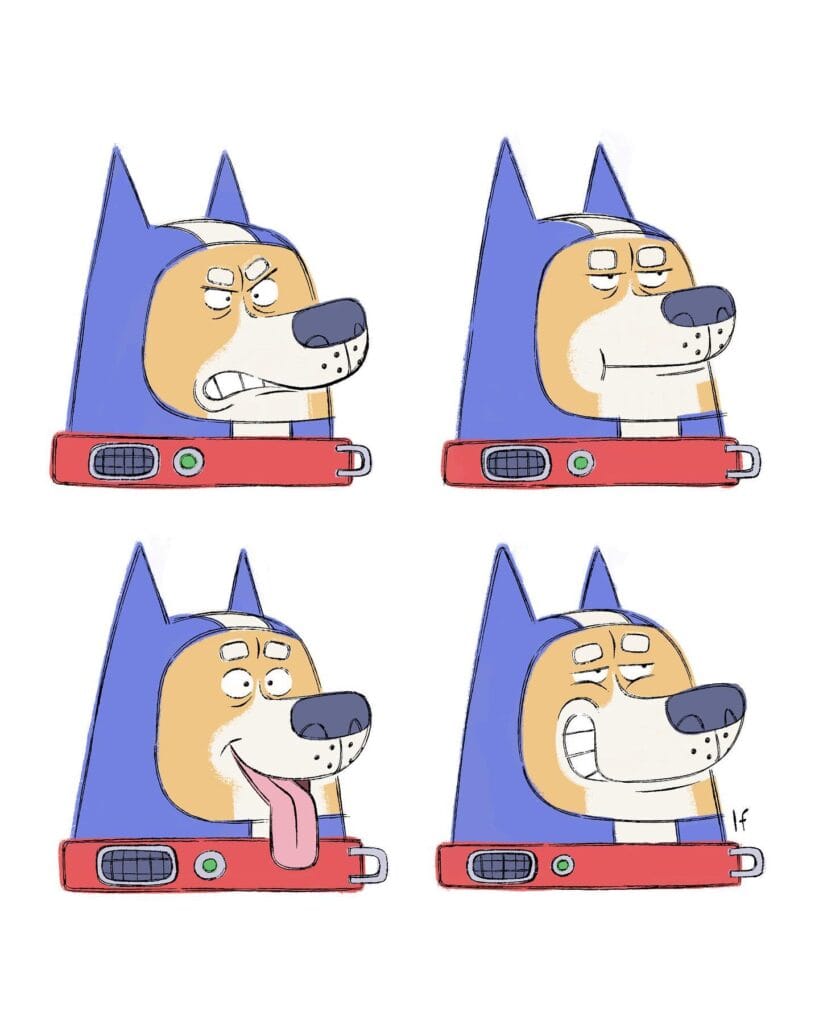
You know that moment when your golden does something so dramatic you can’t tell if she’s annoyed, exhausted, or just done with you? This is that moment.
Leonard Furuberg did the cover art for this book and he shows four different emotions from the cartoon dog, all wearing the same blue superhero cape-helmet hybrid and red tech collar with a green indicator light. The dog goes from grumpy, teeth bared, brow furrowed and looking all hard, to heavy-lidded, bored, to goofy tongue out and finally to a smug side-eye smirk.
Why does this work so well? I think it’s the limited color palette – flat burnt orange, On a lighter cream white, Slate blue, and brick red – all without any gradients of shading. The emotion is given to each face by the positioning of the eyebrows and the mouth only.
The square-ish snout construction also helps the character “read” in thumbnails, as well as when shrunken down to fit inside a Tweet or Instagram story.
Varying just two facial muscles on a sheet will keep your characters consistent and recognisable from scene to scene.
📸 Photo credit: Instagram @leonardfuruberg
#5: Hanna-Barbera’s Classic Hound Trio – The Blueprint of Cartoon Dog Personality
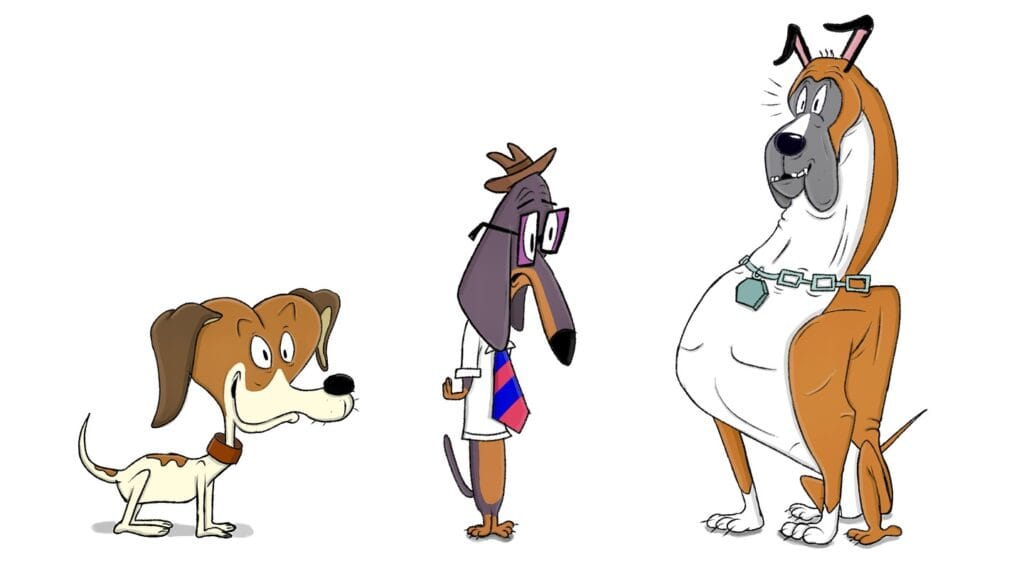
Like this golden retriever, your dog has three basic modes: chaos puppy, couch potato, and “I’m too dignified for this.” These animated dogs are spot-on.
The three best big dogs are shown here in this vector illustration pulled from the golden age of Hanna-Barbera animation. The small beagle on the left is drawn in a warm tan-and-cream and a rust-brown while sporting a dark collar. The middle character is drawn in muted purple-gray with a white lab coat and pink-framed glasses as well as a red-and-blue striped tie. The big guy on the right is drawn in burnt orange and white as well as a teal chain-link collar. He also has a big droopy face that makes him look like the gentle giant that he is. If you have ever wondered what the best big dog breeds are that carry this same personality in real life, that big guy might be a good reference.
What’s so nice about this style is the contrast in line weight. The thck lines on the outside of the dogs make them readable at any size, and the thin lines inside give a bit of detail. Just by looking at the silhouettes of these dogs, I can tell you all about their personalities.
Choose a character type that suits your dog’s personality. The proportions don’t need to be accurate – exaggerating one feature (ears, eyes, body shape, etc.) will give your custom pet portrait an irresistible charm and make it unforgettable!
📸 Photo credit: Instagram @lukasdrawsart
#6: Expressive Dog Character Animation — How Artists Capture Your Dog’s Whole Personality in One Sheet
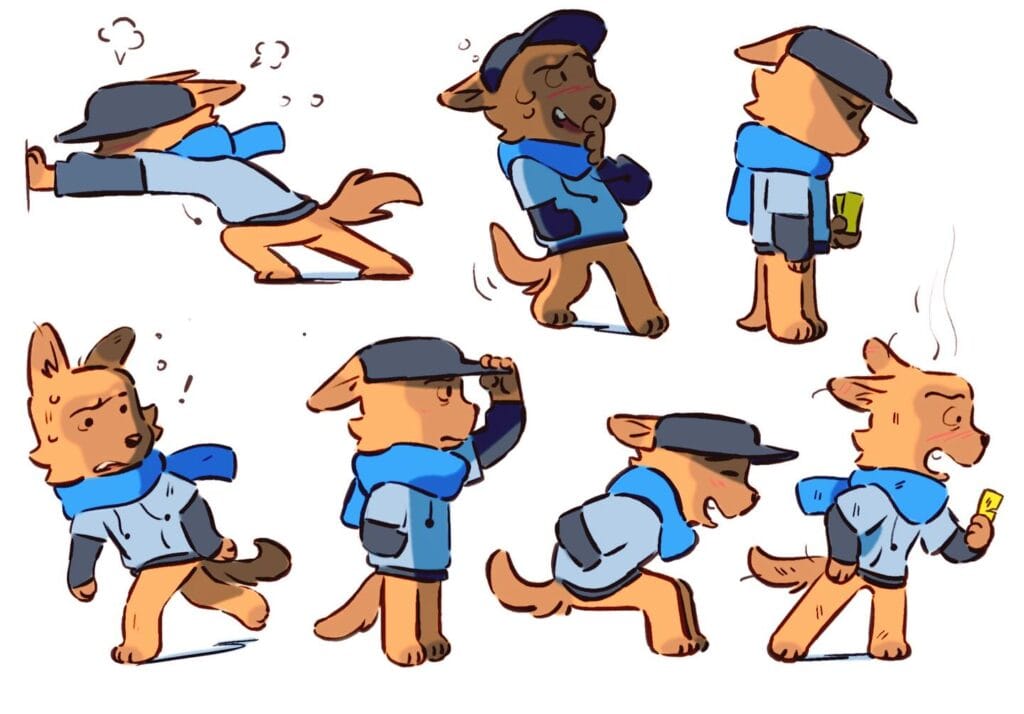
And if you have a dog, especially a golden retriever, you know about those moments when your dog is just, well, completely fine and you’re leaving the house, but the second you go to get your keys, they dramatically face plant on the floor. That’s what this animation reference sheet is about.
Laid out on the floor with 7 poses including a sleeping dog character in a flat-out pose, strutting with a backpack, holding a hot drink, side-eyeing someone, and in full panic mode. The dog character is wearing a blue hoodie, light grey cargo jacket, and a dark navy flat-brim cap. Two fur tones used are a warm golden-tan and a deeper chocolate brown. The fur is drawn with loose, chunky linework and flat color blocking.
The magic of this photograph is in her body language. I love the way her tail is tucked close to her hind leg. It conveys shame. How fun. I also like that her tail is wagging as she runs. To me that says, “I own this sidewalk!” I also love her ears. In fact, full marks for Golden Retriever chaos energy.
Start here: And if you would like to try this style yourself, sketch your dog in just 5 core poses – resting, walking, startled, happy, and confused (that covers 90% of their personality).
Use alcohol markers or Procreate and a flat brush to block colors like this artist does. No gradients. Just bold shapes. The outfit details (jacket pockets, scarf folds) give the character a real feeling without complicating the linework.
but i think this is the perfect style to turn your gold into a sticker sheet 😀
📸 Photo credit: Instagram @nuodia.art
#7: When Your Dog Is Ready to Leave Before You Are
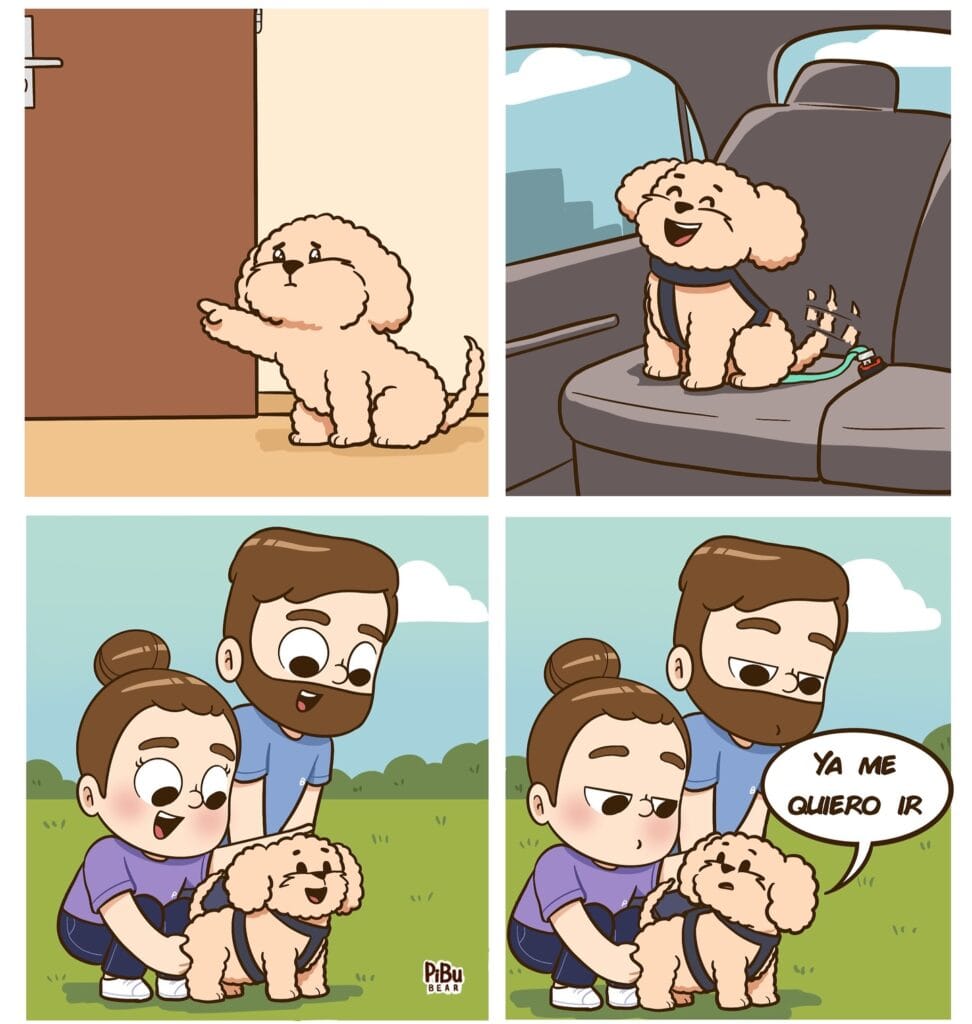
You know that moment when you’ve finally taken your dog to the park, and she’s finally having fun, and then five minutes later she’s just done?
This comic from @pibubear always makes me laugh because it’s so right on and this is how I feel about my dog!
This four-panel strip follows the events of a fluffy apricot-colored poodle on a full outing. Panel one shows the poodle scratching at the door, excited to go. Panel two shows the poodle in the backseat of a car, with a teal leash clipped to a dark gray car harness. The poodle is smiling. Panel three shows the poodle arriving at a green park with their humans, a woman in a purple tee and a bearded man in blue. They both crouch down, smiling. In the fourth panel, 0 seconds later, the poodle has a thought bubble that reads “Ya me quiero ir” or “I already want to leave.”
Real talk: this is the most relatable dog i have ever seen.
I laughed because it was that special dog logic, the anticipation is everything, the reality is negotiable.
If your golden does this at the best dog parks, you are not alone. This is just a personality trait in some of the Goldens.
Save this one for your “dog mom” board. Your followers will tag themselves.
📸 Photo credit: Instagram @pibubear
#8: Mastering the Cartoon Dog’s Mouth — Where the Magic (and the Chaos) Happens
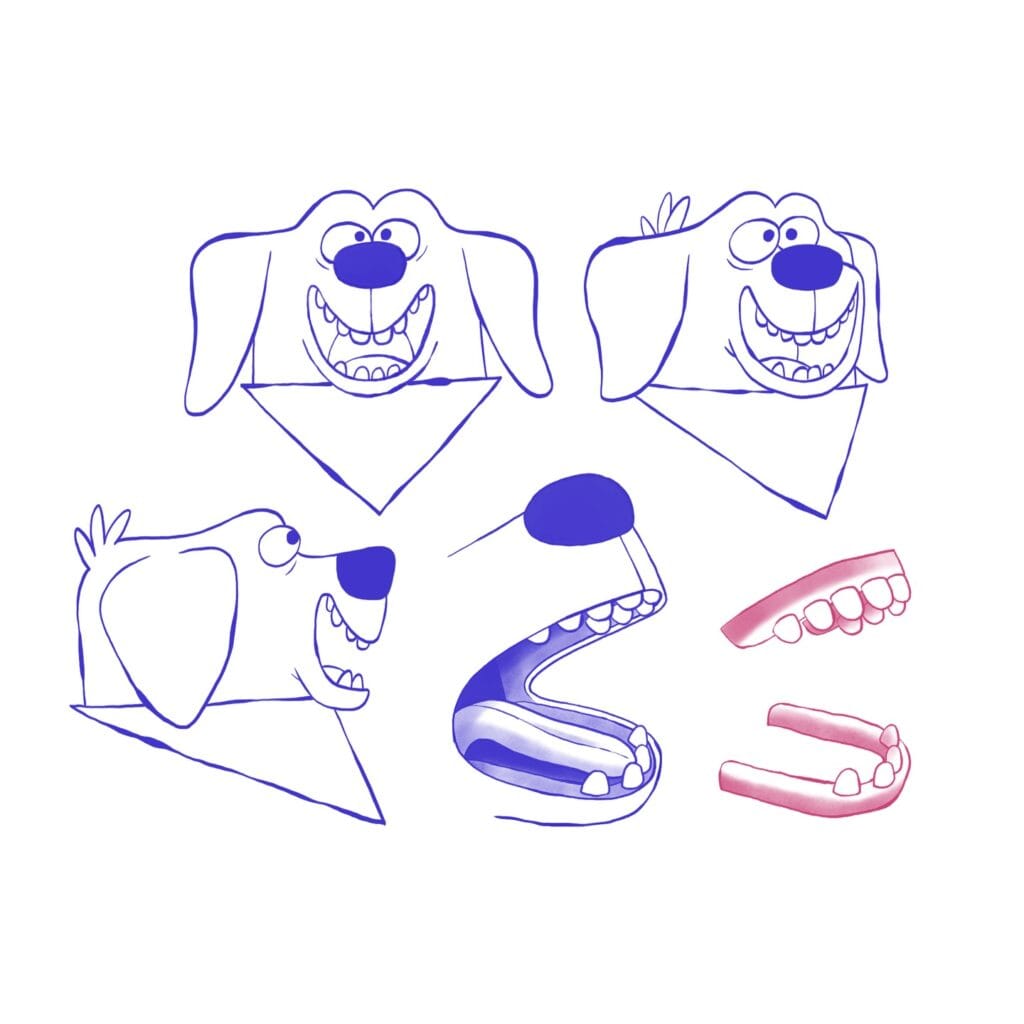
How many of you have seen your dog open their mouth mid-zoomie and gotten a full shot of every tooth? Animators are obsessed with capturing this.
This sheet is a breakdown of cartoon dog mouth construction — and it’s genuinely one of the most technical parts of character animation. You’ve got front-facing grin studies (top row), a side-profile bark pose (bottom left), a wide-open jaw study in blue showing the hinge mechanics, and isolated gum and teeth detail drawings in pink-red for coloring reference.
The front-facing smiles are simple with a heart-shaped head silhouette with droopy floppy ears framing a big smile on the giant’s big nose. Wide open, toothy grin. In profile, the jaw drops away from the snout not straight down.
The isolated mouth pieces in pink? Those are your texture guides — gum color, tooth shape, and spacing all mapped out so every frame stays consistent.
Trace the jaw hinge point first before drawing teeth. Animators call this “anchoring the mechanics” — nail the pivot, and your mouth movements stop looking stiff and start feeling alive.
📸 Photo credit: Instagram @spark.lingonberry
#9: The Round-Faced Scholar Pup — A Character Sheet That Captures Every Mood Your Dog Actually Has
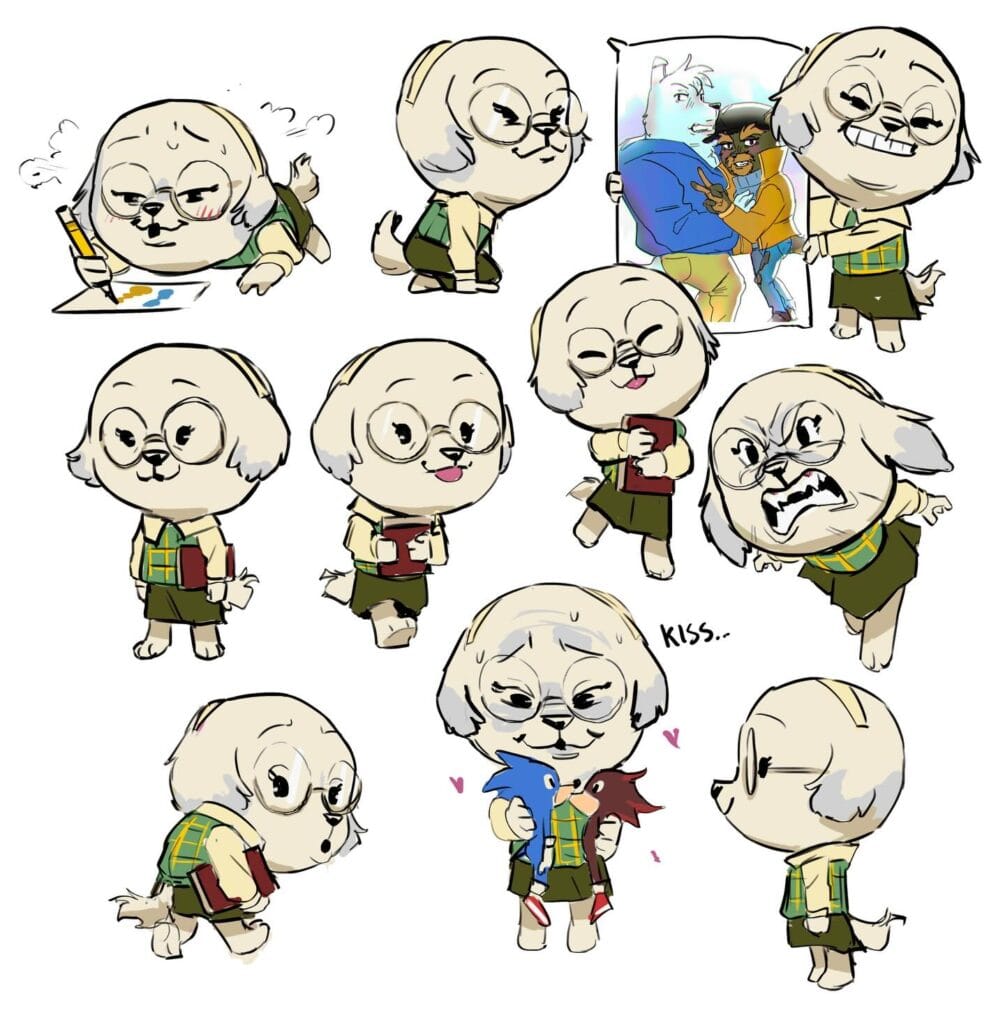
You know what I’m talking about. You’re eating the last of the good snacks in the house without sharing and your golden gives you “that” look. This little dog gets it.
Yay! A new character sheet! Can you tell I’m really bored today? This is a chubby little round-headed doggy friend, with cream and beige fur, round wire-frame glasses, and a green plaid vest over a dark olive skirt. My girlfriend on a Monday, anyone?
This was built with Adobe-style digital inking and uses a muted, warm colour palette of cream, olive, mustard yellow, and deep red with a loose but deliberate linework which gives each pose its own character without over-rendering the style.
Here’s what I love about this character design: same chunky round shape in every pose. Every pose, you recognize her instantly, even when she’s mid-snarl.
Keep this in mind: One of my favorite techniques is to use a book prop. It gives a different look with every photo but it also creates continuity since you see the same object in a few different poses.
The bottom center pose — hugging a tiny blue Sonic figure with little hearts — is a heartfelt one that brings the whole sheet to life.
📸 Photo credit: Instagram @tonikopantoja
#10: The Art of Exaggerated Dog Expressions in Animation
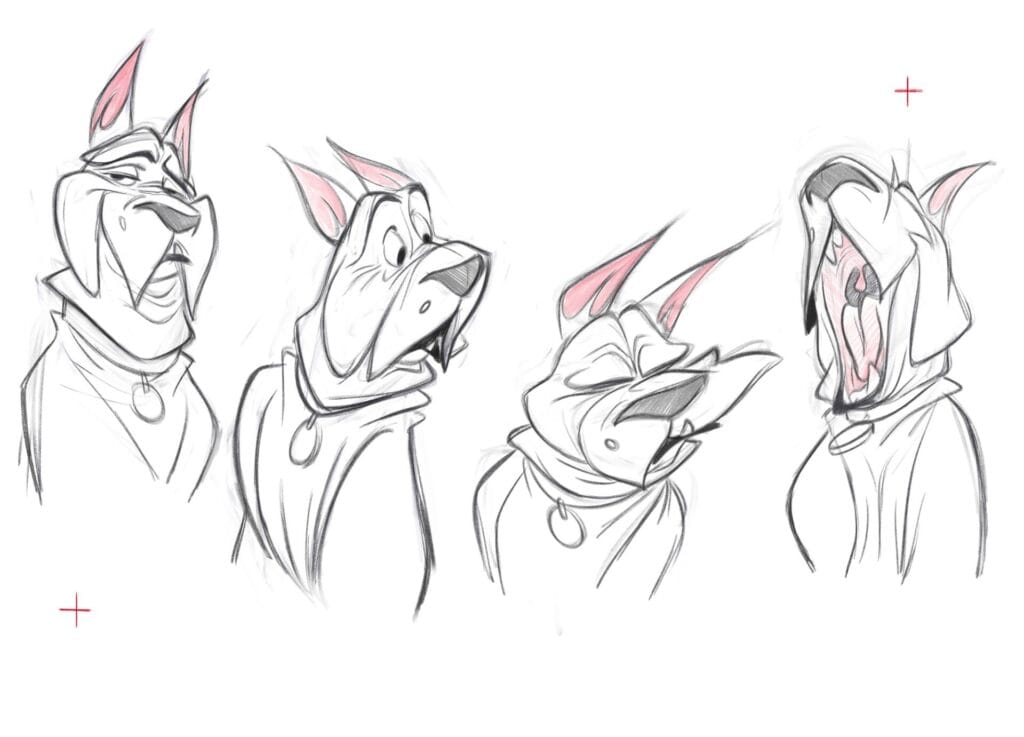
You know that face your golden makes when she hears the treat bag from three rooms away? Those wide-eyed, jaw-dropped, everything-is-amazing looks? Yeah, that’s what these sketches are capturing.
This is an example of a character expression sheet. This artist used graphite pencil on white paper with pink color highlights on the inside of the ears to create a warm and deep feel. The expressions on the dog are suspicion, surprise, laughter and a exaggerated yawn/howl with the jaw dropped completely open showing the tongue with a pink shaded detail as well as visible ridges. 4 expression of doggy!
And the collar with a circular tag as well as the other remains unchanged in all the poses as the animator’s trick for making the character recognisable even when its face goes totally wild.
Each expression changes the ear angle, eye shape and muzzle length – the ears flatten back when angry, shoot upright when shocked. Animators are obsessive about studying real dogs, and the snout even elongates when laughing, a classic squash and stretch.
“All right. I will. I will sketch your dog’s face in four moods, and I will do it in pencil. And you will be very much surprised how much you can tell about your dog’s state of mind from his ears alone, before you get to hear his bark.”
📸 Photo credit: Instagram @valenpalart
The One Thing Most Dog Animations Get Dead Wrong (And How to Fix It)
For as much as I have studied dog animations for the last few months, the commonality I have found with animations that “look off” is the ears and tail working together.
Say your golden retriever comes bounding toward you. Her ears aren’t just flopping back, they’re a few frames behind her head. The sweep of her tail is in the opposite direction of her spine. This is so often done properly in animation that it takes away from the realism.
The common pitfall? Animating the body first, then adding ear and tail movement as an afterthought. Don’t do that.
It is best to animate secondary motion, such as the movement of the ears, tail, and jowls, on a separate pass from the main motion of the body. The secondary motion should always be slightly behind the main body movement and this delay is what makes viewers gasp.
Your character’s floppy ears and feathery tail are your built-in realism tests. If those two things feel alive, so does the rest of the character.
I bet you never figured out my trick of being late for a week. It took me two years to figure out. 😄
Your Floors Deserve Better Than Another “Good Enough” Rug
Golden retrievers are a lot (in the best way). And I mean a lot. Including the mud, the fur, and the wet paw prints after a rainy walk.
Want a floor rug that can stand up to all the chaos that your dog brings, and that looks amazing too? Then this is the rug for you. Your living room can be Pinterest-worthy and golden-retriever-approved.
If your pup is basically your whole world (like mine is) then you might want to check out these best dog wedding ideas for including your furry friend in your big day!
Which rug style are you leaning toward? I like the look of the above rugs for your space.

Amr Mohsen is a software engineer who traded his keyboard for a leash — at least on weekends. His love for dogs inspired him to share what he learns as a dog owner and enthusiast, bringing a detail-oriented, research-driven perspective to every article he writes. If it’s about dogs, he’s probably already looked it up twice.