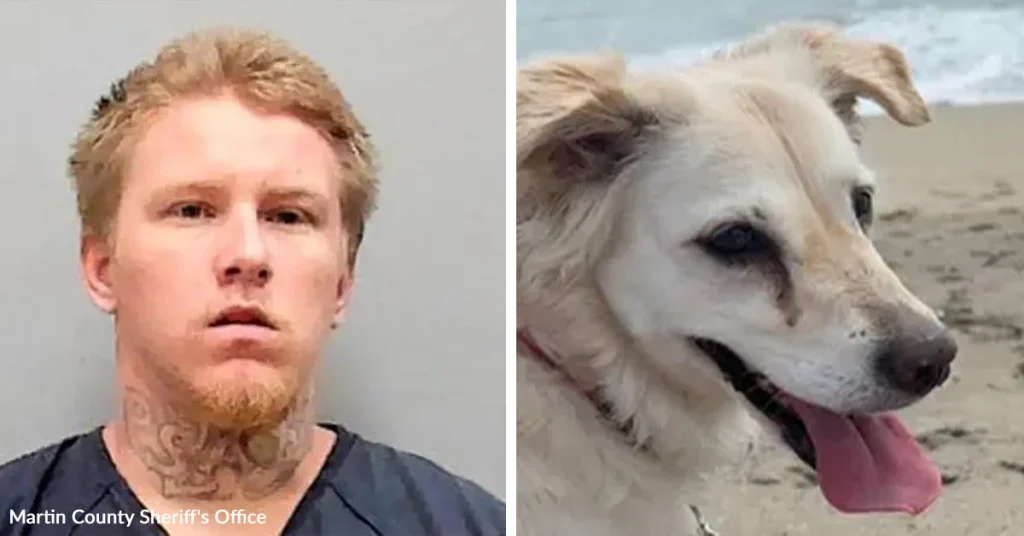
The story of a Florida man sentenced for a shocking act of animal cruelty serves as a stark reminder of the severity of such offenses and the community’s reaction to them. In Martin County, a 24-year-old named Donald Stickens has been given the maximum penalty for his atrocious treatment of a 9-year-old golden retriever named Stella.
This case has attracted significant attention from animal rights advocates seeking stronger regulations against cruelty. In August 2024, officials reported that Stickens was recorded on camera violently assaulting Stella, an elderly golden retriever, by strangling and striking her.
The Martin County Sheriff’s Office labeled the footage as “extremely disturbing,” underscoring both the brutality of the incident and the emotional toll it took on those who witnessed the evidence. This recorded abuse was pivotal in building a solid case against Stickens, leading to swift legal action.

Martin County Sheriff’s Office
In the courtroom, evidence took on significant weight. A judge imposed a five-year prison term on Stickens, marking the harshest sentence for felony animal cruelty in this instance. Such maximum sentences often become focal points in discussions surrounding animal welfare. Many advocates contend that penalties for similar offenses can be too lenient, making this five-year ruling a strong statement against animal cruelty and emphasizing its seriousness over being merely a trivial matter.
While the legal outcome garnered attention, the well-being of Stella resonated deeply within the community. A year post-crime, the Martin County Sheriff’s Office shared an update via social media, revealing a photo of Stella and affirming her good health with her owner. This small, uplifting detail injects a sense of hope into an otherwise dark narrative. Stella’s recovery illustrates her return to a loving home after a traumatic ordeal, showcasing resilience and the importance of accountability.
The sheriff’s office took advantage of its public platform to send a definitive message regarding animal cruelty. In the same social media post, the agency pledged, “we will not tolerate any form of animal cruelty, abuse, or abandonment.” This statement reinforces their commitment to investigate every claim thoroughly, ensuring that all evidence is taken seriously and appropriate action is taken for prosecuting offenders. In our fast-paced digital age, such explicit communication can bolster community confidence that cruelty will not be overlooked.
This Florida case serves as a significant example of how law enforcement, public consciousness, and legal ramifications interact. The availability of video evidence turned what could have been a silent incident into a clearly documented crime. The arrest and subsequent trial demonstrated that authorities were willing to act decisively when confronted with proof. The five-year sentence exemplifies that the judiciary recognizes the gravity of such offenses, justifying the maximum penalty allowed under the law.
Furthermore, this case embodies a community’s connection and emotional response to companion animals. Dogs, often treasured family members, evoke passionate reactions when reports of abuse surface. These acts are perceived as breaches of trust, as animals rely heavily on humans for protection and kindness. The Martin County Sheriff’s Office assertion to investigate all allegations reflects the community’s expectation of accountability.
In this light, the case results might contribute to ongoing conversations surrounding animal welfare and legal consequences. Every jurisdiction has specific animal cruelty laws, yet this sentencing highlights that when strong evidence exists, the legal system can enact serious repercussions, provided officials are intent on pursuing the toughest penalties. It emphasizes how crucial it is for witnesses or community members to report suspected abuse, aiding in the rescue of vulnerable animals like Stella.
Another noteworthy aspect is the sheriff’s office sharing the positive update about Stella. Highlighting her recovery serves as a vital counterpoint to the earlier recounting of her suffering. Accounts of animal cruelty can be distressing, and the knowledge that Stella has triumphed and is safe provides meaningful solace to those following the story. It balances the seriousness of the crime with a recognition of the potential for healing in a nurturing environment.
This Florida case reinforces several essential themes for animal welfare advocates. First, having documentation, such as video evidence, can significantly impact the proof of incidents. Second, public commitments from authorities about the seriousness of animal cruelty can profoundly influence prosecution and sentencing practices. Most importantly, the welfare of the animal at the heart of these discussions is deeply significant to the broader community. Stella’s ongoing care transforms this dark chapter into one of cautious optimism.
The Martin County Sheriff’s Office has positioned this case as a hallmark of their unwavering stance against animal cruelty, abuse, and abandonment. This aligns with the rising public awareness that harm to animals is not a minor issue, but a grievous wrong deserving of substantial consequences. As demonstrated in this case, when robust evidence is present and officials respond with determination, the legal system can enact a strong stance against even the most appalling acts of cruelty.
Back to blog

Amr Mohsen is a software engineer who traded his keyboard for a leash — at least on weekends. His love for dogs inspired him to share what he learns as a dog owner and enthusiast, bringing a detail-oriented, research-driven perspective to every article he writes. If it’s about dogs, he’s probably already looked it up twice.