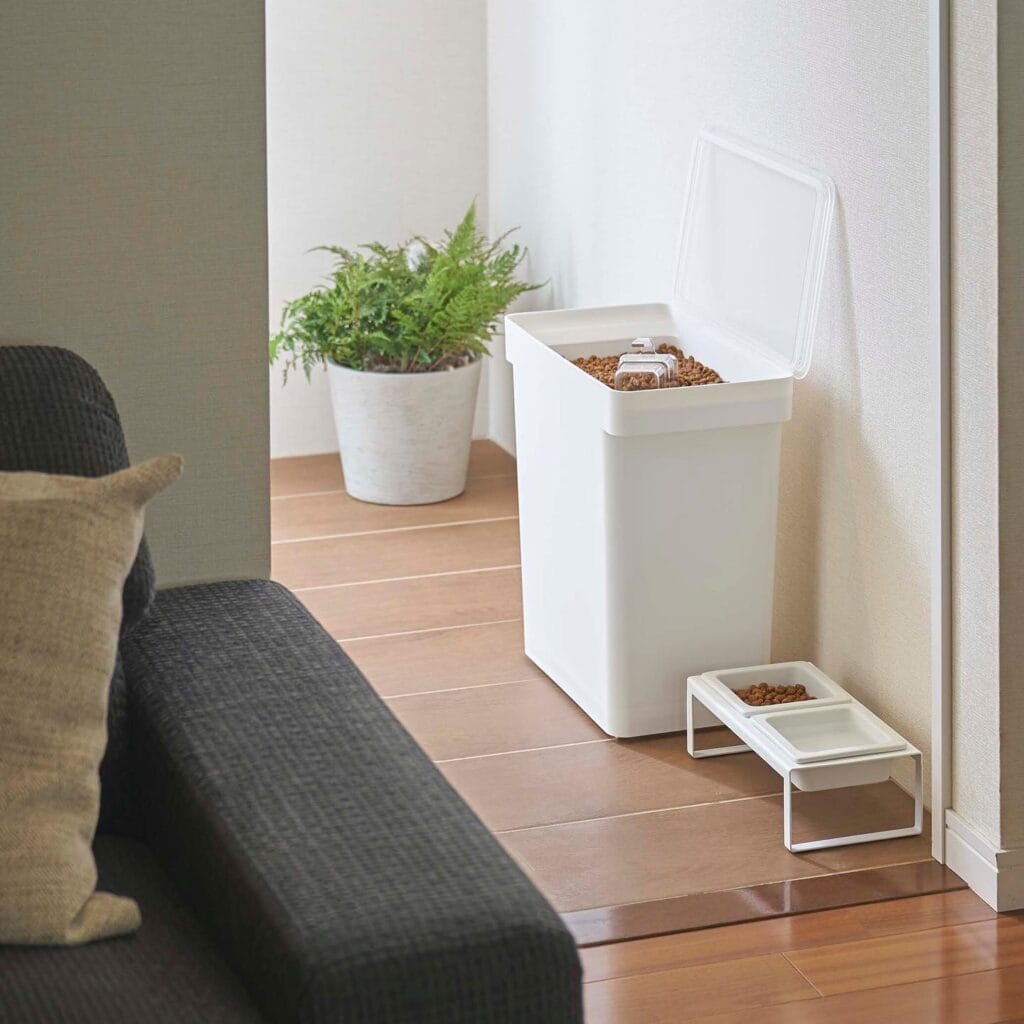
Dog food bags are the worst, right? You finally have a cute kitchen – the type that would be featured on Pinterest – and then that giant, crinkly bag of dog food is just sitting out in the open, judging you.
Sometimes you try to make it as hard as possible by tucking it in a cabinet, but your dog will spend all day nose deep in the pantry the second you turn around. Been there. My cousin had the same problem with her lab and her whole entry way smelled like kibble for months.
No more ugly dog food bags, no more smell of the dog food when you open the door, no more paw accidents!
How cool are these 10 designs? They are all achievable in one weekend and most of them will look so good that your guests won’t even know what’s inside.
#1: This DIY Dog Food Station Is the Pinterest Project Your Golden Retriever Deserves
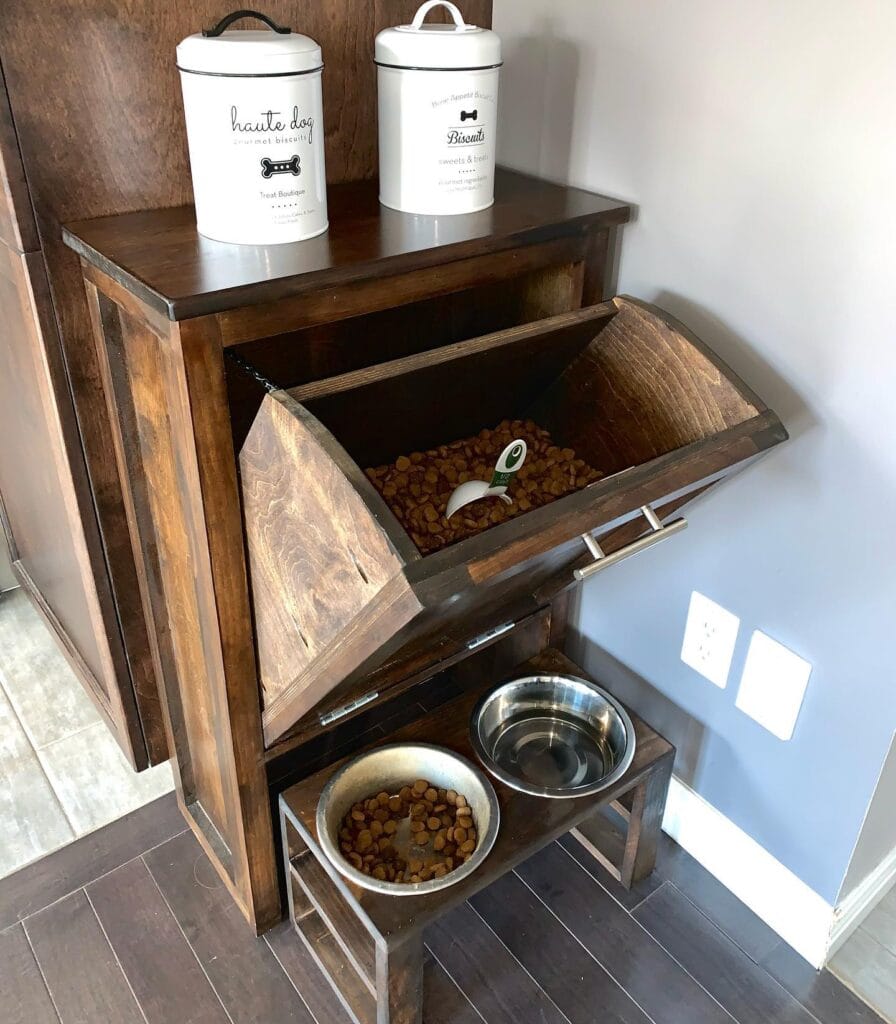
Do you have one of those moments when you are rushing to feed your dog before work, and the kibble bag tips over again, leaving a trail of kibble across your kitchen floor?
Yeah. That was my life every single morning.
This cute dark walnut-stained pine wood dog food station changed our house completely. With it’s flip-top bin that can hold an entire bag of kibble, a measuring scoop that stores inside it, two stainless steel elevated bowls that sit in the stand below and two white ceramic treat canisters that sit on top with labels for “haute dog” and “Biscuits” – it’s the cutest thing I’ve ever seen in my kitchen corner.
Materials & Tools
– 1×10 pine boards (approximately 8 feet total)
– Dark walnut wood stain
– Piano hinge and chain stopper for the flip-top lid
– Two stainless steel bowls (6-inch diameter)
– Silver drawer pulls (×2)
– Wood glue, pocket screws, sandpaper (120-grit and 220-grit)
– Polyurethane sealant (food-safe)
– Circular saw, drill, clamps
Instructions
Cut the pine boards into the pieces needed to form the frame, 2 – 16×30 inch side panels, 1 – 16×12 inch top shelf, and 1 – 16×16 inch bottom platform for the bowl stand.
Sand all pieces with 120-grit sandpaper, then sand with 220-grit sandpaper for a smoother, cleaner surface.
Assemble the frame, using pocket screws and wood glue. Let the frame dry for at least 24 hours. Don’t forget this step, or your cat’s lid will be rattling around every time they go to use it.
I added an interior bin to my pantry and built a 45 degree angle divider into the back of it to help funnel the kibble to the front of the bin. It makes it easier to grab a handful rather than digging around the bottom with my whole arm. Also, the bin holds roughly 30 pounds of dry food, which means less trips to the store and no half opened bags in my pantry.
Next I attached the flip-top front panel to the bottom with a piano hinge and a short chain on each side to keep it propped open at the right angle. This was a small detail that really made it seem like it was intended to be open like that. No lid crashing down while I’m scooping from the bowl!
Cut the 2 circular holes on the bottom platform where the bowls will sit. Make sure the holes are about 8 inches apart from each other. The platform should be about 10 inches off the floor so your girl can eat her meals without straining her neck. It will help if you’re feeding her with dog food for sensitive stomach.
Apply two coats of dark walnut stain letting it dry for 4 hours between each coat. Finish with a food-safe polyurethane sealant on all interior surfaces to protect the wood from moisture and keep your kibble fresher longer.
Prep Time: 30 minutes | Active Project Time: 6–8 hours | Difficulty Level: Intermediate
I like to keep the doggy treat canisters up on the top shelf, but keep a 4-cup measuring scoop right inside the bin. I try and keep all of his stuff up there so that one day, my kitchen corner might actually look like something I was planning on doing!
Seal the inside of the bin with an extra coat of polyurethane and let it cure for a full 48 hours before adding kibble. The smell of fresh stain can be rather strong, and your golden’s nose will thank you for the extra time. You may also choose to line the bottom of the bin with a thin food-safe silicone mat for easy clean-up.
📸 Photo credit: Instagram @dc_woodcrafts
#2: The Raised Drawer Dog Feeding Station (With Hidden Storage)
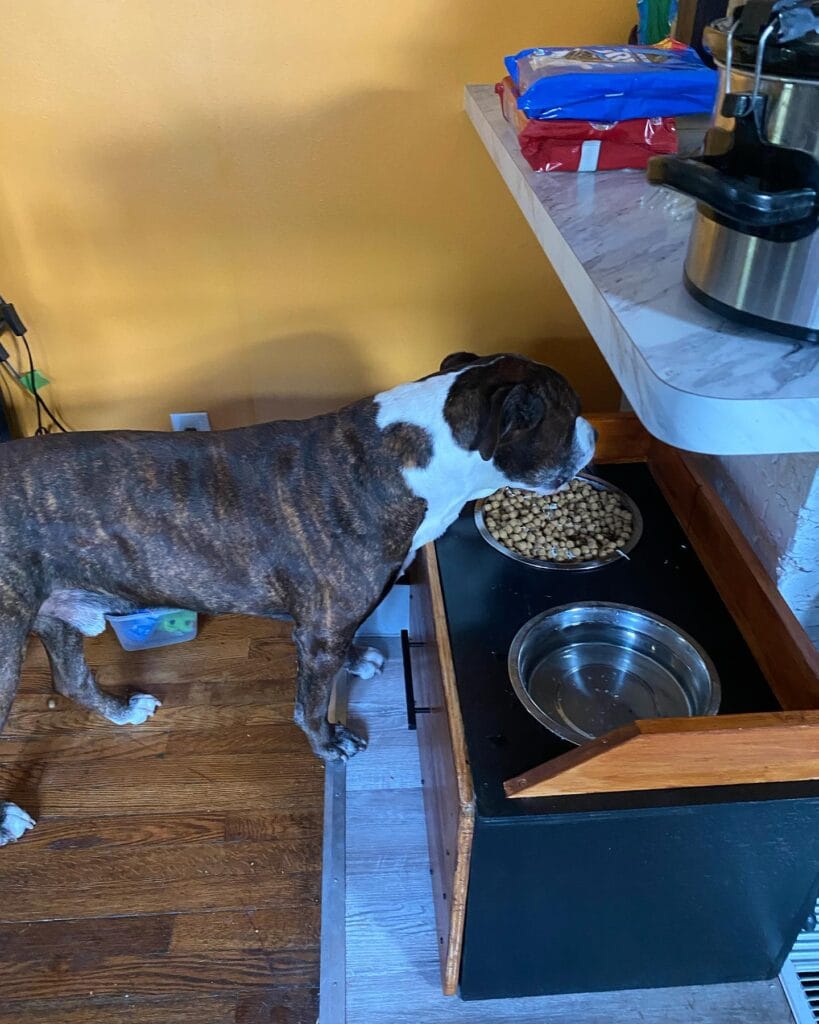
I’m sure all of you have been there, right? When your kitchen is looking like a Pinterest board and then there is just a giant bag of kibble just sitting on the floor, ruining the whole look.
Girl, same.
My cousin built this for her boxer mix. I have to say, when I first saw it, I thought it was a piece of furniture. Love the look.
Materials & Tools You’ll Need:
– 1-inch thick oak wood planks (for the drawer frame)
– Black matte MDF board (for the inner tray surface)
– Two 7-inch stainless steel bowls
– Drawer slide rails (18-inch, heavy duty)
– Wood screws (1.5-inch), wood glue, sandpaper (120-grit)
– Jigsaw, drill, measuring tape
Instructions
Cut your oak planks to approximately a 12” x 24” rectangular frame. Sand every edge because no one wants splinters near their dogs face. Attach the black MDF panel to the inside as the tray floor, which gives it the clean, modern look.
Put the drawer slide rails on both inner sides of the frame. Once they are in place, slide in the tray to make sure it slides easily. Trace around the openings for your bowls with a pencil. Cut out the openings with your jigsaw. These openings will accommodate the stainless steel bowls and they should fit flush so that they do not slide around.
Worth it because: the raised height of the table reduces neck strain for bigger breeds which means less mess on the floor and a happier dog!
Put the food bags on the shelf above just as you see here, and it adds to the look of the space.
And if you make the dog food yourself, then you can pair the station with Homemade Salmon Dog Food Recipes: Nutritious and Delicious Meals for Your Pup.
Seal the oak with a food-safe polyurethane coat. Two thin layers are better than one thick one.
Prep Time: 30 min | Active Project Time: 3–4 hours | Difficulty Level: Intermediate
📸 Photo credit: Instagram @bearbear85
#3: Elevated Double-Bowl Feeding Station With Built-In Food Storage Cabinet
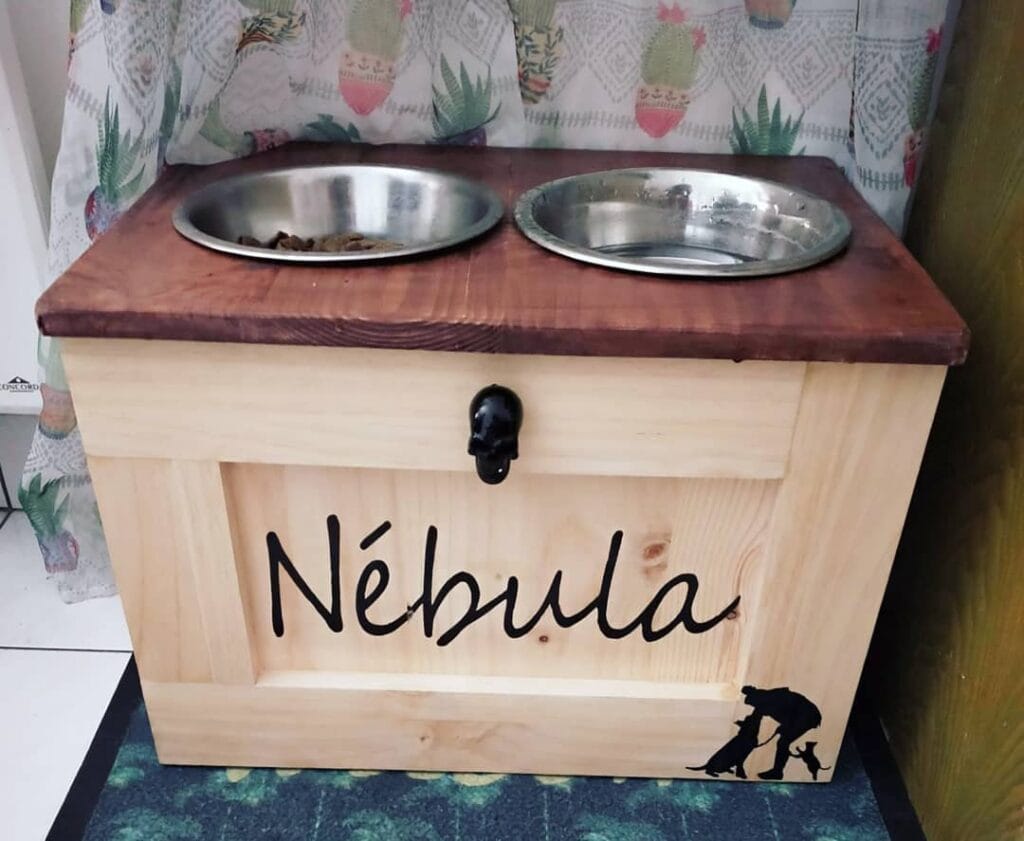
It’s time for my Golden to eat, so I dump his kibble into his bowl and walk away. I hear his bowl slide across the kitchen floor, and turn around to find a trail of food bits strewn out from where he’s lying down. Somehow the kibble bag is wedged behind the trash can again.
This pine wood feeding station with a dark walnut stain top is the perfect fix to all of that.
Materials & Tools:
– 1×6 and 1×8 pine boards (light natural finish)
– Dark walnut wood stain (for the top panel)
– Two stainless steel bowls (12-inch diameter each)
– Black cabinet pull handle
– Wood glue + 2-inch wood screws
– Sandpaper (120-grit and 220-grit)
– Jigsaw, drill, measuring tape
– Vinyl decal or wood-burning tool (for the name)
Instructions
Cut your pine boards to build a box frame that’s roughly 24 inches wide, 12 inches tall and 14 inches deep. Sand every edge with 120-grit sandpaper first, and then finish with 220-grit sandpaper so that the wood feels smooth under your hands.
Attach the 4 side panels of the frame to the body of the cabinet using wood glue and driving a 2 inch screw into every corner. Cut a panel slightly smaller than the opening in the front of the frame and use that as a door for the cabinet. Attach the door with 2 small hinges. Attach the black pull handle to the front panel near the top.
We cut our stained walnut board (a freebie from our local office supply store) and traced two circles of the same size as my bowl. Cut the circles out and then dropped the bowls into them. The raised height allows my dog’s neck to be more comfortable as she eats. This is especially important for large breeds such as a golden as it helps to minimize strain on the neck over time.
Then, burn or vinyl cut your dog’s name on the front panel before sealing with a food safe clear coat.
I also love that the underneath of this thing stores a whole bag of kibble or canned food (depending on which side you use). I am so over a whole bag of food on the kitchen counter!
If your dog has special dietary requirements in addition to this feeding routine, Homemade Dog Food for Diabetic Dogs: A Complete Guide to Managing Diabetes Through Diet is worth a look.
Stain the top panel at least 24 hours before assembly so it cures without warping the wood underneath.
Prep Time: 30 min | Active Project Time: 3–4 hours | Difficulty Level: Intermediate
📸 Photo credit: Instagram @l_atelier_12
#4: Pull-Out Cabinet Pet Food Station with Dual Airtight Bins
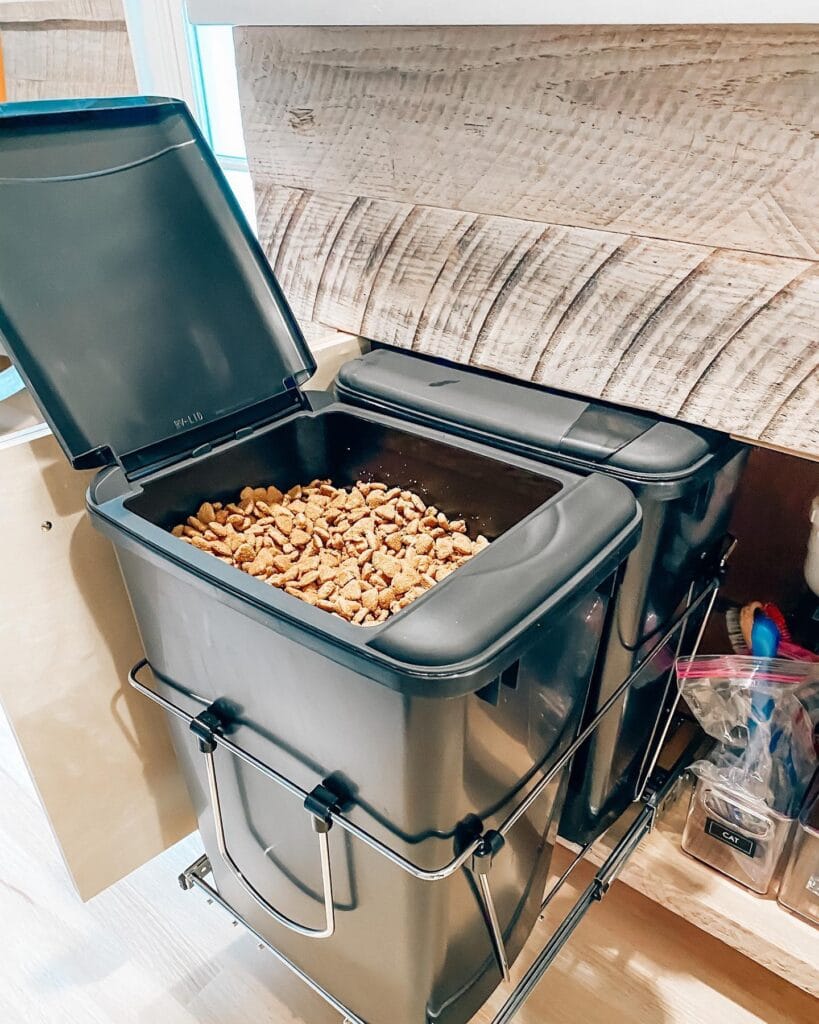
If you’re a dog owner, I’m sure that you’ve been there before. You’re scooping out kibble from a half-ripped bag at 7am, while your dog is circling around your legs like a shark, and somehow half of the food ends up on the floor. Yup, that was my life every day until I saw this setup and immediately sent it to three people.
But here’s another that uses a pull-out cabinet organizer with chrome wire rails mounted inside a lower kitchen cabinet. Two dark charcoal gray plastic bins sit side by side on the sliding rack; one contains dog kibble and the other can hold cat food. (The little “CAT” label on the acrylic container to the right made me smile. I can see the relief of an organization lover!)
Materials & Tools
– Pull-out cabinet organizer with chrome sliding rail system (fits 12–18″ cabinet width)
– Two airtight flip-top storage bins (approximately 33-liter capacity each)
– Reclaimed wood panel for cabinet facing (whitewashed finish shown)
– Small acrylic label holders with printed inserts
– Drill, screws, measuring tape, level
Instructions
Measure the opening of your cabinet. Trust me, this will save you lots of heartache later. Mount the chrome pull-out rail system to the cabinet floor using your drill. Make sure both rails are level side by side.
Once you’ve got both bins on the rack, go ahead and secure it down. You want to make sure the bins clear the door when the drawer is out, and the lids of these bins open toward you, so it needs to be about 4 inches above the door when it’s fully out.
When you’ve got your bin where it feels best, attach the rails with screws. The airtight seal on these bins keeps the moisture out, so your dog’s kibble stays fresher and more digestible. You won’t have to worry about a stale smell coming from your kitchen cabinets.
Attach the reclaimed wood panel to the face of the cabinet. You may need to sand the backside to make sure it is flush.
This would be a great dry ingredient station for crockpot dog food recipes. It’s right beside our kitchen area.
I just stuck a printed label inside each bin, on the side that will be showing, and inside a holder from the dollar store (these actually hold the labels nicely). It only took a few minutes to do it and I liked the end result so much more!
I keep a little scoop inside of each of the bins, so it’s always right there when my girl is staring me down at breakfast.
Prep Time: 15 min | Active Project Time: 45–60 min | Difficulty Level: Beginner
📸 Photo credit: Instagram @cwhome_charlotte
#5: DIY Farmhouse Toy Box Turned Dog Food Storage — The X-Brace Chest That Actually Looks Good in Your Living Room
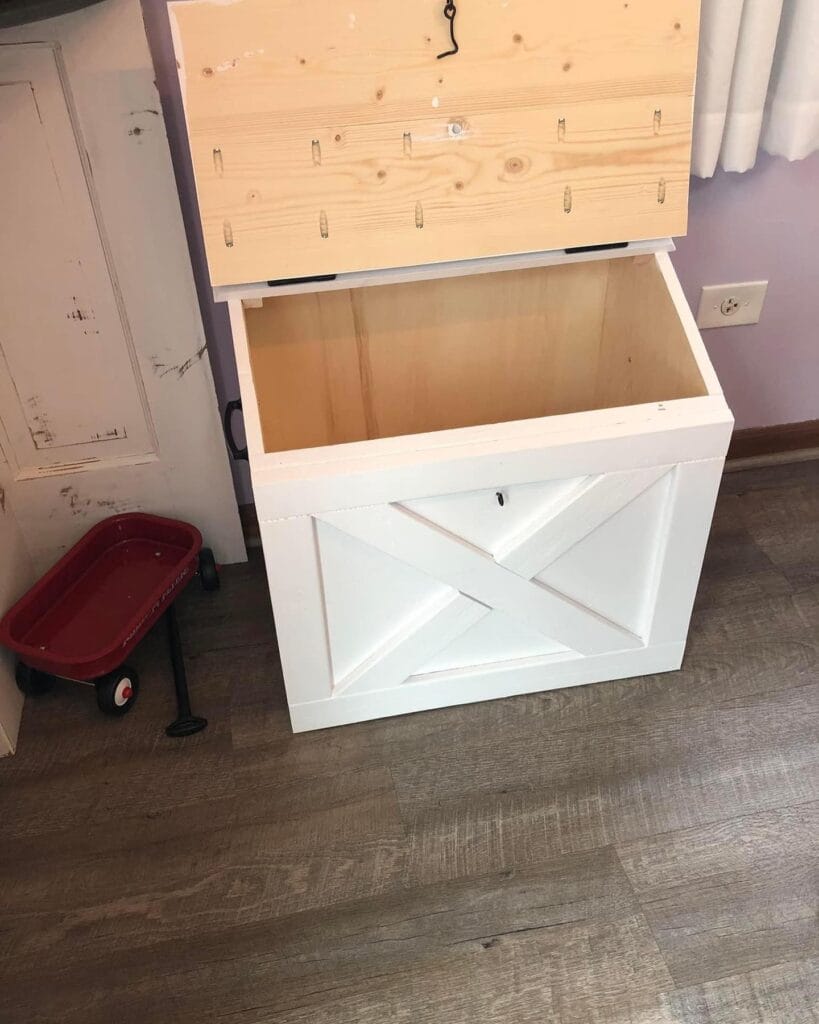
If your dog is one that spins around with excitement at breakfast time and you have a tendency to scoop kibble from a flimsy paper bag that’s already ripping at the seam, then you know this chaos. This stops here.
This white-painted pine wood chest with farmhouse X-brace front panel has a lot of room for food, the lid always stays propped open while you scoop and it looks like something straight off your Pinterest board.
Materials & Tools:
– 1×6 pine boards (sides, front, back, bottom)
– ¾-inch plywood sheet (lid panel)
– Pocket hole screws and Kreg jig
– Piano hinge (full-width, black finish)
– Lid support cable (keeps the lid from slamming on little paws)
– Decorative X-brace trim pieces (cut from 1×2 pine strips)
– White chalk paint + sealer
– Sandpaper (120-grit and 220-grit)
– Wood glue, brad nailer
Prep Time: 30 min | Active Project Time: 4–5 hours | Difficulty Level: Intermediate
### Instructions
Start by cutting the pine boards to size. We made our box to be roughly 24 inches wide by 18 inches deep by 20 inches tall (it fits about 50 lbs of kibble comfortably).
Attach the four side panels to the sides using pocket hole screws drilled at a 15 degree angle. This provides a strong joint that can’t be seen on the outside of the project. Attach the bottom panel the same way.
Next you will cut your 1×2 pine strips into four pieces for the X-brace. You should first dry fit the pieces to make sure that the angle cuts meet each other perfectly at the center. You can set a miter saw to 45 degrees and cut the strips to the correct angle. Glue and nail them flush to the front panel.
Sand it with a 120 grit first, then with a 220. Apply two coats of white chalk paint allowing to dry between coats. Because of the chalk nature of the paint, it’s very forgiving if the dog bowls get scratched or the dog gets muddy paws. Just buff it out with a cloth. It has a flat, matte, farmhouse like look to it.
Attach the piano hinge along the full back edge of the lid. Attach the lid support cable inside the lid. Many people skip this step and then wish they hadn’t when the lid starts to crash down and they are trying to scoop. The lid support cable holds the lid at 90 degrees and keeps your hands free, protecting your dog from the lid crashing down on her head when you are trying to scoop.
Love the lid support cable feature. Keeps the box open hands free so I can scoop with both hands. No more spilled kibble or a safer way to feed my pup!
Seal everything with a food-safe polyurethane topcoat on the interior panels. It makes wiping out crumbs and old kibble dust easy instead of a whole project.
The interior raw pine finish (as shown in the photo) should be left natural. It allows the wooden cupboard to breathe better than a painted finish and prevents moisture being trapped under the kibble.
If you like projects such as this 13 Genius DIY Dog Stuff Every Pet Parent Needs to Try Today! has more great builds you will want to save for a weekend project.
📸 Photo credit: Instagram @jakenjillswoodshop
#6: Built-In Kitchen Island Pet Station with Subway Tile and Raised Bowls
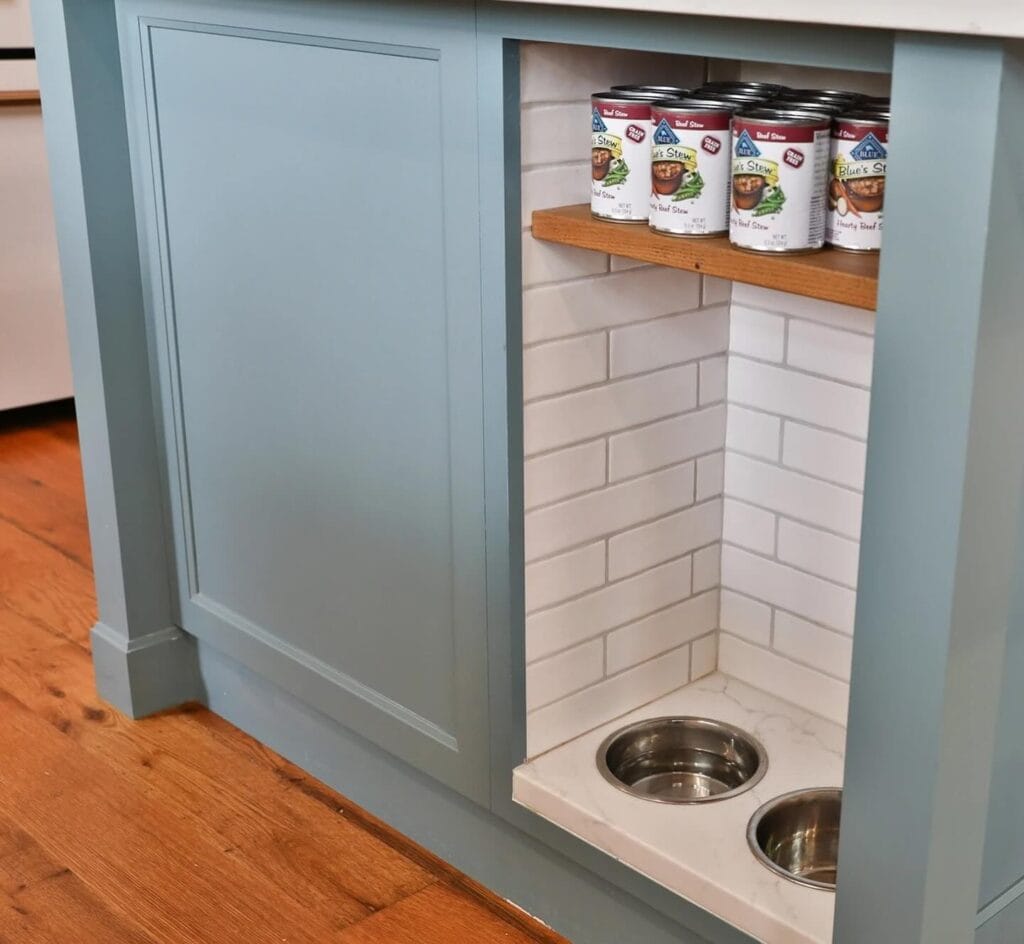
You know those moments when your Golden’s food bowls are sliding across the floor again, and you’re doing a little dance trying not to kick them over while you cook dinner? Yeah, that used to be my life too.
I’m in LOVE with this idea for a built in pet station tucked into a kitchen island. I didn’t even know I needed this until I saw it.
Materials & Tools You’ll Need:
– Blue-gray painted MDF or wood for the cabinet frame
– White subway tiles (standard 3×6 inch) + tile adhesive and grout
– Hardwood shelf board (oak or similar, approximately 3/4 inch thick)
– White quartz or marble-look countertop slab for the bowl platform
– Two stainless steel inset dog bowls (32 oz each)
– Circular hole saw, tile saw, level, sandpaper, paint roller, wood screws
Instructions
So start by cutting out a sort of niche in the bottom of your island. I made mine about 18 inches wide and 20 inches tall. Then frame it out with some 3/4 inch plywood. Next you’ll want to apply your subway tiles to the back and side walls using a regular tile adhesive. Let that cure for a full 24 hours before grouting.
As for the tile sets, I cut the oak shelf board to fit the upper portion of the niche. I sanded it smooth, applied a food-safe wood finish to it, and attached it with hidden brackets. It’ll be my dog food storage area – my can of Blue Buffalo Beef Stew is perfectly within reach.
If you choose to use the bowl platform, simply place your quartz slab on the floor and use a hole saw to cut two circles the size of your stainless bowls. Then, simply drop the bowls in and they’ll stay flush with the underside of the quartz slab. It’s such a nice built-in bowl that there’s no sliding and no hunt for the bowl before you head to the kitchen for your morning coffee!
More than anything, painting the frame to match the cabinets is what will make it look intentional and not as though it was added after the fact.
Plus, built-in storage and raised bowls in one niche keeps your golden’s eating area clean and your kitchen looking good!
Seal the grout with a penetrating grout sealer after it has cured. Dogs are messy and unsealed grout will stain quickly. Also, use epoxy-based paint on the wood frame so that it can be wiped clean without peeling.
If you love projects that make your dog’s life part of your home, the 14 Creative DIY Elevated Dog Bed Ideas You’ll Love is the perfect project.
Prep Time: 1 hour | Active Project Time: 2–3 days (including tile cure time) | Difficulty Level: Intermediate
📸 Photo credit: Instagram @newmarketdesignbuild
#7: Built-In Pull-Out Drawer Pet Feeding Station
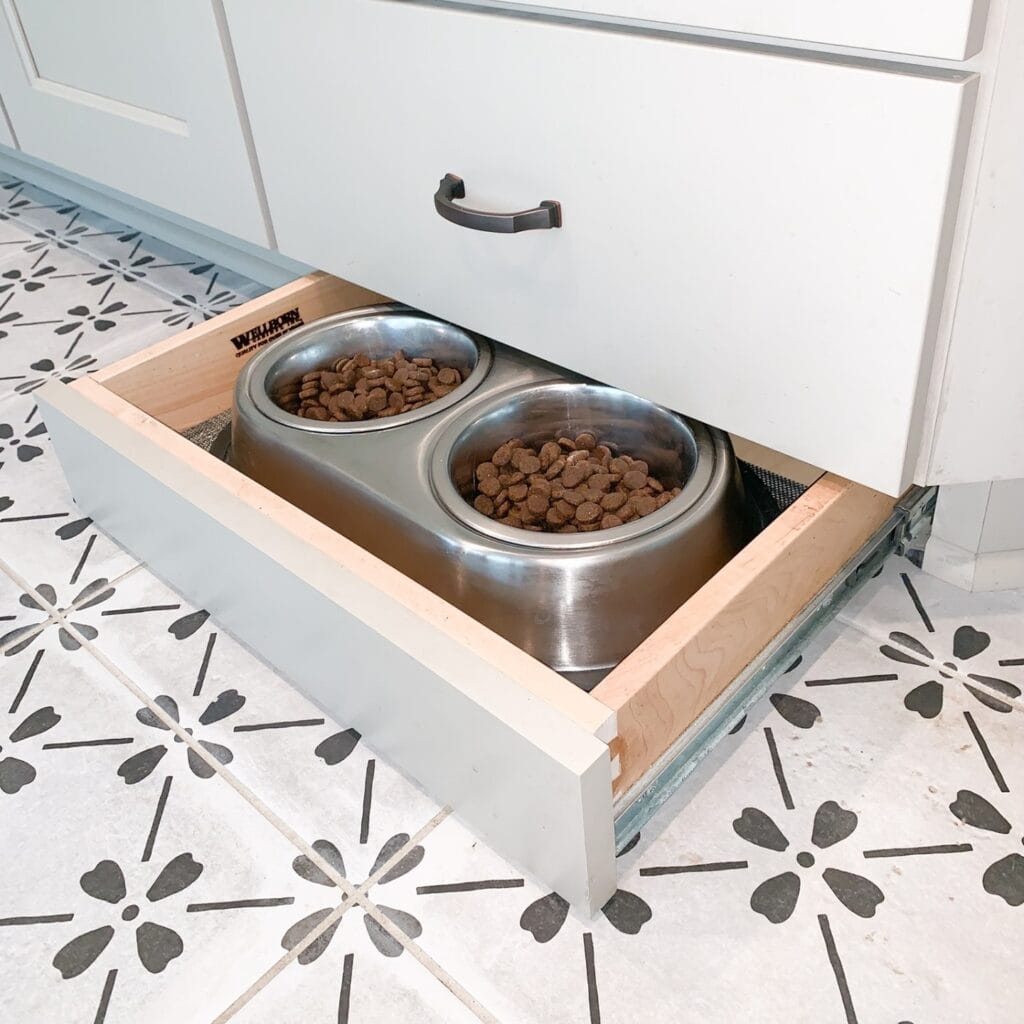
This may or may not have happened to me. Okay, I will admit it- it happened to me. Just the other night I was running around the kitchen and actually tripped over Goldie’s bowls of food! Not only do they make my kitchen look chaotic (the bowls and kibble always end up all over the floor!) but they also get in the way.
This built-in pull-out drawer feeding station is everything.
Materials & Tools You’ll Need:
– 3/4-inch maple plywood (for drawer box sides and base)
– White-painted MDF (for the drawer front panel)
– Two stainless steel raised pet bowls (fitted to sit flush)
– Undermount soft-close drawer slides (22-inch)
– Bronze drawer pull hardware
– Wood glue + brad nails
– Jigsaw (for cutting bowl openings)
– Sandpaper (120-grit and 220-grit)
– Non-slip drawer liner mat
Instructions
Cut the maple plywood into four pieces for the drawer box, two 22-inch side panels and two 14-inch front and back panels. Glue and nail these together to form a rectangle. Attach the 3/4-inch plywood to the bottom.
Now for the easy part: Trace the rims of the bowls onto the base. Using a jigsaw, cut the circles out and the bowls will sit flush in the base. Sand every edge smooth so there will be no splinters. You wouldn’t want your dog getting scratched on the sides!
Mount your soft-close drawer slides at the very bottom of your cabinet kick space and slide your drawer box in. Attach the white MDF drawer front and add your bronze pull.
The pull-out feature hides the bowls when Goldie is done eating which eliminates a trip hazard and creates a kitchen that looks Pinterest worthy.
The liner under the drawer catches any kibble spilled, just lift out and wipe up. My cousin built one of these last spring and said she couldn’t believe she waited so long to do it. Ditto.
What I know you probably have a lot of stuff that your dog likes too put inside your home. So you probably have a lot of different ideas on how to use his crate. So you’ve come to the right place. 14 Stylish DIY Dog Crate Furniture Ideas You’ll Love has so many good ideas that you can use in your home.
Check the height of the kick plate on the inside of your cabinets. Most are less than 3.5-4 inches. You will need at least 4 inches of clearance to put a standard bowl on the inside.
Prep Time: 30 min | Active Project Time: 3–4 hours | Difficulty Level: Intermediate
📸 Photo credit: Instagram @edenandgraydesignbuild
#8: Rustic Wooden Dog Food Storage Box With a Lift-Top Lid
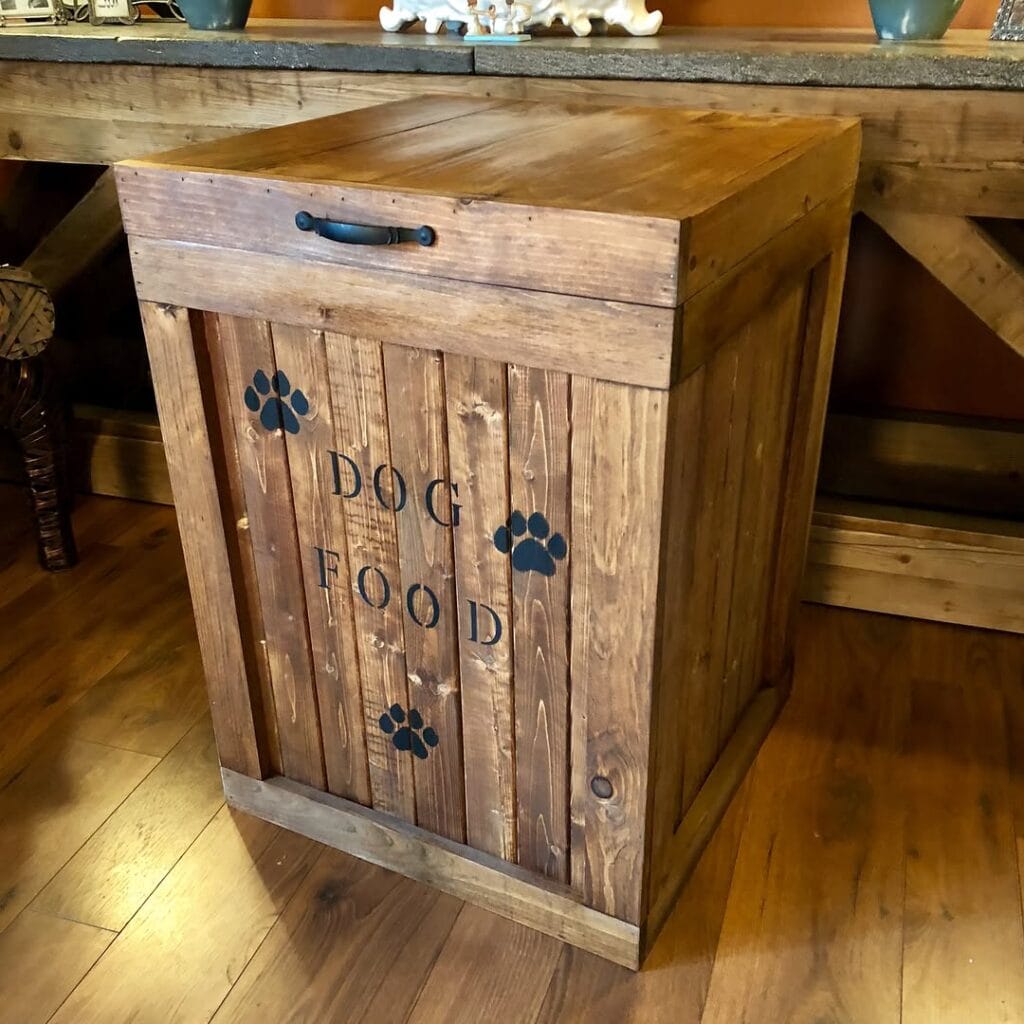
The golden retriever nudges the giant kibble bag across the kitchen floor. It tips over and kibble goes everywhere. Sweeping at 7am in your pajamas, you wonder why you haven’t fixed this yet.
This stained cedar plank lift-top box is the answer.
Prep Time: 30 min | Active Project Time: 3–4 hours | Difficulty Level: Beginner-Friendly
– 1×6 cedar boards (enough for four sides, bottom, and lid) – Dark walnut wood stain – Black letter stencils + black craft paint – Paw print stencils – One black drawer pull handle – Wood glue + 2-inch wood screws – Sandpaper (120-grit and 220-grit) – Polyurethane sealant (food-safe)
### Instructions
First, cut your cedars into the side pieces (4), bottom piece, and lid piece (lid should overhang the box by about ¾ inch on each side). Sand each piece with 120-grit, then 220-grit to get everything smooth for the stain.
I glued the four sides together, and used wood glue along every joint. I reinforced each corner of the box with two-inch screws. I attached the bottom panel the same way. I wanted the wood to look like a vertical plank, as in the image above. To achieve that look, I glued a few narrow 1/4-inch cedar strips on top of the front face panel, and stained it.
Apply 2 coats of dark walnut stain, allowing each coat to dry between coats. Once dry, seal the entire chest with a food-safe polyurethane. Cedar will seal well and will keep moisture and pests completely out of the chest, thus keeping dog food fresh longer.
Attach the black drawer pull centered on the lid. Then stencil “DOG FOOD” down the front panel in black, surrounded by three scattered paw prints.
A little improvement: I put a very thin strip of rubber (it is actually used for making dioramas and stuff) on the inside edge of the lid so it closes a little softer. Now it just closes with a little “thump” instead of clunk.
The sealed lid keeps the kibble fresh, the cedar construction won’t absorb moisture, and the stenciled front would look at home on a magazine spread – not on the top of your utility closet.
Plus, make a small hole near the base of one side panel (as shown in the picture below) to allow air to circulate. If you don’t, you’ll find a musty smell building up inside.
📸 Photo credit: Instagram @sd_wood_designs
#9: DIY Raised Dog Feeding Station With Built-In Storage Box
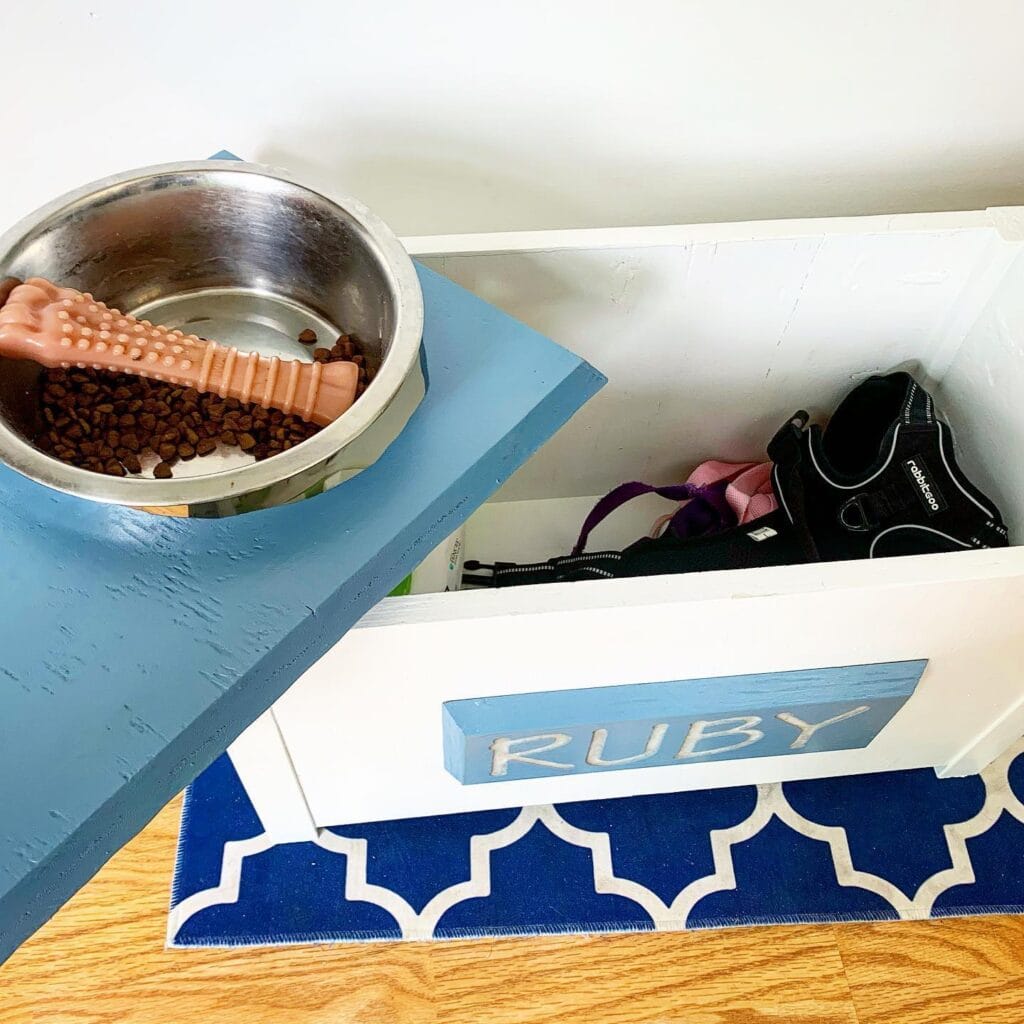
We all know that moment that you’re rushing out the door and you’re stepping over Ruby’s leash, her harness is somewhere under the couch, and the kibble bag just dumped all over the floor again.
This solves all the problems in one shot.
1 inch pine wood boards – white-painted Light blue chalk paint Stainless steel dog bowl – for bowl on the platform Rubber bone chew toy for the bowl area Rabbitgoo dog harness & leash set for reference size Wood letters or stencil for your dog’s name Navy blue Moroccan-pattern rug – size 24 x 36” Sandpaper, wood glue, screws, paintbrush
Instructions
Cut your pine boards into four side panels and one base to make an open-top storage box, 12″ tall x 18″ wide. Sand every edge smooth — splinters near a dog’s nose are bad. Make a second box if you wish.
Glue the box together with wood glue. Screw into each corner of the box. Paint the box white. Let dry and then paint the box with a second coat of white.
I cut a separate, slightly wider piece out of the same blue-painted platform to use as a platform for the bowl. This reduces neck strain for big dogs like my golden, and it’s exactly the kind of small detail that makes a huge difference over time.
If you’d like to add something to the front of your bag (besides dog pictures, of course), a small rectangular plaque can be painted light blue, stencil your dog’s name in white, and attached in the middle of the front panel.
Throw your harnesses, leashes, and spare collars right into the open box. And that stainless bowl of kibble sits right on top of that blue platform.
If you’re anything like me you definitely need a good rug. That way you can put everything on it, then even if you spill your food, it will land on the rug and not your hardwood floor.
Seal all the painted surfaces with a clear matte polyurethane coat. This keeps the chalk paint from chipping when Ruby bumps into it during breakfast.
Prep Time: 30 min | Active Project Time: 3–4 hours | Difficulty Level: Beginner-Intermediate
If your storage box ends up taller than expected, then throw in a small basket for the shorter leashes so that they don’t get buried under the bigger ones.
📸 Photo credit: Instagram @makersbestfriend
#10: Built-In Corner Bench Dog Food Station With Hidden Storage
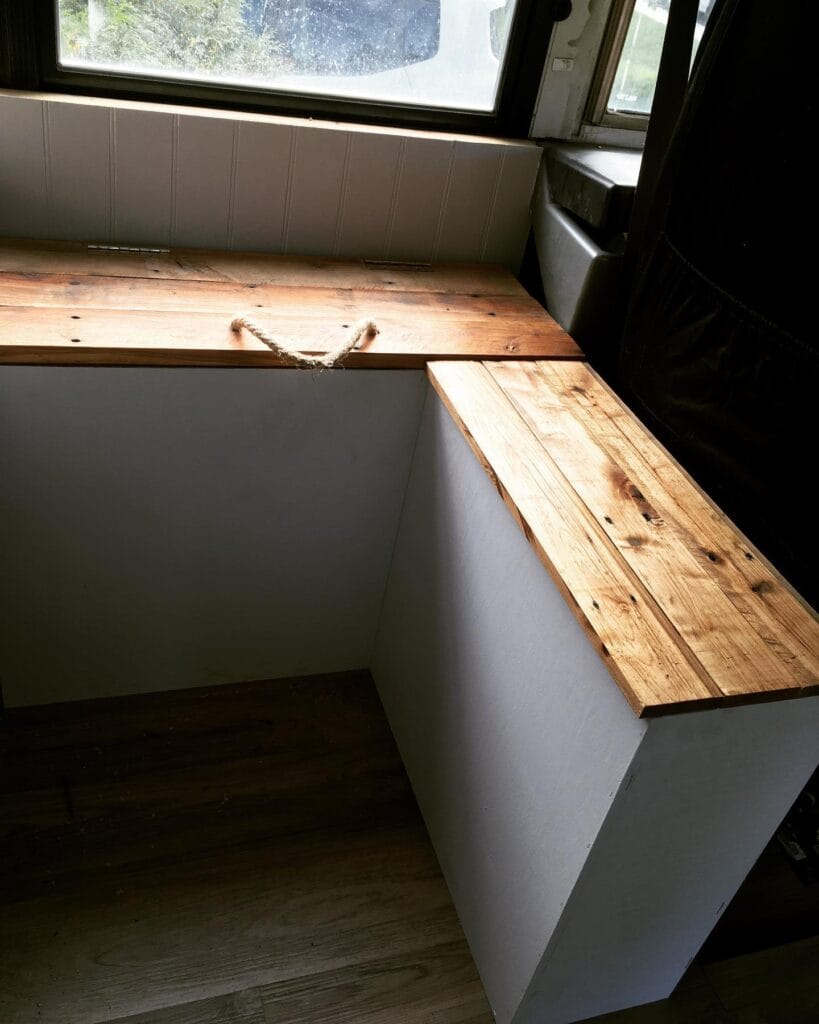
Do you have one of those golden retriever moments where your dog is hungry and you are trying to feed him, and the bag of kibble just tips over? I know I have. Suddenly there is dog food everywhere… on the floor, under the fridge, and in places I won’t find until three weeks later.
Yeah. This corner bench fixes that.
Prep Time: 30 minutes | Active Project Time: 1 weekend | Difficulty Level: Intermediate
What You’ll Need:
– 3/4-inch plywood (for the base box structure)
– Reclaimed wood planks (for the bench top — cedar or pine work best)
– White paint or primer (for the exterior panels)
– 2-inch piano hinge or two standard cabinet hinges
– Thick jute rope (for the pull handle)
– Wood stain in a warm walnut or honey tone
– Drill, screws, sandpaper, measuring tape
– Beadboard paneling (optional, for the wall backing)
### Instructions
First build your L-shaped box frame out of 3/4-inch plywood, cutting two rectangular pieces that meet at the corner. Attach the pieces with 2-inch wood screws, building up the frame from the floor to a height of at least 18 inches, which is deep enough to fit a dog food bin or airtight container inside.
Sand the edges of each piece of plywood so that they do not have splinters. Keep plywood from the dog’s feeding area.
Paint the outside panels matte white and let them dry completely before moving on. I did two coats of paint and I’m so happy I did. They look super clean and hold up well to muddy paws and food spills.
Measure and cut your reclaimed wood planks to fit on top of the L-shaped top. I chose to stain them a warm colour that would contrast well with the white base. The lid of this bin is placed on top with piano hinges at the back. I love that I can open the top with one hand whilst scooping with the other without having to bend or wrestle with a clunky bin!
Drill two holes in the front of the lid and thread a loop of jute rope through and tie it underneath to the other side to hold the rope in place as the handle.
If you are mounting your bench under a window like in the picture below, I would also add beadboard panels to the wall behind the bench. This gives the bench a cottagey feel.
Store kibble in the airtight bins hidden inside the box to keep it dry and contained, so there will be fewer digestive issues for your dog — and fewer pantry smells for you. Built-in storage keeps your feeding area cleaner. Dog will be happier.
Finish the wood top with a food-safe polyurethane coat so that spills are easily wiped away.
Screw the base to the wall studs at the back for extra stability, especially if you’ve got a big golden dog who likes to lean on everything (and we both know she is).
I like to use it as extra seating when I have friends over, so it’s definitely one of the hardest working pieces in my tiny apartment.
📸 Photo credit: Instagram @the_muss_bus
The Airtight Secret That Keeps Kibble Fresh Way Longer Than You’d Think
What’s the number one mistake I see people making when storing homemade dog food? They focus too much on the container and not enough on the seal.
That super cute wooden crate or upcycled tin may look great on your Pinterest board, but if air gets inside, your kibble can go stale in no time. Worse, though, is if your dog’s food gets rancid. Your golden retriever will turn her nose up at it, and you may not even know why she’s suddenly being so picky.
A trick I’ve started doing is to put a food-grade mylar bag inside my container before filling it. I started doing this when my sister’s dog got sick from oxidized food. The bag keeps moisture and oxygen out, even if your container isn’t completely airtight.
Also, shouldn’t you store your dog’s kibble in the garage? I know I would think temperature changes would break down fats faster than anything else.
The container is decoration. The seal is the job.
If you’ve decided to take matters into your own hands, to wash your dog, the 7 Creative Ideas for Your DIY Dog Washing Station situation deserves just as much attention.
Your Couch Deserves Better — And So Do You
If you’re feeling overwhelmed, just pick one product and try it out. It doesn’t have to be your whole house, but the couch cover or a door mat might be all you’re ready to tackle. Your golden is not slowing down, and the mess is not either.
But I had to start somewhere and I started with the sofa protector. And that one win gave me the motivation to keep going.
Even small changes add up fast. And if you want to take it one step further, DIY dog feeding station ideas can make your pet setup look so darn Pinterest-level cute.
Today I want to know what’s the one spot in your home your dog has completely taken over? 🐾

Amr Mohsen is a software engineer who traded his keyboard for a leash — at least on weekends. His love for dogs inspired him to share what he learns as a dog owner and enthusiast, bringing a detail-oriented, research-driven perspective to every article he writes. If it’s about dogs, he’s probably already looked it up twice.