Your golden retriever ran into the backyard like a tiny, wet hurricane last summer and ruined your Pinterest-perfect patio.
I hate getting home to find muddy paw prints on the deck. And there’s nothing worse than sitting down and smelling that soggy dog smell baking into the cushions. And then my girl just sitting there, staring at me, tongue out. As if I had no idea what she was up to.
I’ve been there. My cousin’s lab mix turned her entire yard into a slip and slide and we just stood there watching him and thought, “there has to be a better way!”
Turns out, there is.
A DIY dog pool is the perfect place for your dog to cool off and have fun splashing around – without ruining all the hard work you put into your awesome new outdoor space.
And the best part is that these 10 designs actually look really good. They might even turn your backyard into an eyesore.
#1: DIY Pool Ramp for Your Golden Retriever (The One That Actually Works)
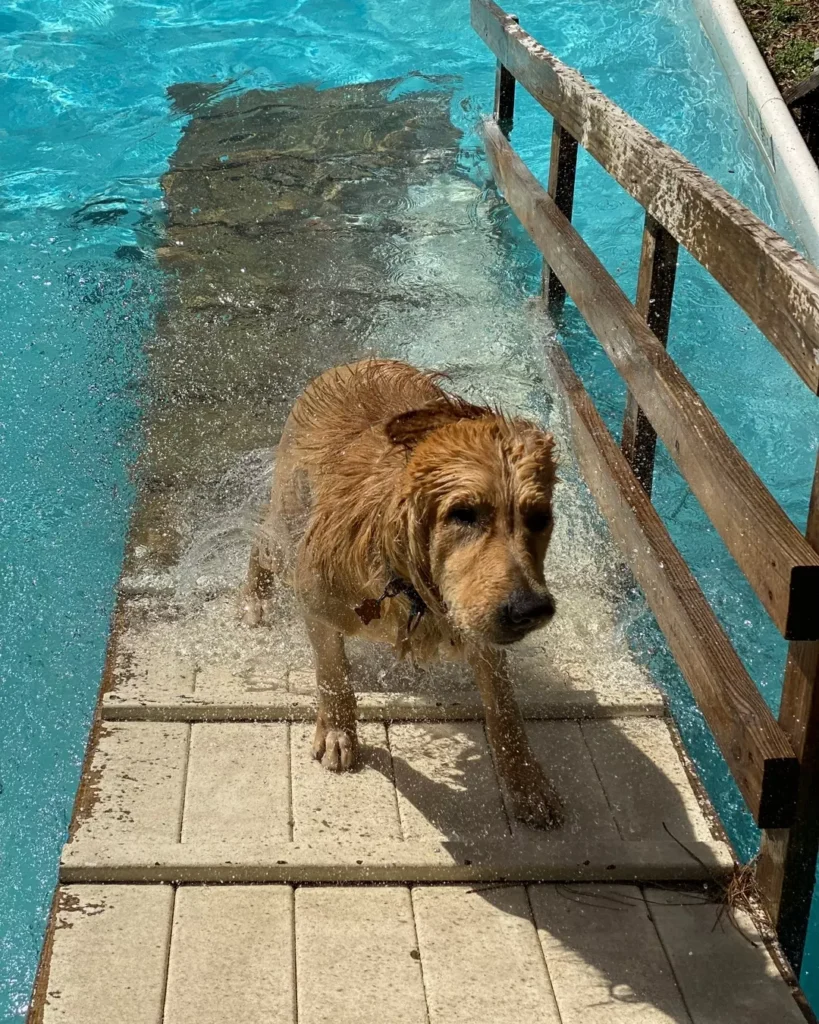
I’m sure you all know what it’s like to have your female dog finally get out of the pool and immediately shake herself dry on your freshly painted deck. Then she’s slipping around trying to get out of the pool because the edge is just not made for dogs. This happened to my friend’s golden, Maple, last summer. Maple kept scratching the pool liner trying to get out. Chaos!
This wooden dog pool ramp is the fix.
Materials & Tools You’ll Need:
– 2×6 cedar planks (cut to 48–60 inches long)
– Non-slip rubber stair treads or grip tape strips
– 4 metal L-brackets (galvanized, rust-proof)
– Wooden handrail posts (1.5-inch diameter, 24 inches tall)
– Exterior wood screws (2.5-inch)
– Wood sealant (waterproof, clear)
– Drill, saw, measuring tape, sandpaper (80-grit)
Prep Time: 30 minutes | Active Project Time: 2–3 hours | Difficulty Level: Intermediate
### Instructions
Cut down your cedar planks so that they fit the width of your pool entry (usually 48 inches for backyard pools).Sand all edges with an 80-grit sandpaper, so that it will not hurt your dog’s paws.
Put the three planks side by side so that they make a walking surface that is 14-16 inches wide. Screw these planks together with the L-brackets underneath. The wood is dense enough to hold a weight up to 100 pounds, so even a chunky golden shouldn’t be a problem.
Attach the handrail posts to the sides of the ramp with exterior screws angled slightly inward. This will keep the ramp from wobbling when she’s charging up it (she WILL), but you knew that. Once the frame is together and solid, apply two coats of waterproof wood sealant and let it cure for 24 hours.
I added some non-slip rubber treads to each of the planks to give her traction when getting in and out of the tub, which is good for her joints as well as my nerves. As she gets older I’m happy to report that the ramp has been a wonderful benefit to her joints.
Angle the ramp about 30-35 degrees into the water. If you go steeper she won’t go down it. If you go too flat, it’ll float. I use a bungee cord or pool hook to anchor the deep end of the pool.
If you love building useful things for your dog then 13 Genius DIY Dog Stuff Every Pet Parent Needs to Try Today! has some really good ideas worth trying out.
Cedar naturally resists moisture and warping so if you reseal it once a season, it will last for years. And watching her trot up the ramp like she’s some kind of royalty is the best feeling.
📸 Photo credit: Instagram @atlanta_dog_trainer
#2: Stock Tank Dog Pool (The Backyard Upgrade Your Golden Has Been Waiting For)
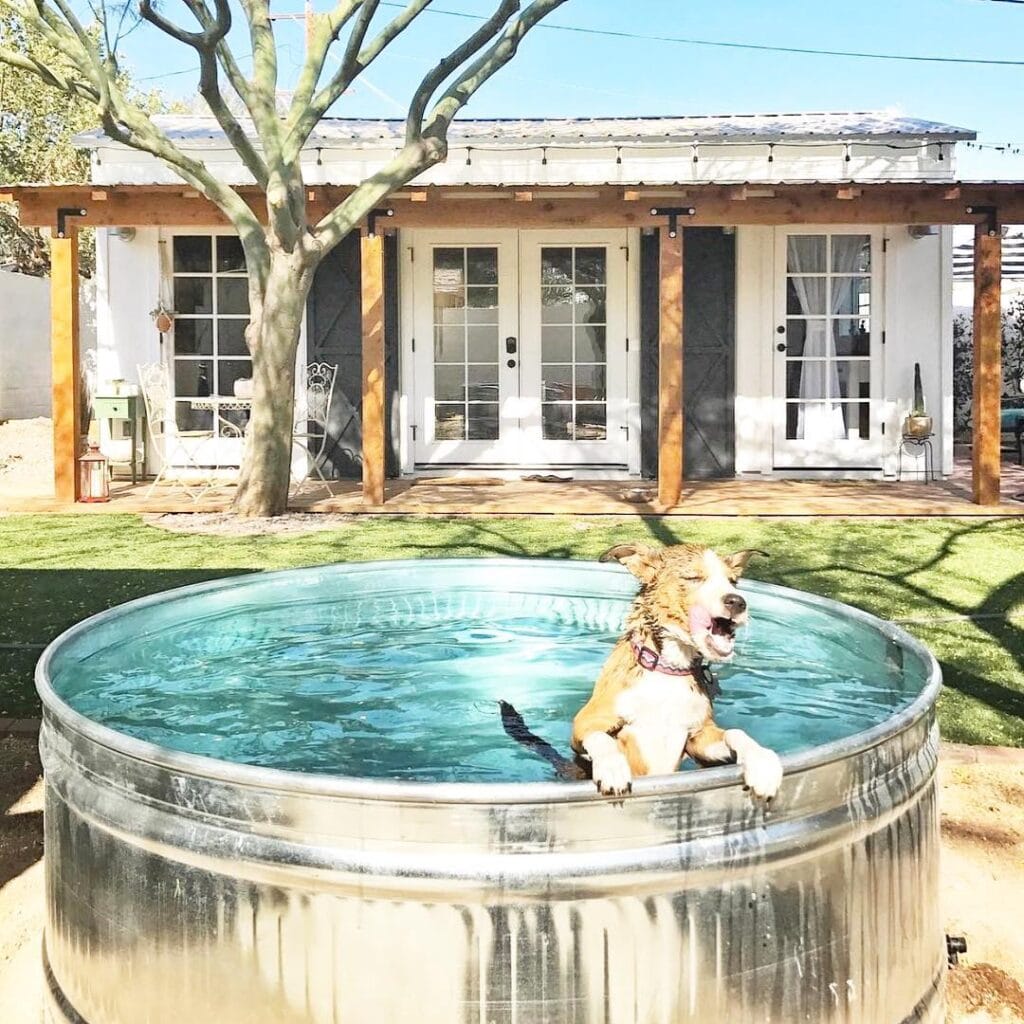
Your dog is soaked. You have muddy paw prints all across the patio. Your dog is panting and you don’t have time to be chasing them with a garden hose all day. I have been there too.
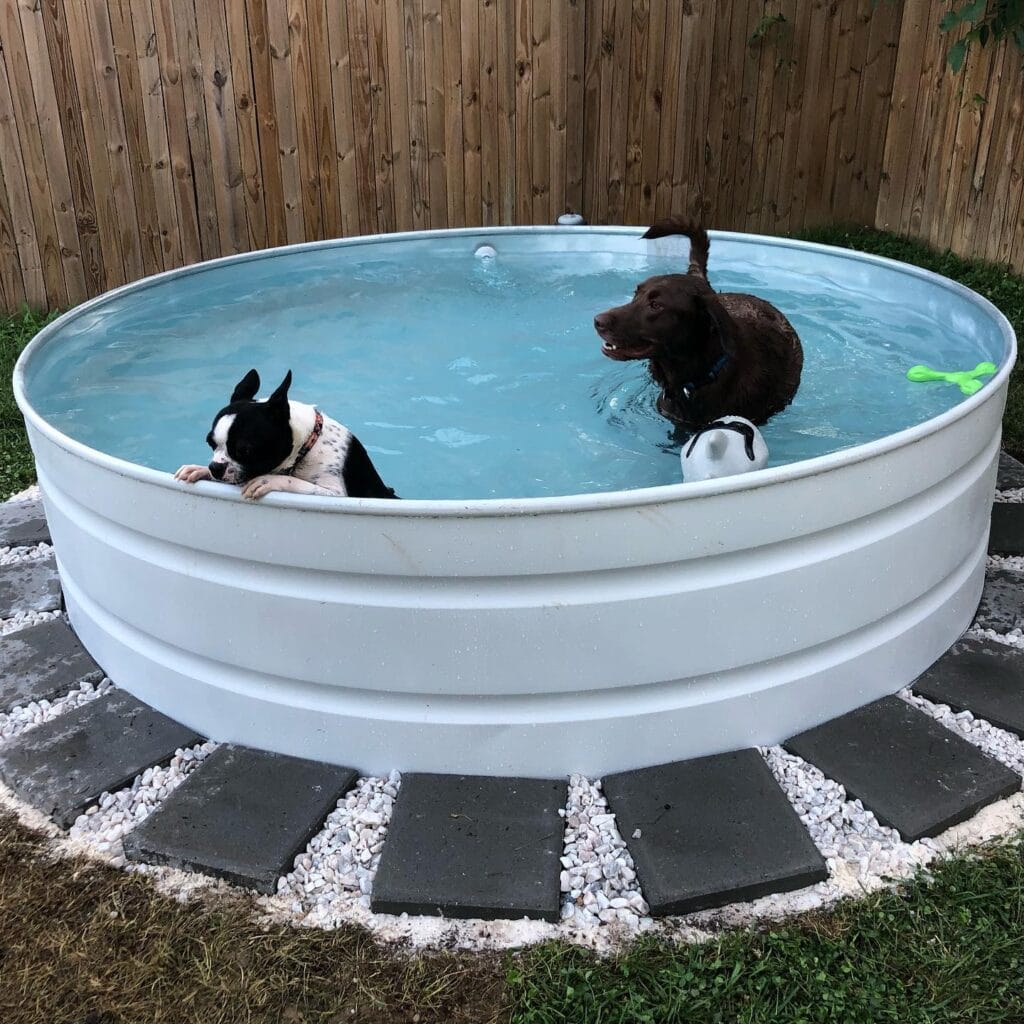
I feel like this galvanized steel stock tank pool is giving me all the Pinterest feelings. And it’s one of the easiest DIY dog projects I’ve done.
Materials & Tools:
– 8-foot diameter galvanized steel stock tank (roughly 2 feet deep)
– 1/2-inch drill bit for drainage
– Garden hose
– Non-slip rubber mat (cut to fit the bottom)
– Hose spigot attachment (optional but worth it)
Instructions
Drill a 1/2 inch drain hole near the bottom of the tank on one side. This lets you empty and refill without having to haul anything heavy. The tank pictured is resting on a flat, grassy surface. The grass helps to buffer any shifting of the tank.
Put your non-slip rubber mat on the bottom of the tub before you fill it with water. This way when your dog jumps in, they won’t be scrambling around the tub or panicking. Fill the tub with your garden hose to about 12-14 inches of water.
It’s a great system because the galvanized steel keeps the water noticeably cooler than plastic, so you won’t see your golden ducking out after two minutes.
I keep a towel and DIY dog accessory station nearby, so cleaning up after the pool is a breeze.
Scrub the inside with white vinegar weekly to avoid any algae buildup on the sides of your dog’s bowl. No chemicals!
Prep Time: 15 minutes | Active Project Time: 30 minutes | Difficulty Level: Beginner
📸 Photo credit: Instagram @chiselbuilt
#3: DIY Wooden Frame Tarp Pool — The Backyard Splash Zone Your Dog Will Lose His Mind Over
Prep Time: 1 hour | Active Project Time: 2–3 hours | Difficulty Level: Beginner-Friendly
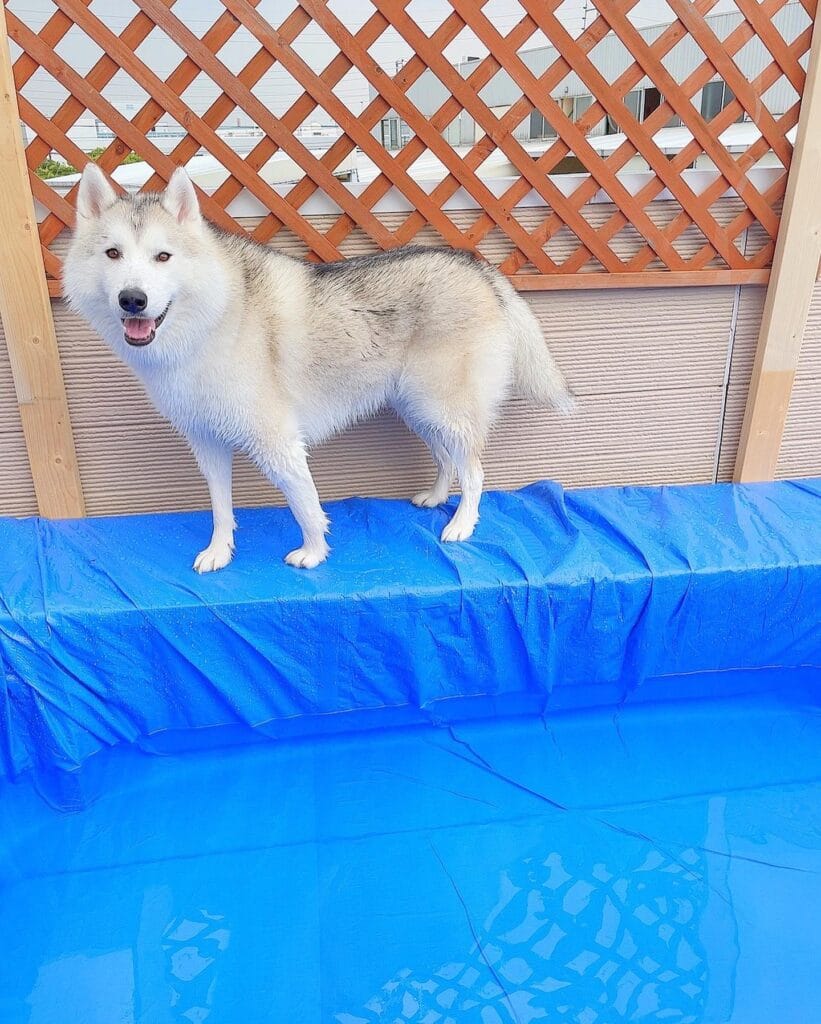
Yeah, so if your golden is panting so hard in July that you feel downright guilty looking at him… that was me with my cousin’s husky last summer. He kept pressing his nose against the sliding door as if to say, “please, I’m melting.”
This is the one we built and it’s exactly what you’re seeing in the photo above. A cedar wood lattice frame wrapped around a simple pool liner that we made from a heavy-duty blue polyethylene tarp. It looks Pinterest worthy, but it can be finished in a weekend afternoon.
Materials & Tools:
– 2×4 cedar or pine lumber (four 6-foot sections for the frame base)
– Pre-built cedar lattice panels (4×4 feet, two panels minimum)
– Corner post lumber — 4×4 inch, cut to 4 feet tall
– Heavy-duty blue poly tarp, minimum 8×10 feet (the thicker the mil, the longer it lasts — go 6 mil or higher)
– Outdoor wood screws (3-inch galvanized)
– Staple gun with heavy-duty staples
– Waterproof outdoor wood sealant
– Drill + saw
– Measuring tape + pencil
Instructions
Build your rectangular base frame using the 2×4 lumber. Screw the four sections into a 6×4 foot rectangle lying flat on the ground, which will become the footprint of your pool. Secure a 4×4 corner post upright at each corner, drilling two screws into each post from below.
Attach your lattice panels to the outside of the corner posts (on the long sides). This gives the tent that more structured look, but also acts as a wind block so that your dog’s splash zone does not get too large. Seal all the exposed wood with your waterproof sealant and let it cure.
I put my liner on before the water. Just draping the blue poly tarp in loosely on the inside of the frame, then stapling the excess to the top edge of the frame, works great. The weight of the water pulls the tarp tight and smooth.
Fill it with 4-6 inches of water, this is a great depth to let the dogs wade around in to cool off without the risk of drowning. This also makes it a great pool to leave out for a solo playtime for your dog since he won’t worry about getting in over his head.
Make sure that you cut your tarp a little oversized. The excess tarp that is folded over the edge of the frame will act as a built in splash guard. Your deck stays way dryer.
📸 Photo credit: Instagram @bokumarley
#4: The Bright Green Above-Ground Dog Pool That Actually Works
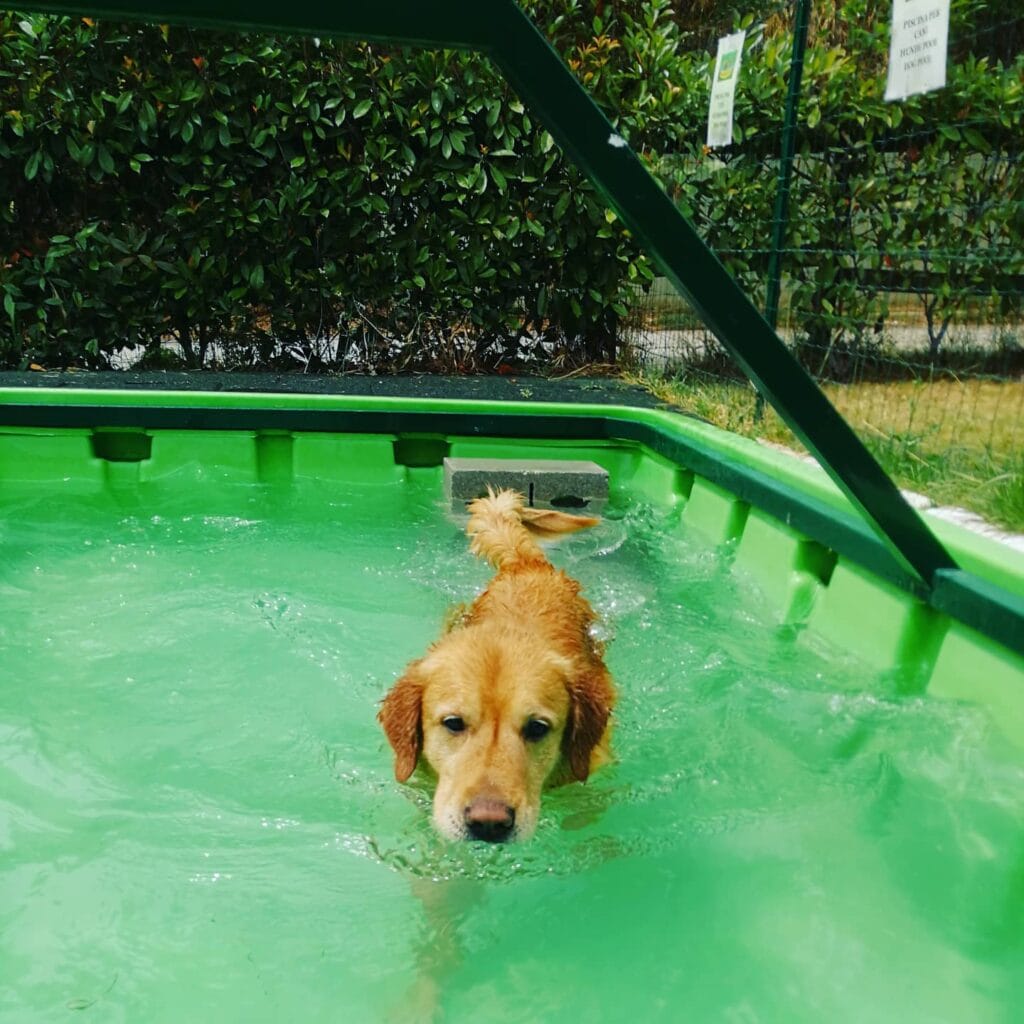
Your dog just got back from the park and she is S-O-A-K-E-D. Not, “cute damp,” mind you, but soaking wet, shaking water everywhere, and you watch in slow motion as it hits your entryway rug.
Its a bright lime-green, above-ground dog pool. It’s made from a rigid plastic stock tank, and has a built-in entry ramp, so it gives your girl a special splash zone without turning your living room into a waterpark.
Materials & Tools:
– Large rigid plastic container (approx. 47″ x 31″ x 16″) in UV-resistant green
– Metal ramp frame with anti-slip grip surface (steel, powder-coated green)
– Rubber edge trim for pool rim
– Garden hose for filling
– Waterproof sealant
– Power drill + screws
Instructions
Put the container on a flat grassy area out of direct afternoon sun. Attach the metal ramp frame to the short end of the pool using a drill. The frame should be at a slant. This should be about a 30 degree angle. It allows your dog to walk into the pool without jumping in. Add some rubber trim around the top edge of the pool so the plastic will not catch on the belly of your dog.
Fill up the tub to the point that there are 4 to 6 inches of water in the bottom. This way, the small golden will be able to cool off in the tub without getting too cold.
It’s also great in that there is no hesitation in getting in, which in turn means she will use it, which means my floors will stay clean!
Change the water every 2-3 days. Add a splash of white vinegar to keep algae from forming on the green walls.
📸 Photo credit: Instagram @letorridelgarda
#5: The “Paws & Goggles” Inflatable Dog Pool Party Setup
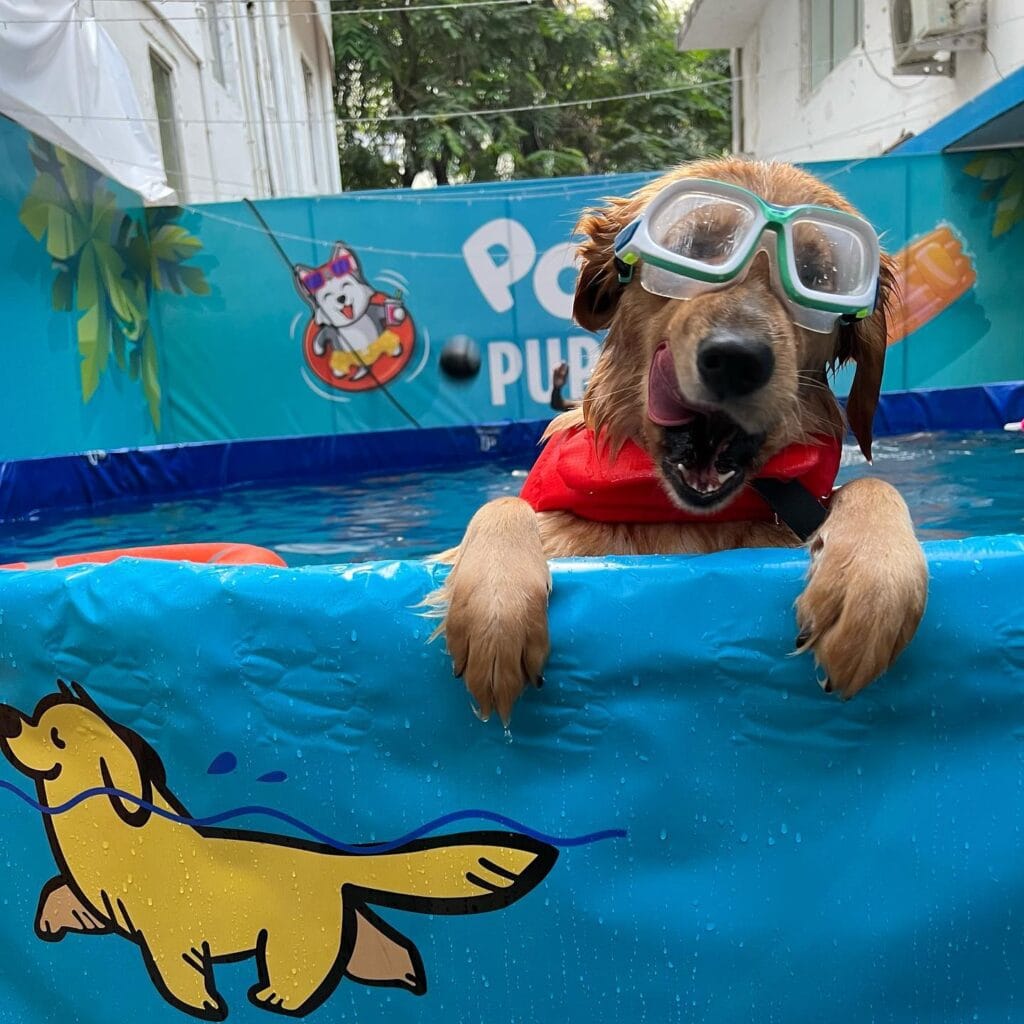
Your dog just body-slammed the kiddie pool and water went everywhere – the patio, your sandals, your iced coffee. And your dog is looking at you as if she did nothing wrong.
That is a very good set up.
. Materials & Tools: . Blue inflatable rectangular pool (approx. 8ft x 5ft x 18in) Red nylon dog life vest with chest strap and handle Child-size swim goggles (green-framed, 4-5in wide) Waterproof pool banner/backdrop for decoration (tarp-weight vinyl) Cartoon dog pool decals or iron-on stickers Inflation pump (electric pump saves your lungs) Garden hose.
Instructions
Step 1: Lay the pool flat on a level surface. I do mine on the grass. It gives her a better grip to climb out. Inflate the pool with an electric pump until the sides feel firm but not tight. I fill mine to about 80% full. Any more than that and the sides start to collapse when my 60 pound golden gets excited about playing.
Fill with water to about 10-12 inches deep. Don’t worry about drowning. They won’t go under water.
Attach the red life vest to your dog before she gets in. The handle on the front will make it easy for you to lift her mid-panic, trust me, you’ll need to. Slip the goggles over her head. They do not have to be watertight as they are mainly for the adorable factor (eye protection).
Attach the vinyl backdrop to the edge of the pool using zip ties. I added some cartoon dog decals to the front panel, which makes it that much more Pinterest worthy.
Real talk: keep a dry towel folded near the edge of your bed. the moment she decides shes done she will shake right on you.
Prep Time: 15 min | Active Project Time: 30 min | Difficulty Level: ⭐ Easy
Our Shallow Fill tubs are made to keep the water inside, making for less of a mess on your patio and more time for you to enjoy the afternoon!
If you have a dog that is a little on the nervous side about water, it is best to start with just six inches of water and build up. It usually only takes two or three sessions before a dog stops treating the pool like a predator.
📸 Photo credit: Instagram @poolpupper_petpark
#6: The Kiddie Pool Splash Zone (A.K.A. Your Dog’s New Favorite Summer Spot)
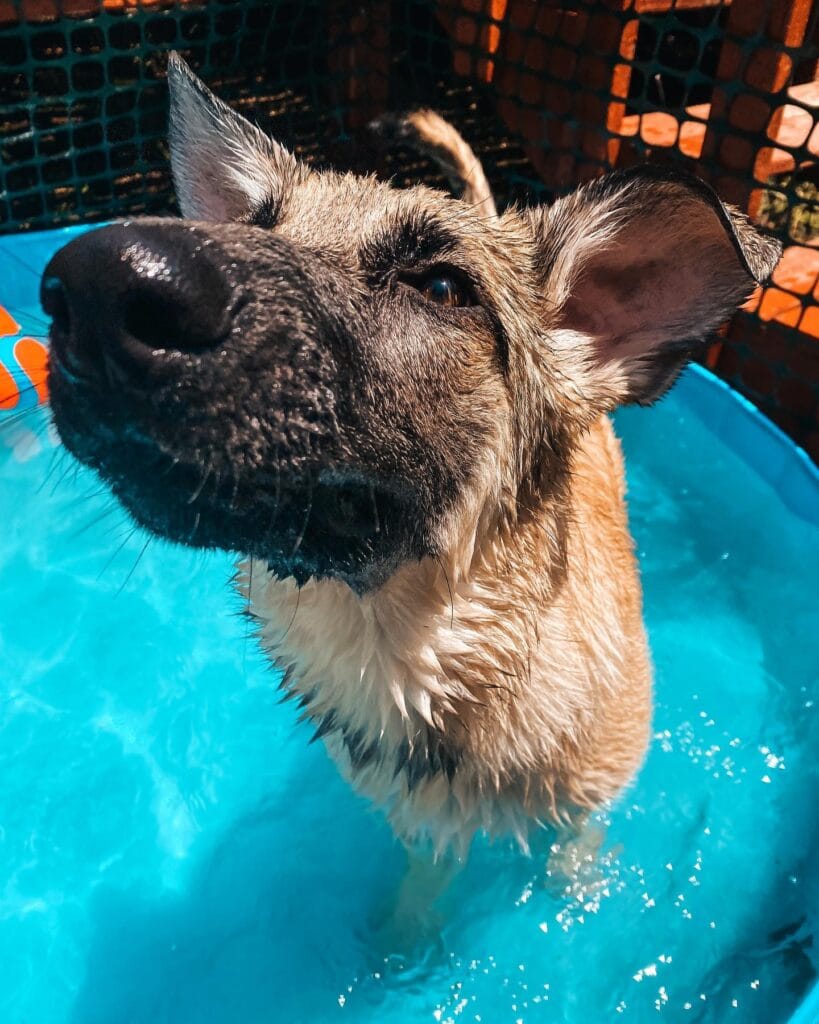
At least once a week I spend a few minutes cleaning up the mud left behind by my golden after he soaks himself while racing around the yard. The mud spots are usually left in just the right spot so I have to stand on top of the couch to reach them, which just so happens to be made of white linen.
Was it last July? My neighbor literally zip tied a tarp to her fence trying to contain the splash zone. I felt that in my soul.
This setup? So much better.
Prep Time: 15 minutes | Active Project Time: 20 minutes | Difficulty Level: Easy
What You’ll Need:
– Blue hard plastic kiddie pool (we’re talking the classic 60-inch diameter kind — grab it at Walmart or Target)
– A garden hose
– A mesh safety fence (the dark green kind, staked into the ground around the pool — this is the real game-changer)
– A colorful floating toy (Nemo vibes are chef’s kiss)
– Optional: a rubber mat underneath for grip
### Instructions
First, find a level place in your yard. The more shaded the better, because water can get hot in the sun. Set the pool down and turn the hose on until the water level reaches about 8-10 inches.
3. Put your green mesh fence around the outside of the pool in a loose circle. This gives your dog a splash zone to play in. The mud and chaos will be contained to the inside of the fence, therefore you will not be tracking mud across your patio and you will actually enjoy watching them play instead of dreading what a mess they are going to make when they are finished!
Give the floating toy a toss before your dog enters the tub. This builds excitement and will make them more comfortable entering on their own.
And let them figure out how to get it on their own the first time. German Shepherds and goldens especially tend to step into it slowly, sniff it all over, then just go nuts, which is the best thing you will ever see in your life.
Change the water every couple of days. Rinse the pool with a little white vinegar (to avoid the algae growing along the plastic rim).
If your dog loves this kind of active outdoor play then this 7 DIY Dog Agility Course Ideas for Fun will be the perfect next step to burn some extra energy.
📸 Photo credit: Instagram @therealpupsofga
#7: DIY Wooden Frame Pool With a Polka Dot Tablecloth Liner
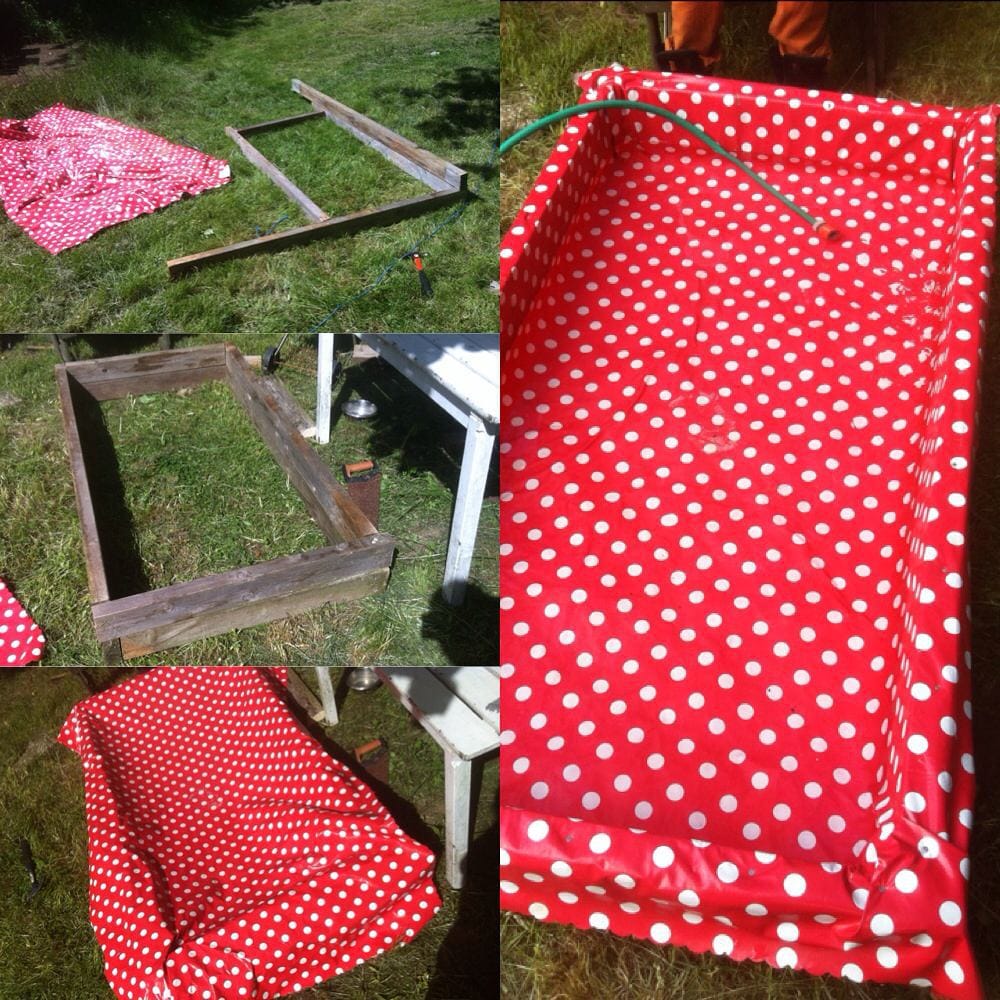
It was a scorching July afternoon, the sun’s rays beaming down upon my dog who was panting like a furnace and staring at me with her sad, melting eyes. I had a similar moment with my dog last summer and wasn’t in the mood to spend $200 on a plastic kiddie pool that would crack before August.
Prep Time: 20 min | Active Project Time: 1 hour | Difficulty Level: Beginner
– 4 pieces of 2×6 lumber (two at 48″ and two at 30″)- Wood screws (3-inch) – Red and white polka dot vinyl tablecloth (waterproof, at least 60″ x 84″) – Garden hose – Power drill – Staple gun
### Instructions
Lay the pieces flat on the grass, and screw them into a rectangular frame, with the 48-inch pieces forming the long sides and the 30-inch pieces forming the ends. Remember to drill pilot holes so the wood doesn’t split.
Once your frame is up and sturdy, drape the [http://www.pinterest.com/pin/55245469057554798/ vinyl tablecloth] generously over the inside of the frame, pushing it into the corners and pulling it taught on the outside edges. Staple the excess down along the outside of the frame to keep it in place. Now when your Golden gets a splash, he will get a real splash – not just a little puddle.
Stick your garden hose in and fill it up. It stays pretty well together once all the water is inside.
If any of the tablecloth is hanging beyond the staples, trim it off so your dog doesn’t get his paw stuck in it when he steps on it. Also, I reinforced the four corners with extra staples so that I wouldn’t have a slow leak in the middle of the splash.
📸 Photo credit: Instagram @xanthinka
#8: Stock Tank Pool With a Built-In Wooden Deck (The Backyard Upgrade Your Dog Deserves)
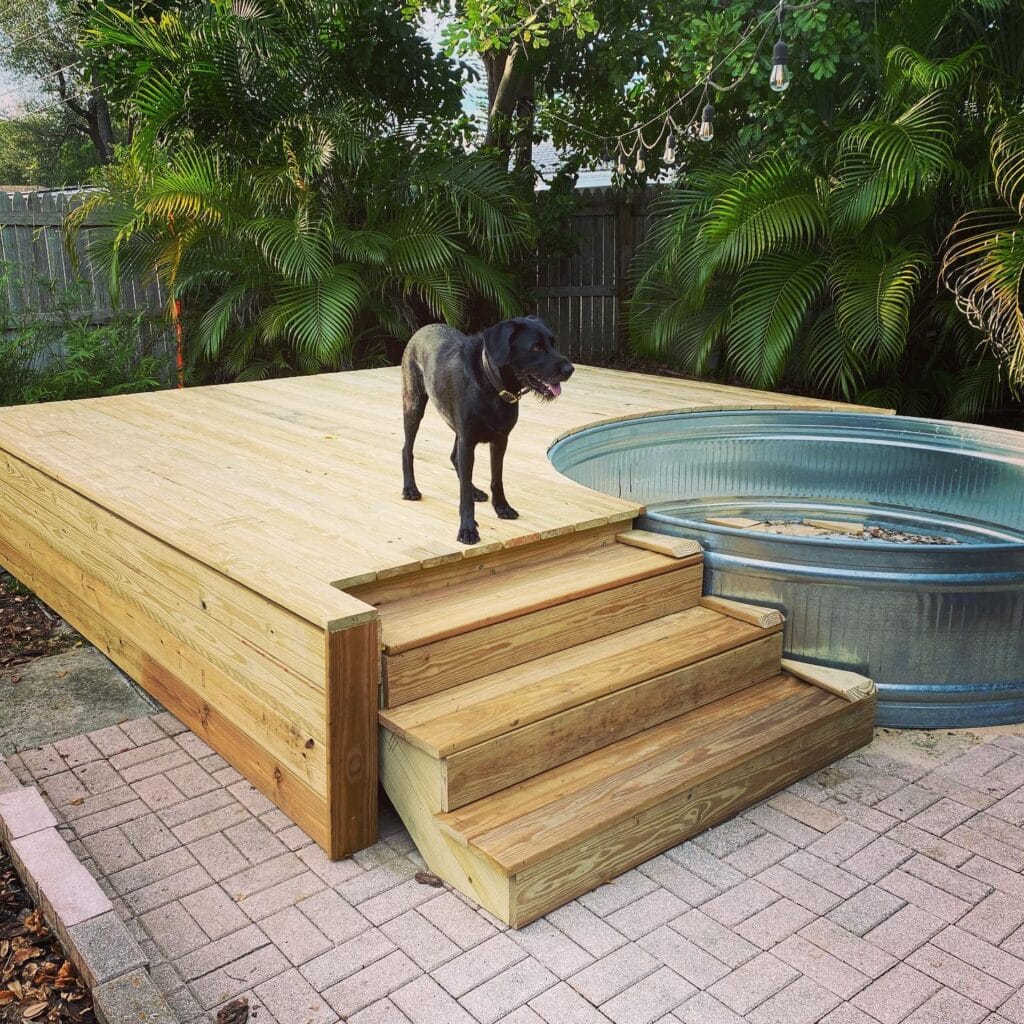
If your golden is desperate to cool off, circling the yard, panting and you just stand there with a hose and think, “This can’t be the solution”!
Yeah. Been there.
Prep Time: 2–3 hours | Active Project Time: 1–2 days | Difficulty Level: Intermediate
Materials & Tools:
– 8-foot round galvanized stock tank (the kind used for livestock — rust-resistant and seriously sturdy)
– Pressure-treated 2×6 lumber for the deck frame
– 5/4 x 6 pressure-treated deck boards for the surface
– Concrete pavers for the base layer
– 3-inch exterior wood screws
– Circular saw, drill, and level
– Gravel for drainage inside the tank base
– String lights (optional but chef’s kiss)
Instructions
First of all, you need to lay your pavers flat and level. This is often the step most people rush and the step which may cause the deck to wobble forever.
Once the paver base is solid you can build a rectangular frame out of 2×6 boards to wrap around three sides of your stock tank. My neighbor did this last year and he said that that was the hardest part…getting the frame tight against the tank, but that is what makes it look intentional rather than thrown together.
If you have a 5/4 x 6 deck boards put them on the frame and cut a curved edge where the tank will sit flush into the deck (it only takes 20 more minutes to cut that curve. Trust me).
Secure all boards with 3-inch exterior screws, leaving a gap between boards for drainage. Then attach the 3-step staircase on the front corner with the same lumber. I know you all think the staircase is cute, but it’s also helping your dog. She isn’t using a ramp and a low entry isn’t causing her hips to crash into the edge. In the winter, my girl swims every day so the less jumping in, the better!
Fill your tank, hang some string lights, and call it a day.
As you can see, the combination of pressure-treated wood and galvanized steel tank means that it won’t warp or rust out by September. Features-wise, the built-in deck provides a dry landing zone so there are no muddy paw prints being dragged straight into your house after swim time.
If you love backyard builds like this, I think you’ll like these 15 DIY Dog Playground Ideas for Your Backyard as well.
Seal the wood with a good outside grade wood sealant before you fill the tank. This will help keep out moisture and keep the fresh lumber color from turning gray quickly.
📸 Photo credit: Instagram @gingerbeardman1986
#9: DIY Wooden Ramp Entry Above-Ground Dog Pool
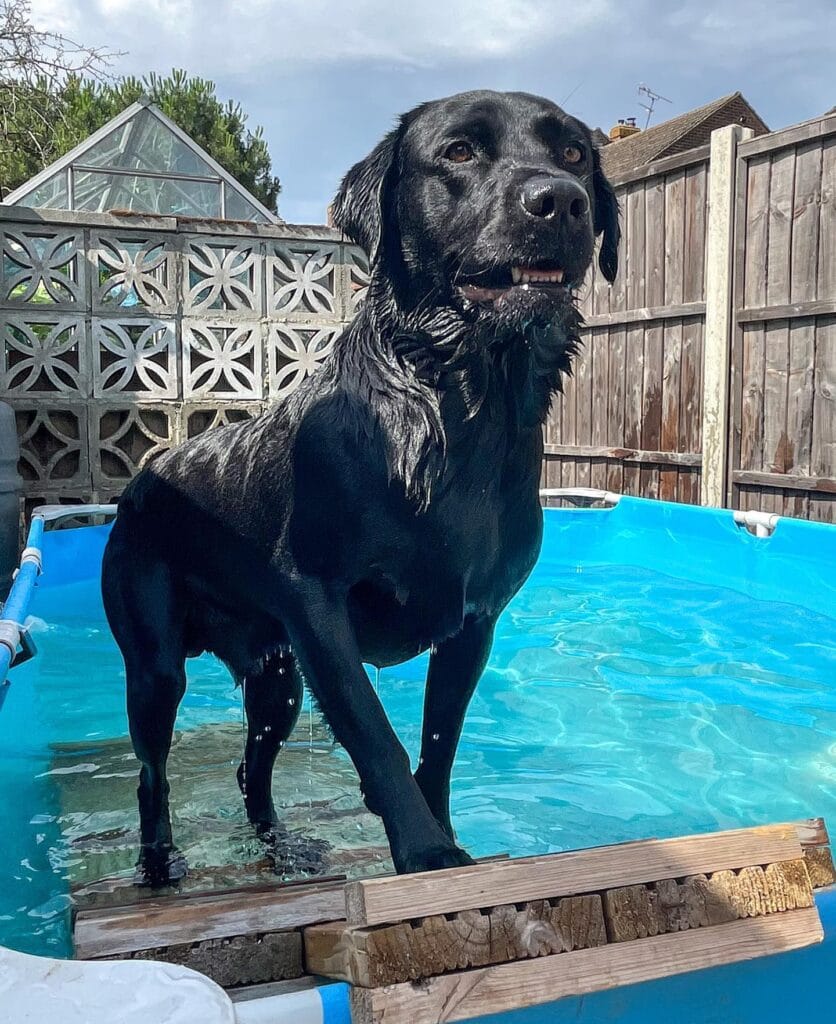
One of my cats is obsessed with our inflatable pool. She claws at the side trying to get in and while doing so, she ends up splashing water all over the patio. So, I have built a platform that attaches to the side of the pool. Cats can now sit on the platform and play in the pool without me having to pick them up.
My doggy is doing a happy dance in that picture because that is what summer dog ownership is all about! A sturdy wooden plank ramp resting over the edge of a blue above ground frame pool so that your dog has a proper entry and exit point without the crazy mess.
Materials & Tools:
– 2-3 pressure-treated wooden planks (roughly 24 inches wide x 48 inches long)
– Wood screws (2.5 inch)
– Drill
– Coarse-grit sandpaper (60-80 grit)
– Waterproof wood sealant
– Non-slip rubber mat or grip tape strips
Instructions
Sand the edge of every plank, you do not want a splinter and a wet dogs paw. After sanding, lay your planks down side by side and drill a hole through each one for a cross support plank underneath at both ends. This will help keep the ramp from bending when your 50+ pound dog is running full speed at it.
rest one end flat on the pool floor, the other on the outside edge of the pool. The raised lip of the frame pool is a natural anchor, so I didn’t use any hardware to anchor it to the pool wall.
The solid bottom means that your dog can put her paws down and rest them without worrying about slipping or scratching up the pool liner. I do recommend you seal the wood every season to keep it from rotting.
After a swim, a rinse with one of these 7 natural DIY dog shampoos for a soft coat without harsh chemicals will clean your dog without stripping his coat of it’s natural oils.
Prep Time: 20 min | Active Project Time: 1.5 hours | Difficulty Level: Beginner
Cut the corner of the entry side of the ramp at a slight angle so it is flush — this small detail helps the whole ramp feel “locked in” and safe.
📸 Photo credit: Instagram @workingwithmonty
#10: The Blue Kiddie Pool Setup That’ll Make Your Dog Forget It’s Bath Time
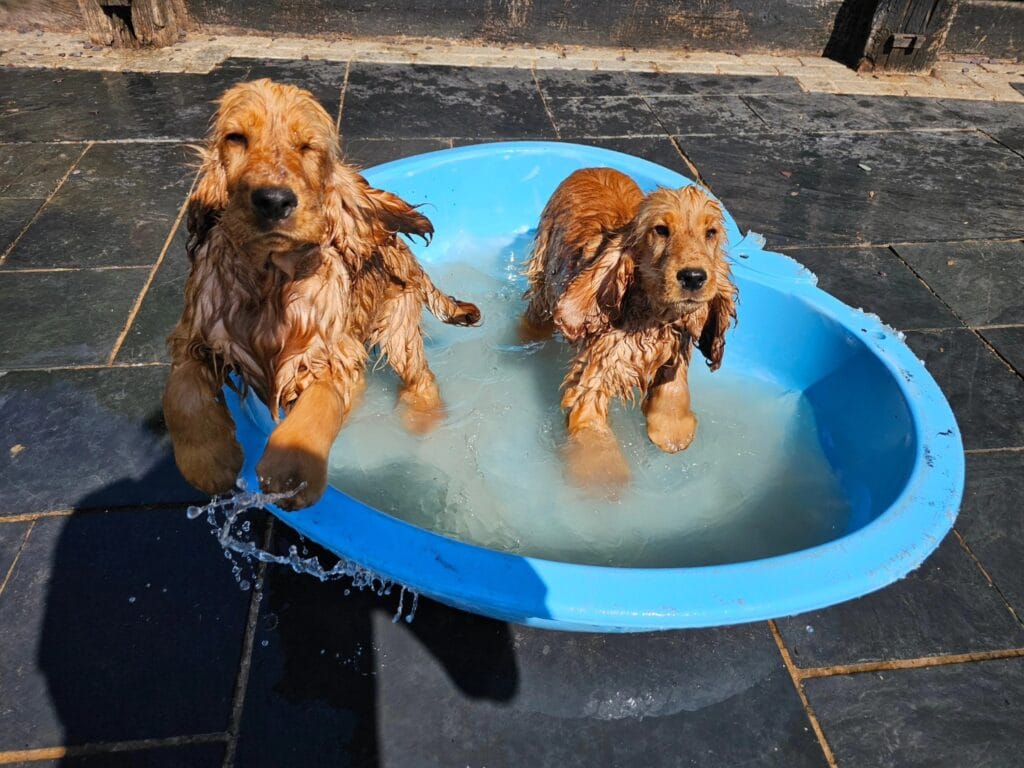
If you have a golden that comes barreling through the back door covered in mud from digging holes in the backyard, shaking water everywhere before you can even grab a towel, this is for you.
Prep Time: 10 minutes | Active Project Time: 20 minutes | Difficulty Level: Beginner
Materials & Tools:
– Blue oval plastic kiddie pool (approx. 47–55 inches in diameter)
– Garden hose
– Non-slip bath mat (fits inside pool base)
– Mild dog-safe soap (optional)
– Flat stone or slate patio tiles underneath for stability
### Instructions
Put in about 4-6 inches of cool water in the pool so that the dog’s paws and ankles are covered. This way, they aren’t overwhelmed and can play in it. Set it directly on your slate or stone patio surface so that it doesn’t tip if two excited spaniels decide to splash at once (yes, 2 will always find a way to jump in).
Start off with just 1 dog. Let them sniff the edge, let them paw at the water, just be curious about it. The fact that the water is so shallow will make them feel the ground under their feet which makes them way more willing to step in and stay in.
Being a shallow water fish, they stay on the cooler side of things on hot days which means you can spend more time in the outdoors.
Rinse pool out after each use and tip over on its side to dry out. If it sits for a while there will be mold growth.
📸 Photo credit: Instagram @villaspaniolcocker
The One DIY Pool Mistake That’ll Have You Draining It by Day Two
Once you have your pool built, it’s common to forget about the drainage until you are standing in a swamp in your backyard.
secretly the pros care more about the slope then they do the size.
If you’re setting up a kiddie pool, or a lined wooden frame pool, put it at just a slight angle, so that one corner is lower than the other corner. Cut a hole at the lowest corner. When you’re ready to drain it, it’ll all just flow out. No more needing to tip a 200 pound pool of water while your golden retriever looks on, feeling superior.
This is what happened to my cousins lab last summer. My cousin had a beautiful cedar pool built for the lab and spent about 45 minutes fighting the water out every time. It was remedied with a simple adjustment.
Furthermore, line the bottom with a rubber bath mat. Your puppy will not be able to get a grip on a bare plastic surface. They will start to slip around and get scared off the pool.
Keeps her paws happy in the water and her backyard will be her favorite place to hang out! Just like our dog house plans give her a shady retreat next to it.
Your Dog-Proof Living Room Starts Right Now
First, there’s no reason why you have to choose between loving your golden retriever or loving your home. Both can exist. I always thought that was impossible until I made the switch to a place that didn’t make me feel like my couch would always smell like wet dog after a rainy walk.
Pick one of these and work on that. Just one. Maybe it’s the washable slipcover, maybe it’s the indoor mat situation — whatever feels like your biggest headache.
And if your dog needs their own cosy corner too then these DIY dog couch ideas might save your actual sofa from becoming their bed.
So tell me, what is the one spot in your house that your golden retriever has taken over?

Amr Mohsen is a software engineer who traded his keyboard for a leash — at least on weekends. His love for dogs inspired him to share what he learns as a dog owner and enthusiast, bringing a detail-oriented, research-driven perspective to every article he writes. If it’s about dogs, he’s probably already looked it up twice.