I read the other day that a tired dog is a good dog. I’m not sure that I agree with that. Getting a dog tired is hard work.
I kept tossing the ball until my arm gave out, and he was still zooming around as if nothing happened. I stumbled into the world of dog obstacle courses and how to set up some myself at home, and it changed everything.
Turn your backyard (or living room, no judgment) into the thing that finally burns off that golden retriever energy — without sacrificing your decor.
These 10 easy ideas are great for any budget, any space and any dog that’s one bored afternoon away from eating your couch.
#1: The Deflated Football Tug Toy That Will Save Your Sanity (And Your Couch)
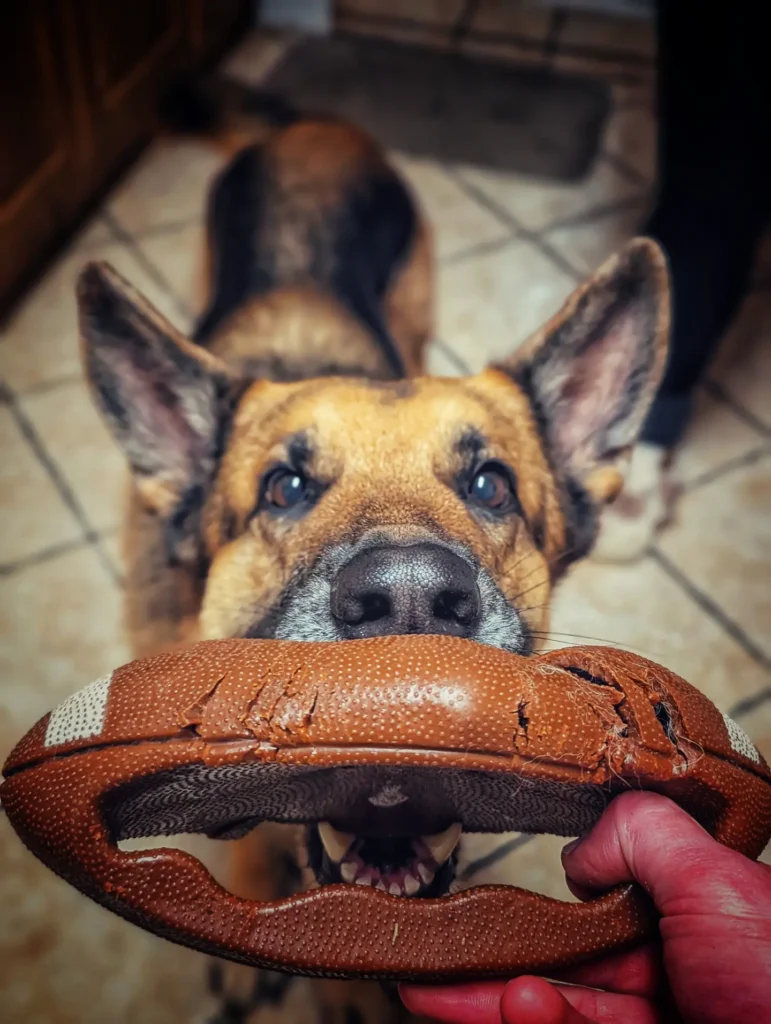
You know that moment when your golden is starring you down with a toy in his mouth and his eyes are saying play with me or I will destroy something? Yeah, that’s the energy in this photo and it reminds me of my cousin’s shepherd mix who once turned 3 throw pillows into confetti in one afternoon.
This is a rubber ring tug toy that looks like a small football. It has already been in some serious battles, as you can see the cracks in the textured brown rubber surface, frayed seams and some bite marks.
Get yourself a heavy-duty rubber chew ring (I prefer ones that are almost football-style textured with reinforced seam stitching. The texture helps to make the toy more interesting for your dog to chew, and gives you something to grip without losing a finger during tug-of-war).
For a homemade version, braid three strands of fire hose fabric into a ring and knot the ends. It’s very durable even for the toughest chewers, and you can get it to last much longer than rope or plush.
If your golden loves tug games, make sure that you have a space set aside so that she doesn’t drag you on your good rug. One simple setup from these 17 Creative DIY Dog Run Ideas for Your Furry Friend can really give her an outlet.
Rotate toys every few days. Otherwise, dogs will get bored with a toy. But it will be a new toy. Its just one that has been hiding in the closet for 2 weeks.
📸 Photo credit: Instagram @sheddingovereurope
#2: Build a Pro-Style A-Frame Ramp Your Dog Will Beg to Climb
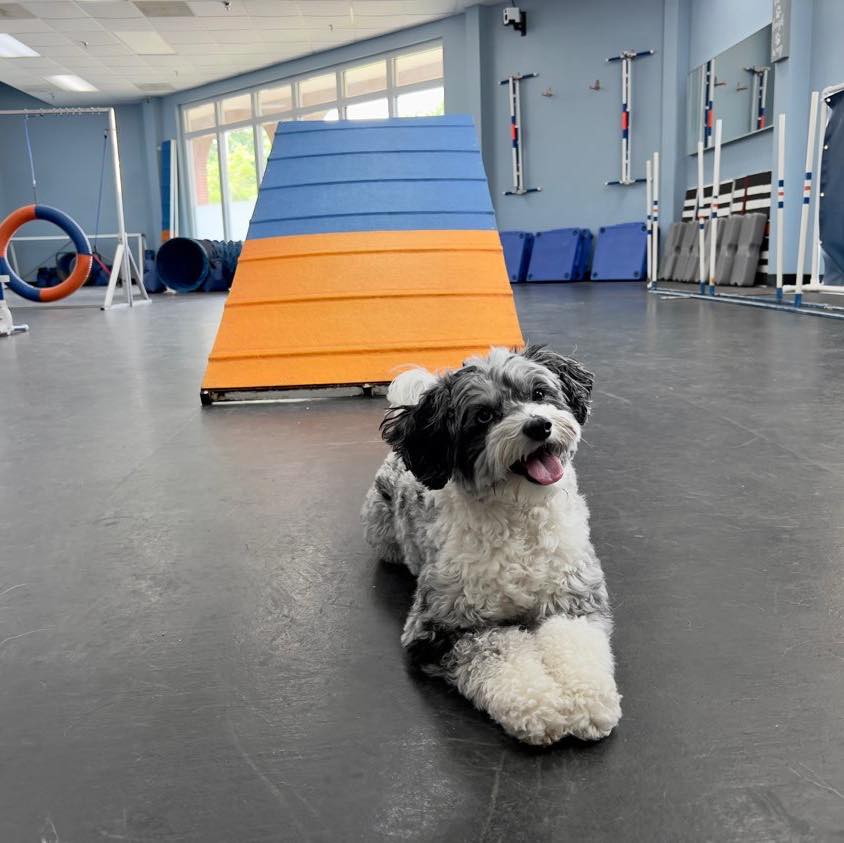
He’s finally burning off some energy instead of stealing all my socks off the counter, so that’s a plus.
It’s agility time indoors and this set-up is giving full professional dog gym. I’m a little obsessed with the blue and orange A-frame ramp … it’s bold and sturdy, and let’s face it, dogs love a ramp they can conquer. The whole room feels open and purposeful, and I like the dark rubber flooring instead of that scary slip and slide situation.
To build an A-frame ramp, you will need two flat wooden panels, perhaps 4 ft by 8 ft plywood, ¾-inch thick, and heavy-duty piano hinges to attach the panels to each other at the peak. Non-slip rubber stair treads could be used along the surface, and the ramp could be painted a contrasting color at the base (orange) and peak (blue) so the dog would be able to visually track the incline of the ramp.
The rubber interlocking floor tiles under the landing are fantastic for protecting joints from the force of jumping and preventing slipping (so you don’t have to worry every time she jumps off the top).
And if you love to build things for your pup, check out 13 Genius DIY Dog Stuff Every Pet Parent Needs to Try Today! for more awesome ideas.
Attach a wooden crossbar strip every 8 inches up the ramp surface; it will give paws something to grip as they climb up and go down.
📸 Photo credit: Instagram @zoomroomsouthatx
#3: Turn Your Pool Into the Ultimate Dog Obstacle Course (With a Fetch Twist)
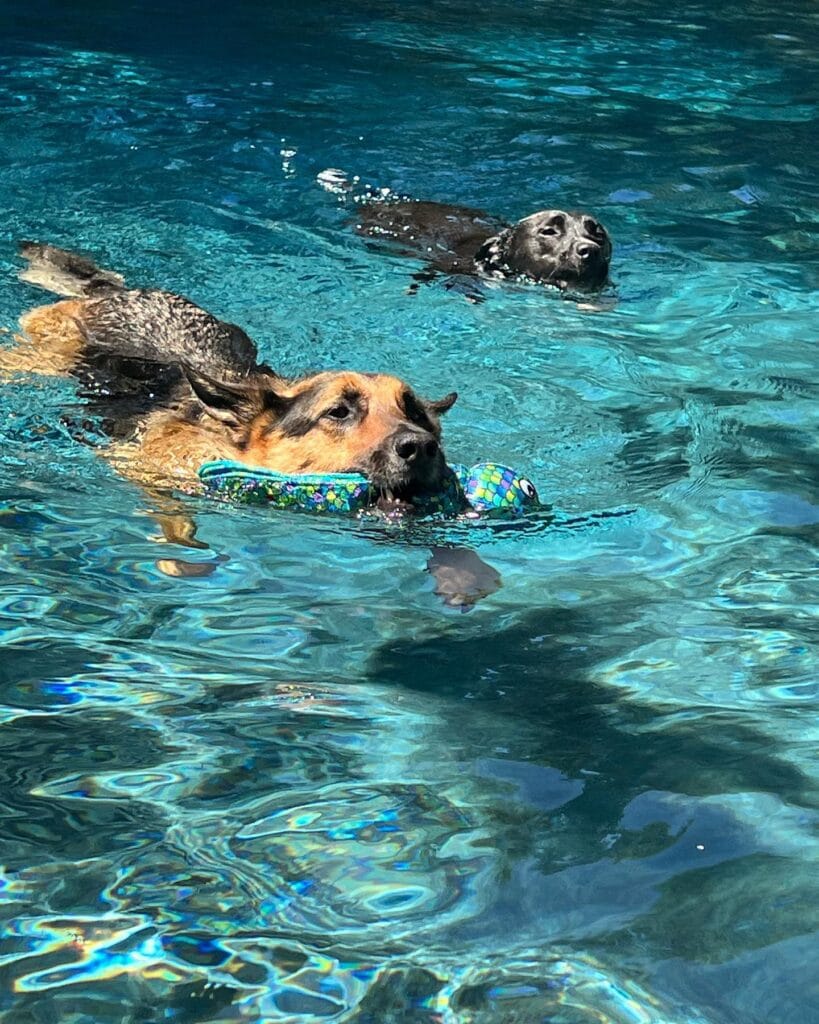
I’m sure you all know that exact moment when your dog is staring at the pool and his tail is going absolutely insane and you’re thinking “hey, we need to make this more fun for my dog…” And this is where this idea comes in.
two dogs mid-swim with one of them carrying the colorful fish shaped pool toy in her mouth like she won it. feel the energy?
What you’re looking at is a very easy (and super smart!) set-up that can be done with a handful of your dog’s floating fetch toys (like the ones with a mermaid scale print which are easy to spot in the turquoise water) and a pool. Toss the toys out at different distances to create a retrieve course! This German Shepherd is working hard to get back to the edge first – and your golden will be able to relate and will love the competition-style energy!
Next, cut some pool noodles into 12-inch segments and zip-tie the noodles together to form a floating lane. This gives your dog a path to follow — fetch a toy at the end of the noodle lane and let her swim through it.
Not sure how long your sessions usually last, but for play in the water I would make sure they’re under 15 minutes. The dog may be fooled by the fun and not notice that he is tiring faster while swimming than he would while running. If you see him panting hard even in the water, you might want to be thinking of wrapping up.
📸 Photo credit: Instagram @carawhitley
#4: DIY Dog Agility Jump — The Classic Hurdle Your Dog Will Fly Over
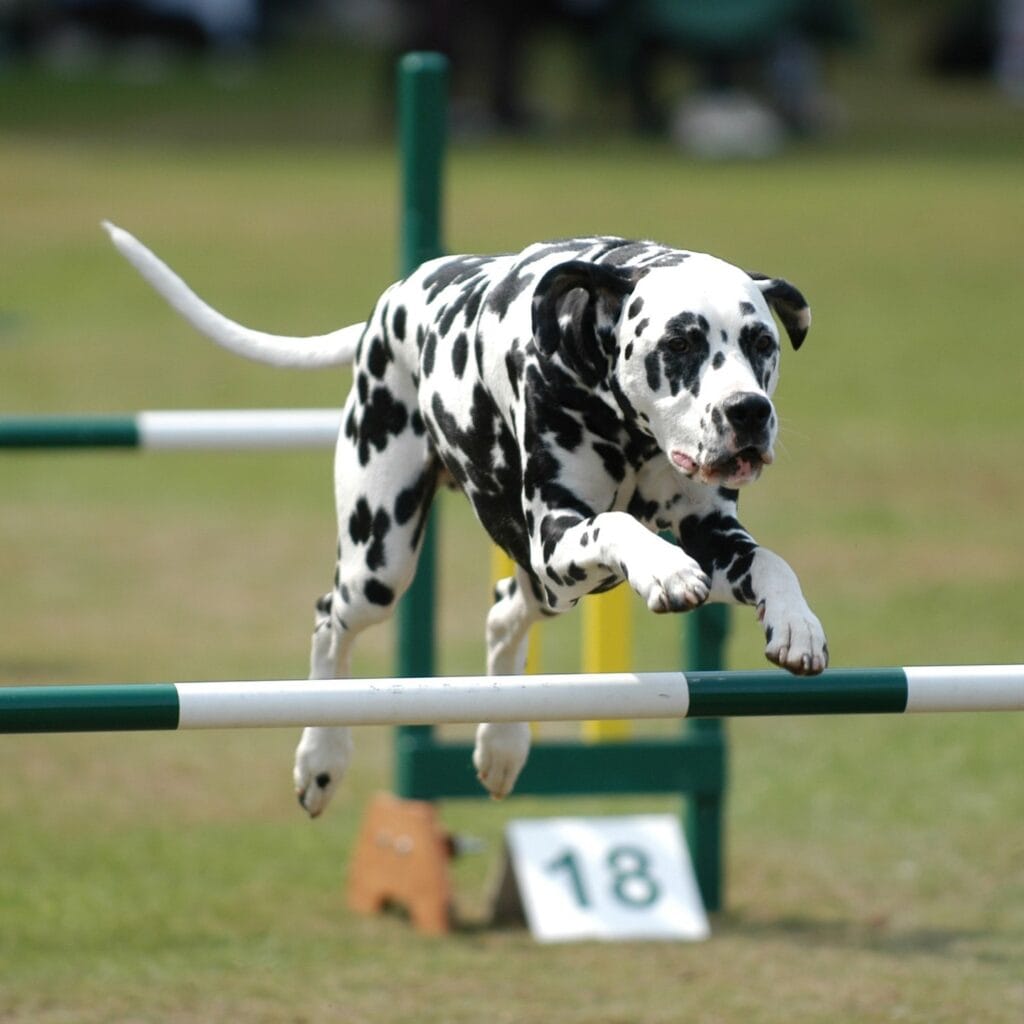
It’s only a matter of time before your golden is zooming around the backyard again. She’s practically begging for something to do. You’ve got the energy, she’s got the zeal… all you need is a goal.
We’re getting in the game. A clean regulation style agility hurdle can add a touch of class to any agility run. The set-up is dead simple: green and white PVC jump bars, bright green upright posts, and a numbered station marker (obstacle #18) to give your course a “real” feel, even if the only competition your dog is doing is with the squirrels.
I got 1 inch PVC pipe in white for the cross bar, and hunter green for the uprights, spray paint or colored sleeve, the jump cups are the little brackets you attach to the bar to raise and lower it, you can adjust the height without tools. Start your puppy on a lower height, 8 inches, and then move up to 16-20 inches as she gains confidence.
Cut your uprights to 36 inches tall and your crossbar to 48 inches wide. That will give you a hurdle that is stable and will not tip when she clips it on the way over.
Print a small white number card and laminate it. Stick it into the ground near the base of the pole. It is a small gesture, but it tells your dog that this spot means something.
The bar is just set in the cups (not in slots) so that when she falls, it just goes and not caught her legs, so she is safe to try again.
📸 Photo credit: Instagram @oneminddogs
#5: Build a PVC Tunnel Your Dog Will Actually Use (No Sewing, No Fuss)
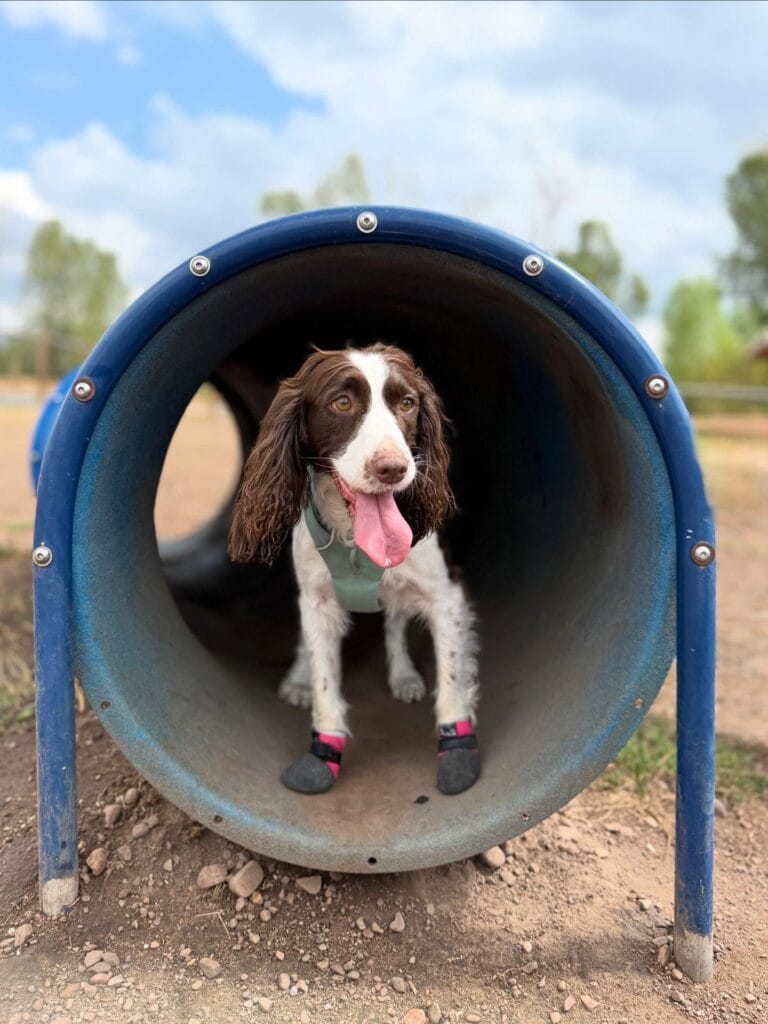
We’ve all had that one moment where your fur baby comes sprinting through the living room and slides on the freshly mopped floors, falling into the couch… again. My cousin has a springer spaniel, and this is what happened every single morning. So she decided to build this tunnel for her dog outside, and now, she sprints out there as soon as she sees her owners.
The set up is a blue PVC rigid pipe tunnel, the tunnel is about 24 inches in diameter, mounted on two metal support legs bolted into the ground. The tunnel is low enough that even a medium-large dog can walk through without crouching. This dog is a chocolate and white springer and is even wearing Ruffwear Grip Trex boots in pink and a sage green dog vest.
You can find a 36 inch diameter concrete forming tube at your local hardware store. Spray paint it a very dark shade of navy blue, and attach metal end rings with bolt fasteners to the ends. Set it on galvanized pipe legs anchored in gravel or compacted dirt.
One thing to remember: The gravel base underneath might just be there for aesthetic reasons, but it serves a more practical purpose too. The gravel helps to drain faster, so that no muddy paw prints are left on your porch after your dog has returned from his run.
Cut the tube to a length of approximately 4-5 feet long. Long enough to feel like a real tunnel, but not so long that a nervous dog becomes fearful.
📸 Photo credit: Instagram @luckypennyjo
#6: The Natural Log & Solar-Powered Dog Park Setup (Outdoor Agility Zone)
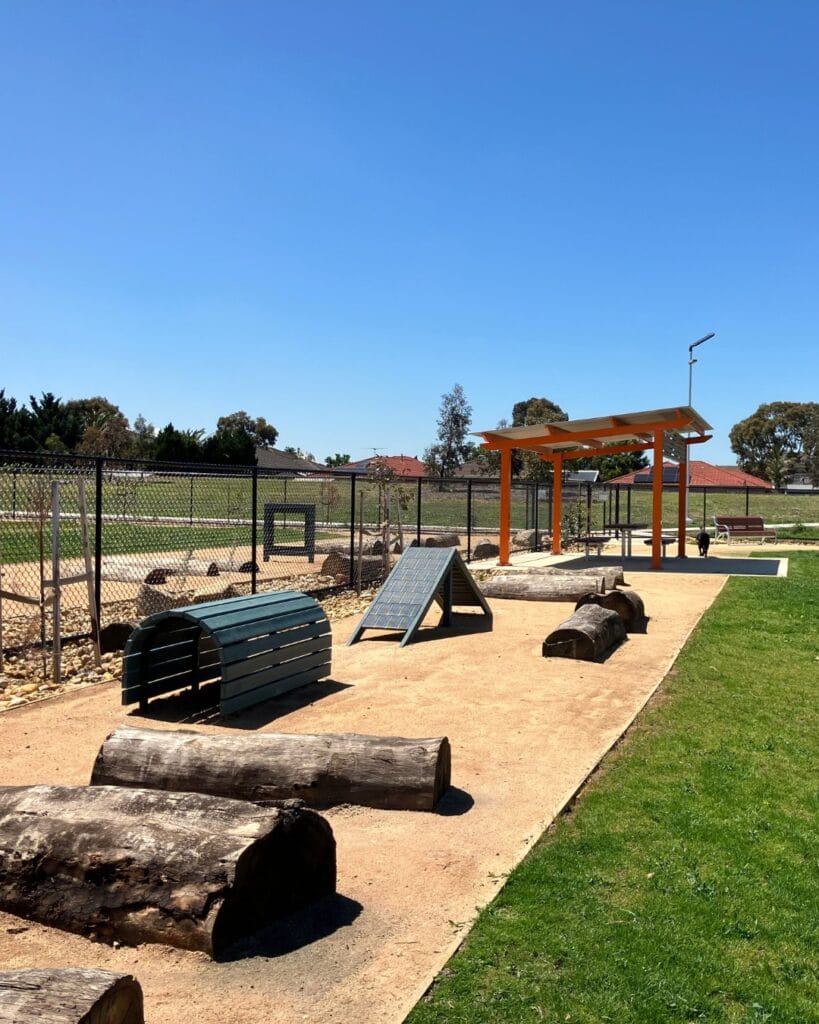
If you have a golden retriever like me, then you know exactly the mood I’m talking about. It’s the day that your golden has been inside all day and she is ready to go and you can just feel her energy and you know that if you let her out you are in for one muddy mess of a day. Well that’s where this great set up comes in handy.
We use a hard surface of compacted decomposed granite for the agility zone. The granite drains quickly and stays firm under paws. It keeps mud off your floors! The entire agility area is enclosed with a black chain-link fence. Our girl can run free and is safe. In the back is an orange powder-coated steel pergola to shade you and keep you from squinting while you watch her run.
The logs are the star here. They are all ‘halved natural hardwood logs’ in different sizes. Some are laid flat and used as an obstacle to step over, while others are grouped together to be used for weaving. I found them at a local tree service or lumber yard for next to nothing. I also have a dark green slatted timber tunnel (roughly 60cm wide) made from a box frame build with treated pine boards. The A-frame ramp is made of grip-tape panels wrapped around a plywood frame, this helps to stop the little paws from slipping during the climb.
Real talk: Start building the “fenced” area before you start putting in obstacles. You don’t want to add them until you have a well fenced zone. It’s much more fun for you and your dog if he can run around without you hovering.
I put a solar panel light on a pole at the corner of the yard, so the dog can run out in the evening and it’s not dark (we don’t run electricity out there).
📸 Photo credit: Instagram @merri_bekcitycouncil
#7: Turn a Picnic Table Into the Coolest Dog Hangout Spot at Your Local Park
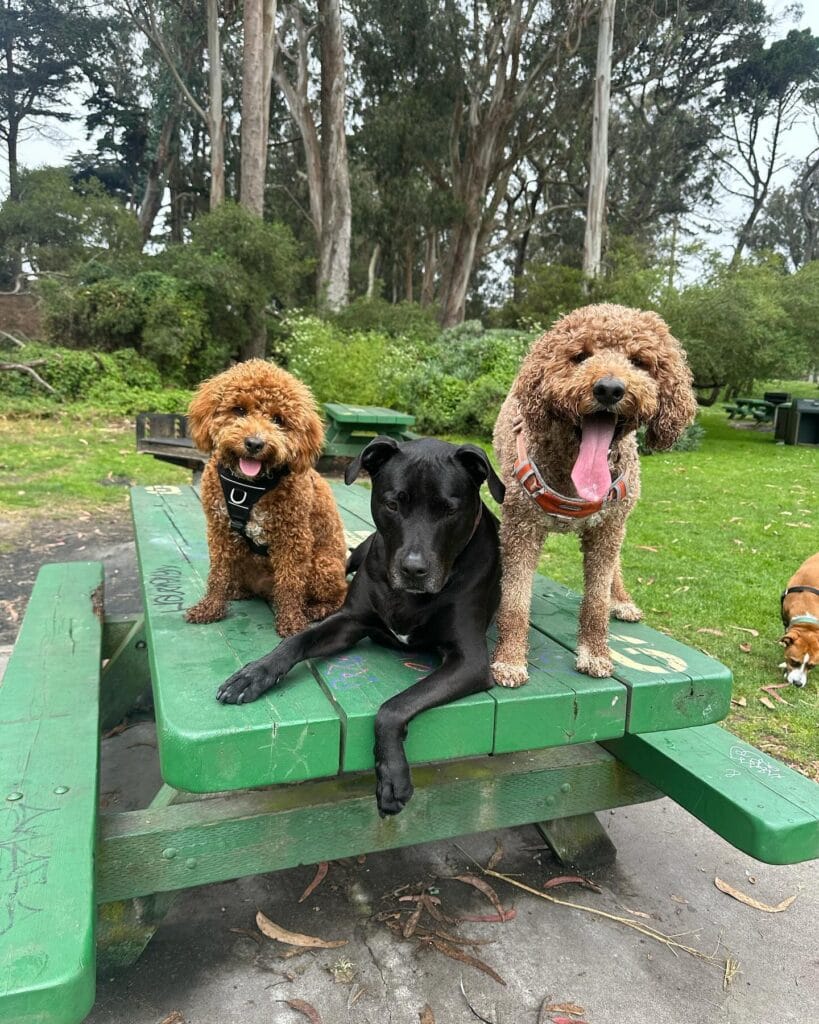
Your golden is the one at the park that wants to climb on everything, the benches, the rocks, the big scary log by the trail. Mine too. And honestly, I think that energy is just begging to be channeled into something fun and structured.
This photo gave me so many ideas. The dogs in this photo are a mini goldendoodle, black lab mix and a standard goldendoodle. They are just chilling on a green painted picnic table like they own the place! But, that table is also an obstacle course element!
Grab a standard 6-foot wood or recycled plastic picnic table (the green ones at most city parks work perfectly). The raised platform allows dogs to more easily jump on and off, helping to build rear-end awareness and confidence. Add in orange or red nylon collar markers so your pup stands out during training, especially in wooded areas like the eucalyptus grove in the background!
For a do-it-yourself setup at home, one idea is to anchor a 4×4 ft pressure-treated wood platform that is about 12-18 inches off the ground. Sand it with 60-grit sandpaper and paint it with non-toxic outdoor deck paint (in a bold color) so the surface will look different than the ground.
Something else that is often skipped is practice of the dismount as much as the jump. A dog that lands on all four legs is far less likely to have issues in the future.
📸 Photo credit: Instagram @dog_loving_mom
#8: PVC Tunnel Run — The Low-Cost Agility Obstacle Your Dog Will Zoom Through Every Single Time
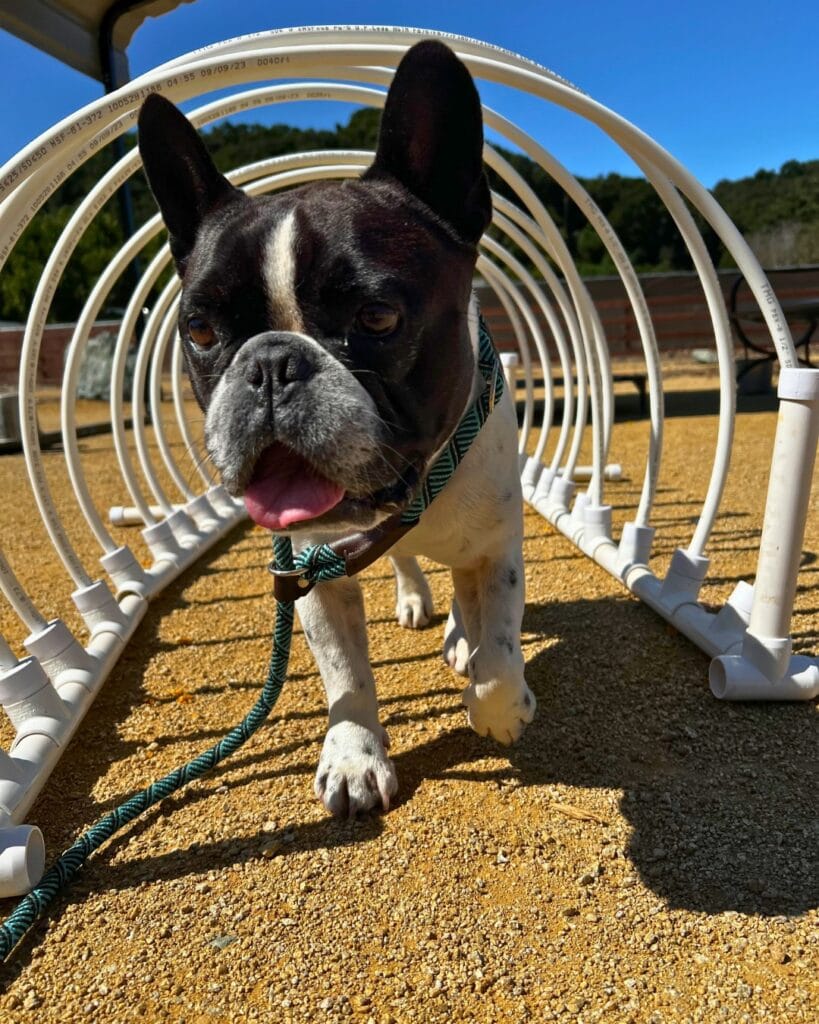
Your dog is staring at you with those eyes and the tail is going a million miles an hour. What are you going to do with all that energy? This PVC Tunnel Run is the answer you didn’t know you needed.
White PVC pipes arch into a tunnel series. The hoops are each made from ¾-inch schedule 40 PVC bent into semicircles, and anchored with T-joint fittings pressed into a gravel base. The dog in the photo is clearly enjoying himself running through it tongue out no hesitation at all. And the sandy gravel underneath is comfy on paws and drains well.
You can always make your own. You will need 10-12 feet of flexible ¾ inch PVC per hoop, T-connectors, and a bag of pea gravel to put on the floor. Space the hoops about 12 inches apart so that when your dog walks through them she is able to do so with a rhythmic stride. The combination of the flexibility of the pipe, the T-connectors, and the gravel will burn off some mental and physical energy, keeping your dog calmer at dinner time.
Cut the pipes so that the hoops will be about 48 inches high for medium to large dogs or 36 inches high for smaller dogs like this Boston Terrier. The tunnel works even better as part of a bigger setup though, so check out these 15 DIY Dog Playground Ideas for Your Backyard.
Check your T-joints before each run. A loose fitting T joint can collapse and you know how your dog would react to that.
📸 Photo credit: Instagram @springdalepetranch
#9: The A-Frame Ramp + Tunnel Combo (And Why It’s the Ultimate Backyard Setup)
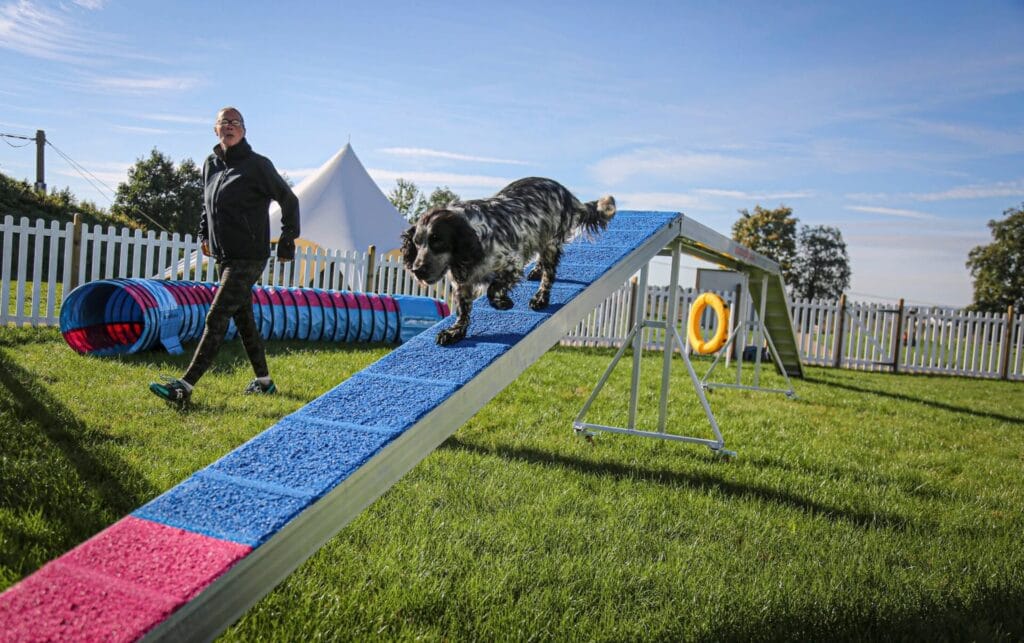
Has your golden been zooming around your yard for no apparent reason? Do you find yourself standing still with a treat in your hand, but your golden just seems to do laps around you? Here’s a setup that finally gives all that energy somewhere to go.
This scene is so good! A blue and pink textured ramp leads up and over the peak, sitting on a sturdy steel A frame with a blue and magenta spiral tunnel laid out on the real grass. The fun colour means you can spot it from across the yard and the rubberized grip surface makes sure your dog isn’t slipping mid stride.
The ramp is surfaced with rubber crumb grip matting in alternating blue and pink sections. The pink sections are contact zones for the dog to touch down on when they land. Not only is it pretty, but it also shows the dog where to slow down. You can purchase pre cut rubber gym flooring tiles and attach them to a 1.2m x 25cm plank on each side of the A-frame peak with outdoor adhesive.
The tunnel is a (collapsible nylon agility tunnel) that is roughly 3 meters long. It will need to be staked into the grass with the (ground anchors) so it does not shift while the dog is running through it.
Keep the peak of the ramp around 1 meter high for medium sized breeds (any higher and the ramp will be steep enough to spook some dogs off of it).
📸 Photo credit: Instagram @thevalleyevesham
#10: DIY Agility Tunnel Station Your Dog Will Actually Use
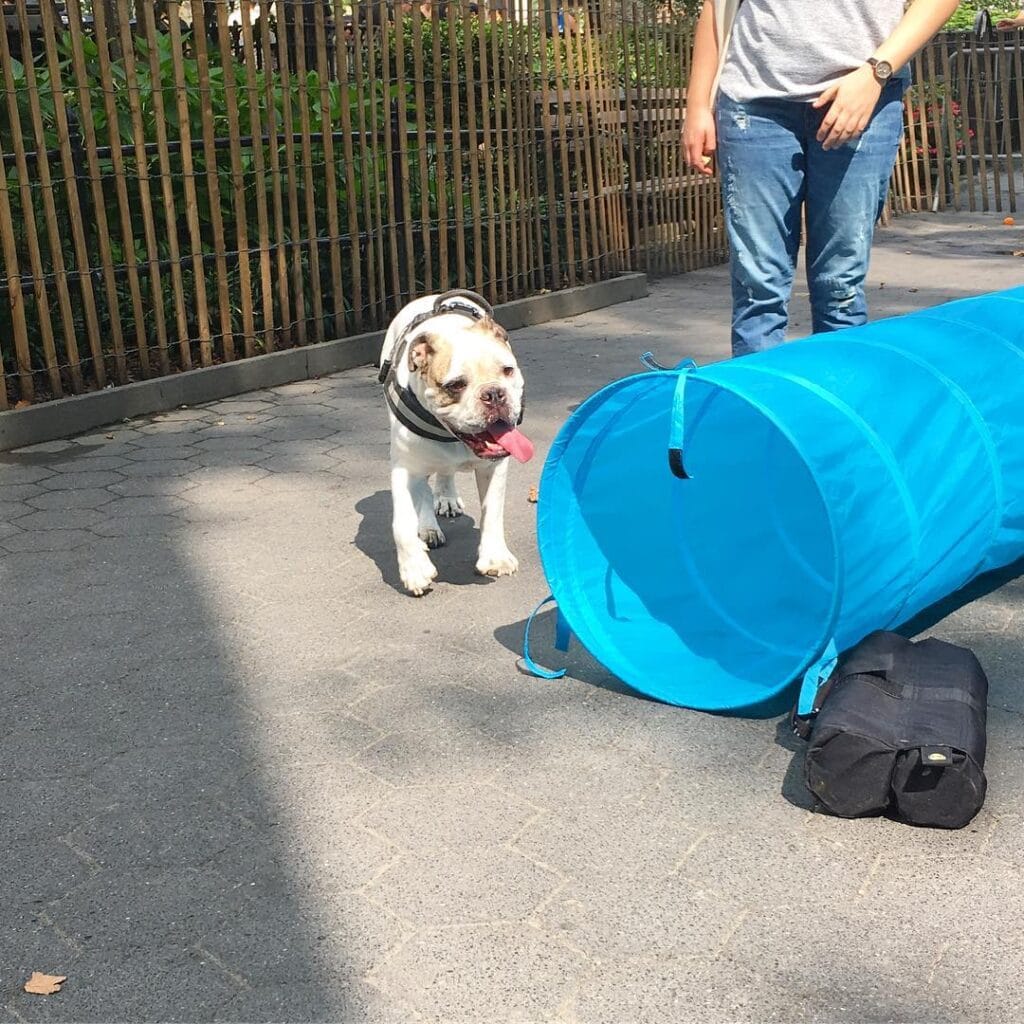
Let’s face it, if you have a golden who likes to run around in the yard, at some point you’re probably going to find yourself watching him knock into the patio furniture. So here’s a way to stop that.
These photos are giving me full “my dog has a real hobby now” energy. A bright cyan blue, collapsible fabric tunnel (24 inches in diameter) is sitting low to the ground on a paved surface, held down by two black sandbags on either end. It’s so clean and so intentional, and I’m sure your dog will be obsessed.
Grab a pop-up agility tunnel in a high-visibility color (I like the blue one!). You’ll also need some heavy-duty sandbags to keep the tunnel from moving around when your pup sprints through it. The dog in this photo is wearing a gray padded harness so he can have control without pressure on his throat while running fast.
Rest it on a flat, non-slip surface like pavers or packed dirt. Both ends need to be anchored – I learned this the hard way when my cousin’s dog flipped a loose tunnel and started to panic.
The tunnel itself is very lightweight, so it stores in seconds! Who doesn’t love a feature that saves space, right? And it keeps your yard Pinterest-ready.
But honestly? Start with just the tunnel. One obstacle, practiced daily, builds more confidence than a full course your dog ignores.
📸 Photo credit: Instagram @dexter.bully
The One Spacing Secret That Makes or Breaks Your DIY Obstacle Course
Most people will make their first dog obstacle course and, after some time, they will wonder why their dog keeps skipping stations, or getting confused when going through it. I did that with my cousin’s lab mix last summer.
What I learned today was the secret is the spacing between the obstacles not the obstacles. The worst event I have ever been to.
Most tutorials tell you what to build. Nobody tells you that dogs need 6-8 feet between each station, to reset their brain and actually learn the sequence. To close together and your golden is basically crashing one obstacle into the next..
The mistake that every other dog owner I know makes is to make their dog work at adult-dog difficulty right away. Don’t. Start each new obstacle at the lowest level that your dog can succeed on. And by “lowest level” I mean embarrassingly low. Make her get five easy repetitions before you raise the bar, literally.
There is one little change that I would advise and it would be to build the jump poles out of pvc pipes instead of wood. Not only are they a lot lighter, but if a horse clips one, then it will fall away instead of scaring the horse into never jumping that course again!
Once she has conquered the obstacle course, the 7 Creative Dog House DIY Plans for Your Pup are the next weekend project.
Your Golden Deserves a Clean Home and You Deserve Your Sanity Back
Pick one thing from this list to try this week. Maybe it’s the waterproof throw you’ve been putting off buying or finally setting up that mudroom basket by the door.
Small changes add up fast, which means your Pinterest-worthy living room could still be possible with a dog.
Once I stopped fighting the mess and just planned around it, things got much easier. Your home can still feel cozy, cute and pulled together even if you’ve got a golden retriever who likes to think the couch is his throne.
So, what’s the one golden retriever mess that’s driving you absolutely crazy right now?

Amr Mohsen is a software engineer who traded his keyboard for a leash — at least on weekends. His love for dogs inspired him to share what he learns as a dog owner and enthusiast, bringing a detail-oriented, research-driven perspective to every article he writes. If it’s about dogs, he’s probably already looked it up twice.