
And yes, your 70-pound bundle of chaos does love you and all that but girl, that plastic crate in your living room is killing your vibe.
That is the same thing that happened to me when my cousins dog came to stay with us for a month. He was an ugly black wire crate and it just sat there and looked terrible. I wanted to throw a blanket over it every time someone came over.
I know that you may have Pinterest boards full of coordinating cozy rooms, so the thought of a drab eyesore of a crate beside your carefully chosen throw pillows may sting a bit.
Dog cage furniture DIY sounds like a crazy idea but it’s real, and it’s easier than you think. Try these 7 great dog cage furniture ideas to make the crate something that your guests compliment instead of quietly judging.
#1: DIY Double Dog Crate Furniture With a Wood Top (The One That Actually Looks Good in Your Living Room)
You’ve probably caught yourself in a moment when your golden retriever is sprawled out on the floor and your wire crate just sits there clashing with everything you’ve carefully put together. I know that was the problem my cousin was facing. Her crate looked like it belonged in a storage unit rather than a Pinterest-worthy living room.
This build is different.
Prep Time: 1 hour | Active Project Time: 6–8 hours | Difficulty Level: Intermediate
Materials & Tools:
– 3/4″ plywood or pine boards (for the frame and base)
– 3/4″ solid pine for the top surface (natural finish)
– Gray chalk paint or milk paint (this build uses a warm light gray)
– Black steel rods (3/8″ diameter, cut to your desired height)
– Gold brass latch hardware for the smaller door
– Wood glue + pocket screws
– Drill, jigsaw, miter saw
– Sandpaper (120 and 220 grit)
– Paintbrush + foam roller
Instructions
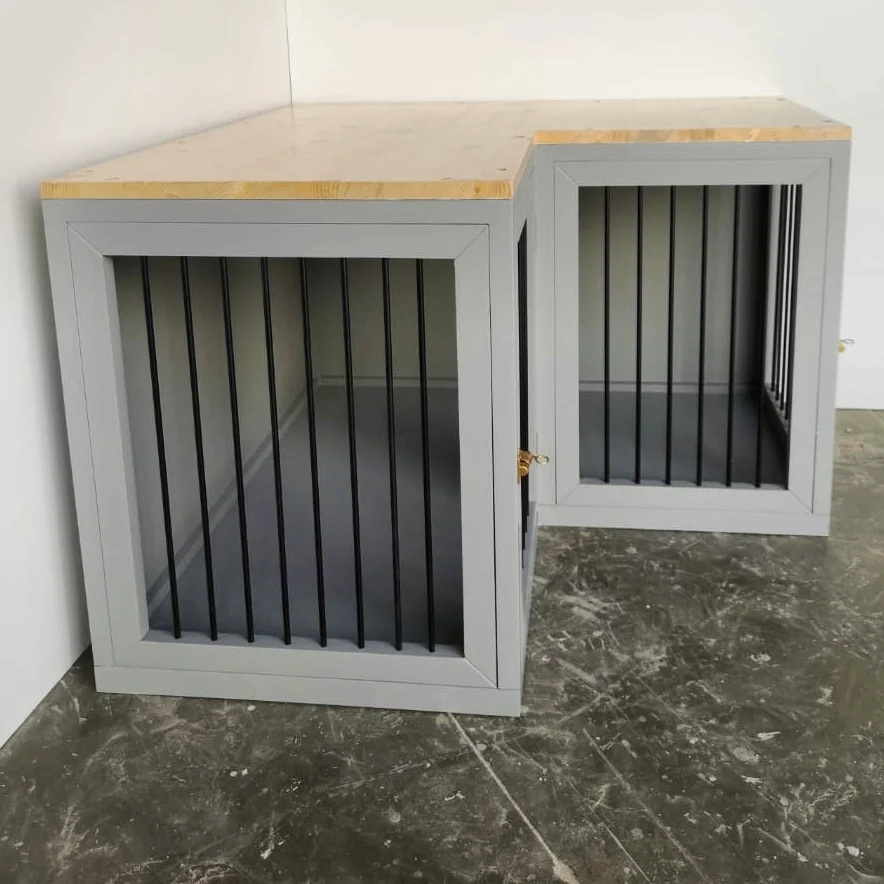
First, cut the pine boards to create two separate crate openings, one bigger (roughly 36″W x 24″D x 30″H) and one smaller (roughly 24″W x 18″D x 24″H). These two units sit side by side, with the bigger one slightly taller, and the solid pine top spans across both to create one connected surface.
Make sure you build each box using pocket screws and wood glue at each corner. Do not rush this part of the project. Let the glue cure at least 30 minutes before moving to the next step so you do not end up with a wobbly box once the rods are in place.
Drill evenly spaced holes along the top and bottom rails of each frame front. Space the black steel rod holes about 2.5″ apart for a clean bar look. Slide each 3/8″ rod through the holes, secure with a dab of epoxy inside the holes, then wipe away the excess before it sets.
Sand down the entire frame with 120 grit then 220 grit so there’s a nice smooth surface for the paint. Two coats of light gray chalk paint. Let it dry in between each coat. The paint has a matte finish that hides the small imperfections. So it feels like a furniture store and your golden retriever that you don’t deserve but totally gets.
Attach the gold brass latch to the smaller door panel. It’s a small detail but it really ties the look together against the gray.
Then, cut a section of the pine top to overhang the front and side edge of the frame about 1″. Leave it natural or apply a coat of danish oil to it for warmth. Screw it down from the inside so no hardware is visible on the top.
More roomy inside for the dog to stand, turn and settle down comfortably. The steel rod spacing keeps the inside open for the dog so she doesn’t feel closed in, which can cause anxiety for dogs that are uneasy about traditional solid-wall crates.
Seal any open wood edges inside with pet-safe paint to make cleaning up a little easier if muddy paws happens (it will).
📸 Photo credit: Instagram @furnature.ae
#2: DIY Built-In Sideboard Dog Crate (The One That’ll Make Your Guests Ask “Wait, Is That a Dog House?!”)
Your dog probably does that thing where she drags her muddy paws all over the living room floor and then immediately wants to curl up somewhere cozy. Mine does. And the last thing either of us wants is a wire crate sitting in the middle of our Pinterest-perfect living room that looks like a jail cell.
This build is different.
Materials & Tools You’ll Need:
– 3/4-inch oak plywood (for the cabinet body)
– 1×2-inch oak slat strips (for the slatted door panels)
– Brass bar pulls (approx. 5 inches, like the ones visible in the photo)
– Piano hinge or 35mm concealed cabinet hinges
– Wood glue + 1.5-inch brad nails
– Sandpaper (120-grit then 220-grit)
– Water-based wood stain in warm walnut
– Miter saw, jigsaw, nail gun, drill
Prep Time: 1 hour | Active Project Time: 2 full weekends | Difficulty Level: Intermediate
### Instructions
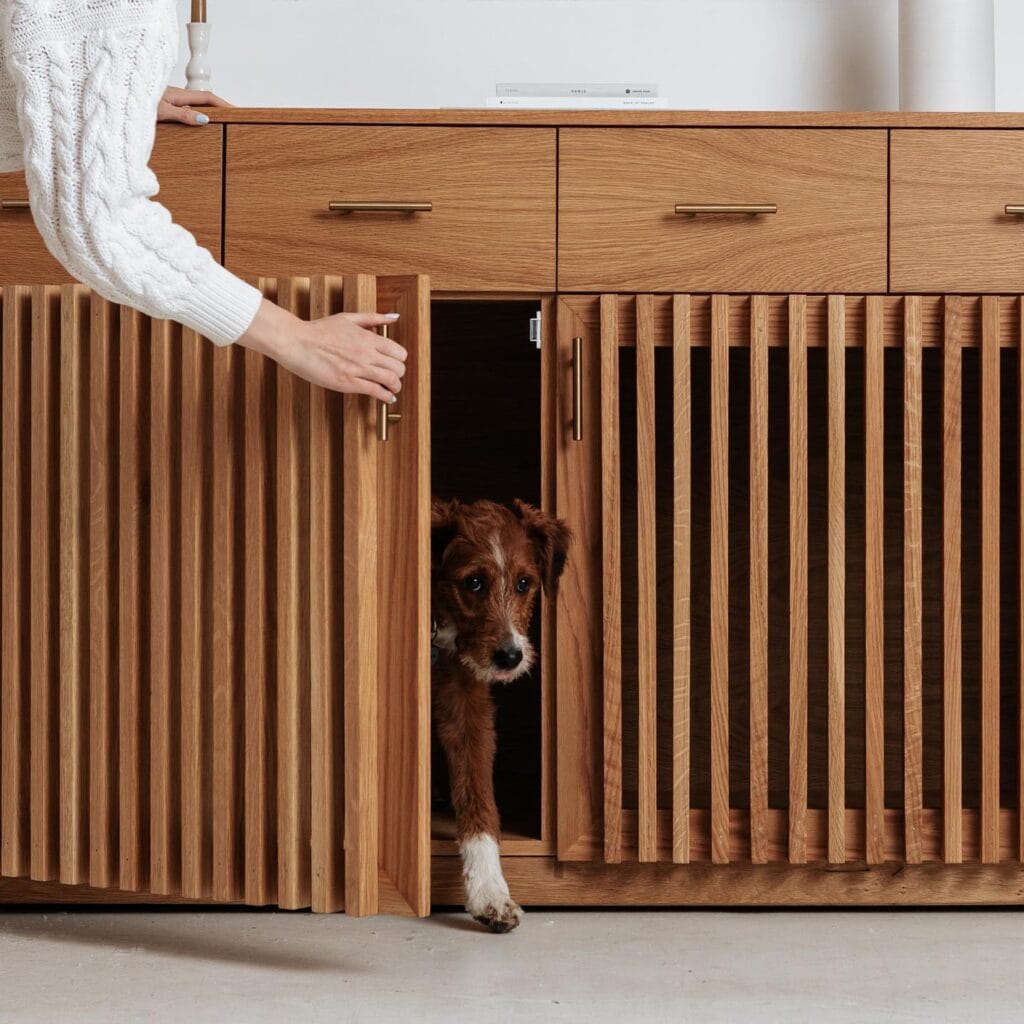
First of all cut the plywood to size for the side panels, top, back panel, and middle if you desire to have sideboard drawers above the crate. The crate section is on the left side and the drawer unit on the right. This separation makes it look more like furniture than a pet product.
Sand every panel with 120-grit sandpaper first, then sand with 220-grit to get that super-smooth surface your dog will be rubbing up against a hundred times a day.
If you decide to make slatted doors, rip your 1×2 oak strips into fairly consistent widths on a table saw, and space them roughly 1/2 inch apart when you attach them to a door frame made of 3/4-inch oak. The slats will provide airflow for your dog and give her the benefit of seeing around the house, so she’ll never feel trapped. The built-in ventilation will help keep your dog calm, which will reduce the number of anxiety-related scratches on your floors.
Attach the door frame to the cabinet using concealed 35mm hinges so there will be no hardware showing on the outside of the cabinet. Install the brass bar pulls centered on each door panel. The brass against oak gives this sideboard a high end look.
I stained the whole thing before I nailed it together. Getting in there between the slats after everything is nailed together is a nightmare (ask me how I know).
Cover the inside of the floor with a washable cushion that fits the dimensions of the entire floor. It gives your Golden a den that feels like hers, and you get a piece of furniture that actually belongs in your home.
I have the slatted doors because it makes her feel more at ease to see the room without being in it. Since dogs feel more secure when they are in a “cage” she is not as restless and doesn’t feel the need to chew on everything in sight when I come home.
If you love projects that serve multiple purposes around the house, then check out 13 Genius DIY Dog Stuff Every Pet Parent Needs to Try Today! for some more ideas that will make your space work harder for you and your furry friend.
I used a router on the outside edges of the cabinet to create a very subtle round-over. This softens the whole look of the cabinet and also protects my dog from getting cut by the corners when she’s nudging her way in and out.
📸 Photo credit: Instagram @dune.customworks
#3: Slatted Sage Green Dog Crate Cabinet With Built-In Lighting
When my golden retriever claimed the corner of the living room and the plastic crate I shoved it to my Pinterest board wasn’t quite the vibe I wanted.
Yeah. I’ve been there.
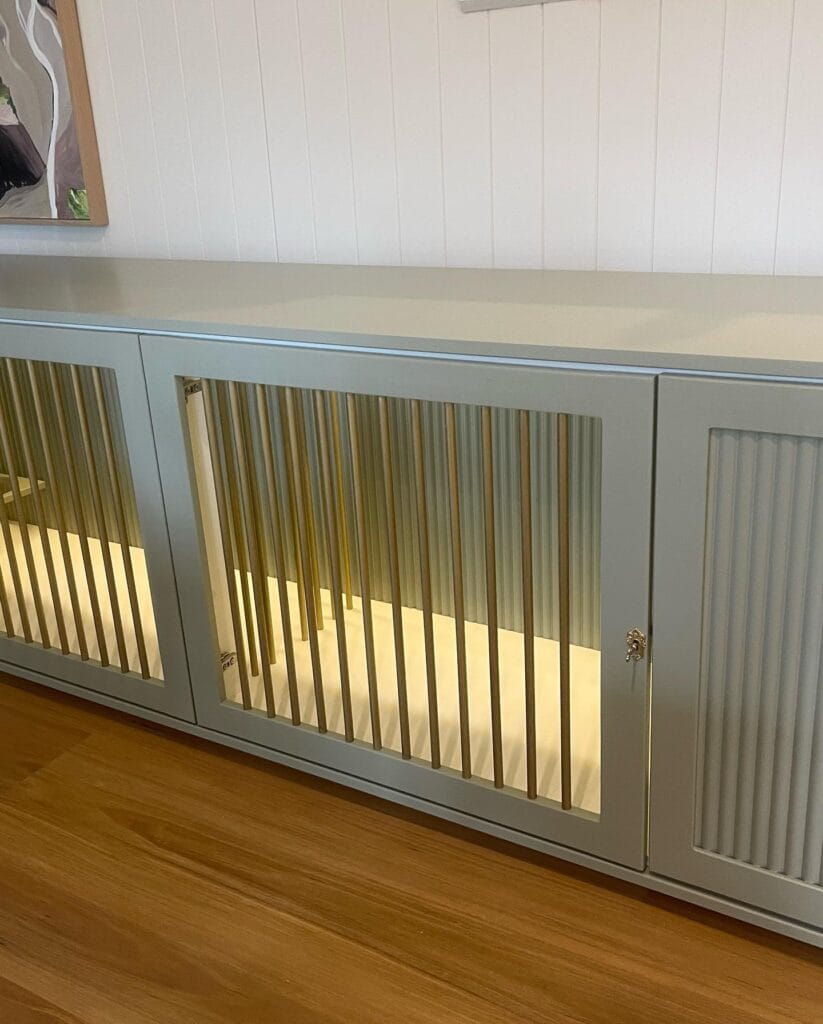
You can’t help but fall in love with this sage green slatted cabinet crate. It looks custom but it’s actually a dog den! The vertical brass-toned wooden dowels are secured in a painted MDF frame, backlit with a warm LED strip lighting to make the entire thing glow! The soft gold color keeps the space calm for anxious dogs. The soft gold glow will keep the light from being harsh on their eyes and not make the space feel like a dark cave.
Materials & Tools
– MDF boards (for the frame — ¾ inch thickness)
– Hardwood dowels (⅝ inch diameter, cut to uniform height)
– Warm white LED strip lights (adhesive-backed)
– Satin latex paint in sage green or duck egg blue
– Decorative brass hardware (lock + pull)
– Reeded glass panel (for the solid side door)
– Wood glue, drill, miter saw, sandpaper (120 and 220 grit)
Instructions
I cut my MDF into a rectangular frame made of two side panels, top, base and a back shelf strip. I sanded every edge with 120 grit first and then again with 220 grit. This was done to ensure the wood surface was as smooth as possible ready for the paint.
Build the dowel grid next. Drill a series of even spaced holes along the inner top frame and also along the base board, spacing each hole about 2 inches apart. Apply a bead of wood glue to each end of the dowels and then press the dowels into their respective holes. Let the glue cure for at least 24 hours before moving it.
Run your LED strip along the inside base before attaching the bottom panel permanently. Most people dont do this and are then crawling around in a cabinet with a staple gun. Dont be those people.
Paint the entire exterior two coats of sage green satin latex paint. Let each coat dry 4 hours. The satin finish wipes clean. Dried kibble, muddy paw prints or mystery drool all come off with a damp cloth. This means you are not spending your weekends with a bucket of soapy water in your hand scrubbing the piece. I actually like having it in my living room now!
Attach your brass lock hardware to the door frame and hang the door on concealed hinges so the front stays sleek. The lock gives you control of guests or meals without stressing your dog out with a heavy latch.
If you love making things for your dog and they actually look good in your home, 12 Heartfelt Designs for DIY Dog Accessories has some great ideas to bookmark.
It’s not just the warm lighting inside that looks pretty. Dogs settle in rooms with softer lighting better, so your golden will actually use it rather than pushing the door open and sleeping on your feet at 2am.
My other suggestion is to buy your dowels in a natural wood tone and not paint them. The reason being is that the contrast of the raw wood slats and the painted frame give it a more high end look. The dowels painted the same way take away from that look.
⏱ Prep Time: 1 hour | 🔨 Active Project Time: 6–8 hours | ⭐ Difficulty Level: Intermediate
📸 Photo credit: Instagram @mandaleighfurniture
#4: Build a Dog Crate End Table That Looks Like It Belongs in a Pottery Barn Catalog
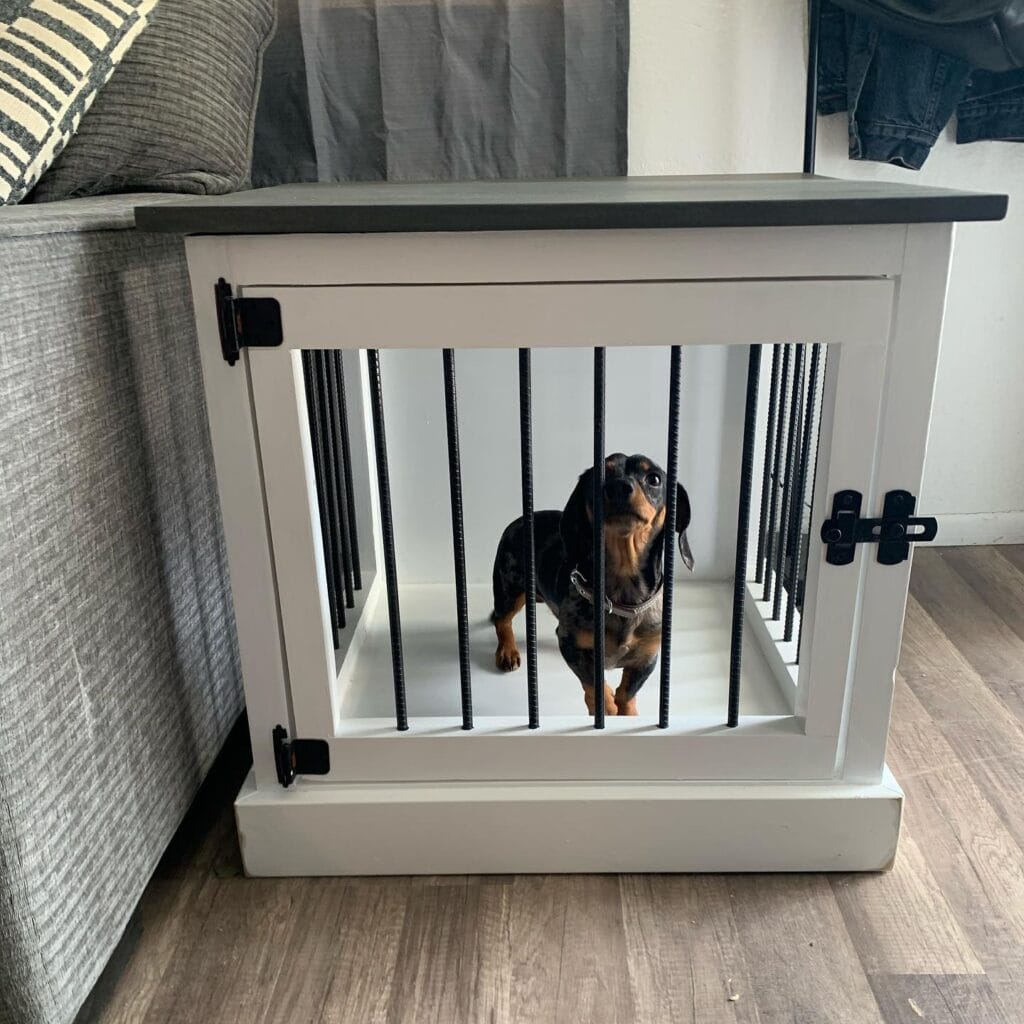
You know the feeling when your dog is just “staring” at you from across the room and her metal wire crate is the first thing guests see when they walk into your home. That has been my dog’s life…well, for two years before my cousin finally had enough.
The build fixes the mismatched look of having a black crate and a white sofa. This dog crate is made of solid white-painted wood and can be used as an end table. The top panel is finished in a dark charcoal gray color. A front door is made using vertical black rebar rods as bars. The front door is housed inside a clean white wood frame. The crate is fitted with matte black hinges and a sliding bolt latch. The crate sits flush against the sofa.
Materials & Tools
– 2×4 lumber (framing)
– 1×6 pine boards (side and top panels)
– ⅜-inch rebar rods (cut to matching lengths for bars)
– White chalk paint or exterior-grade white paint
– Dark gray paint or stain (for the top)
– Matte black hinges (x2) and a sliding bolt latch
– Wood screws, drill, circular saw, sandpaper (120-grit and 220-grit)
– Wood glue, tape measure, level
Instructions
I also cut my 1×6 pine boards into 4 panels for the frame (side walls, back panel and top). However, my cousin didn’t do a dry fit and her frame ended up crooked. Make sure to lay everything out on the floor before you put a screw in!
Build the base of the box first, attaching the side panels to a ¾ inch thick plywood floor piece using wood glue and screws. Let it dry for at least an hour. Since the base box will be solid before the door frame is added, it will not wobble once your dog is inside.
For the door frame, cut two vertical side pieces, and two horizontal rails from the 1×4 pine. Drill a couple of evenly spaced holes (about 1.5 inches apart) along the top and bottom rails to seat the rebar rods. Tap the rods into place with a rubber mallet, and secure each one with a small drop of strong construction adhesive. Because the rebar rods are just there for show, it will keep the front open so the dog doesn’t feel like it’s closed off. The sides are still wood, so it’s structurally solid.
Attach the door to the main crate box using your matte black hinges, attaching one near the top and one near the bottom for even weight distribution. Add the sliding bolt latch at mid-height on the right side – it’s where it is in the picture and it makes it easy to open with one hand.
To sand the entire piece, start with 120-grit sandpaper and then follow up with 220-grit sandpaper to create a smooth surface for painting. Apply two coats of white chalk paint to all wood surfaces except the top of the piece. Paint the top panel in your dark charcoal gray. The two-tone finish is what makes this look intentional.
The best part: and because the crate also turns into a fun end table, we get to reclaim some floor space while our dog gets a cozy den she’s going to want to chill in!
If you want to take your dog’s space even further around the house, check out 12 Creative DIY Dog Gate Ideas for Your Home for some great builds.
Get rebar rods a little bit longer than you need them and grind/file the ends so they’re smooth before inserting them. If your dog crate feels even a little bit off-kilter on the floor, add some felt furniture pads to the corners of the bottom; the pads protect your hardwood and level everything out.
Prep Time: 30 minutes | Active Project Time: 4–6 hours | Difficulty Level: Intermediate
📸 Photo credit: Instagram @standstrongsawworks
#5: Built-In Dog Crate Console Table With Drawers (The Pinterest Dream That Actually Works)
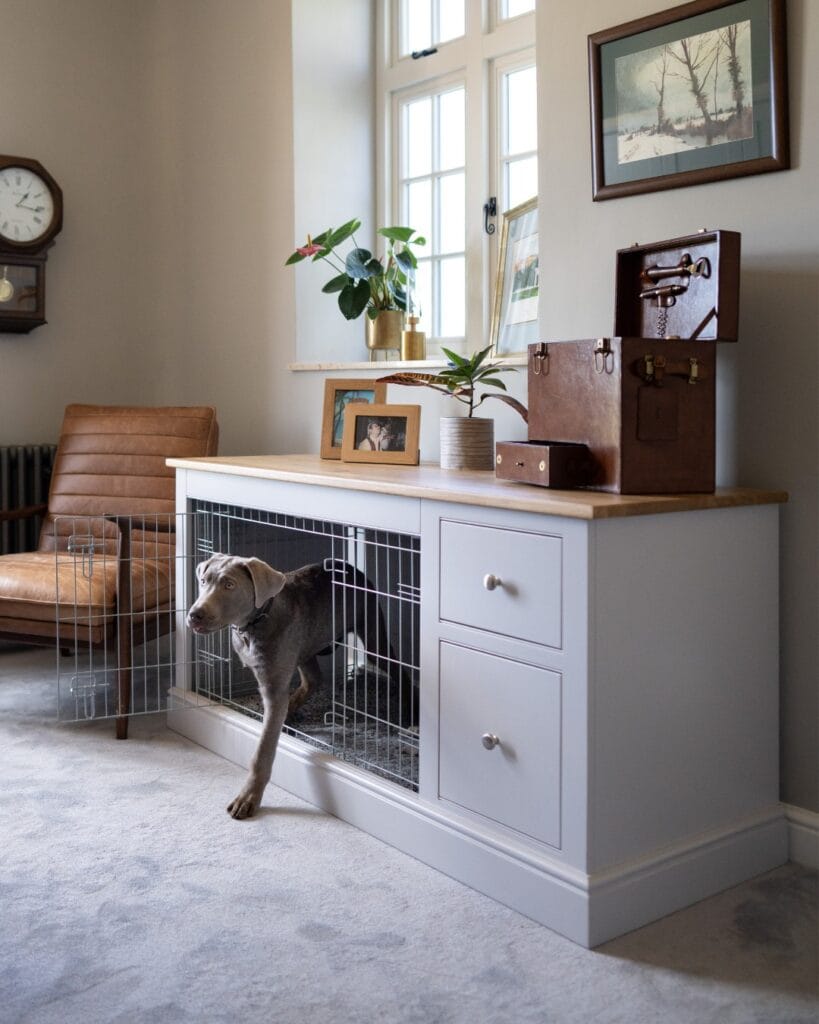
Your golden retriever might have that look–you know the one where she’s half in, half out of her wire crate staring at you with sad eyes while you try to host people in your living room. It’s not the crate. It’s just… there. Clashing with everything you’ve so carefully curated.
This build fixes that.
Prep Time: 2 hours | Active Project Time: 2 full weekends | Difficulty Level: Intermediate
Materials & Tools
– 3/4-inch MDF or birch plywood for the cabinet body
– Solid oak board (at least 1.5 inches thick) for the top surface
– Farrow & Ball Purbeck Stone or similar warm gray paint for the exterior
– Two drawer box kits with soft-close slides
– Round ceramic knobs in matte white
– One 42-inch folding wire dog crate (the internal frame)
– Wood glue, pocket screws, 2-inch finishing nails
– Orbital sander, miter saw, brad nailer, paint roller
Instructions
Cut plywood panels to make a cabinet box that is about 48 inches wide by 20 inches deep by 34 inches tall. Cut the front panel to include a space for the wire crate. Cut this cavity so that the wire crate will slide into it with about 1/2 inch of space on each side.
Attach the lid using pocket screws in the interior corners. Add a center divider to separate the crate space from the right side drawer. This is a structural panel so make sure you glue it. Sand every panel with 120 grit sandpaper before assembly, you’ll be glad you did. Paint reveals everything.
The drawer boxes are built from 1/2-inch birch plywood and mounted on full-extension slides. Being that the drawer column is separate from the crate, your golden’s space will remain her space and won’t have to deal with rattling hardware being near her head when she’s laying down.
Use two coats of gray paint on a foam roller for a smooth, brush-stroke-free surface. The oak top is loose on the table (secured with figure-8 desktop fasteners underneath). Can’t you just smell the warm wood grain against the cool gray?
The whole point of having a feature/ benefit, though, is so that the room looks nice even on the messiest Monday morning, so here’s where the payoff comes in: a functional console table also makes a great dog den!
Real talk: The wire crate is fully removable for easy cleaning. You can simply slide it out, hose it down and slide it back into the stand for a nice cozy and enclosed feeling for your golden. Plus you get a large flat surface to place framed photos, potted plants and whatever else you’ve been pinning.
If you want to add more to the top of your dog crate, check out 7 Creative Dog Crate Topper DIY Ideas for some really clever ways to style your oak surface.
Paint the inside of the crate cavity a dark charcoal. This will make the wire crate almost invisible, and will give the piece a built-in look.
📸 Photo credit: Instagram @thepaintedfurnitureco
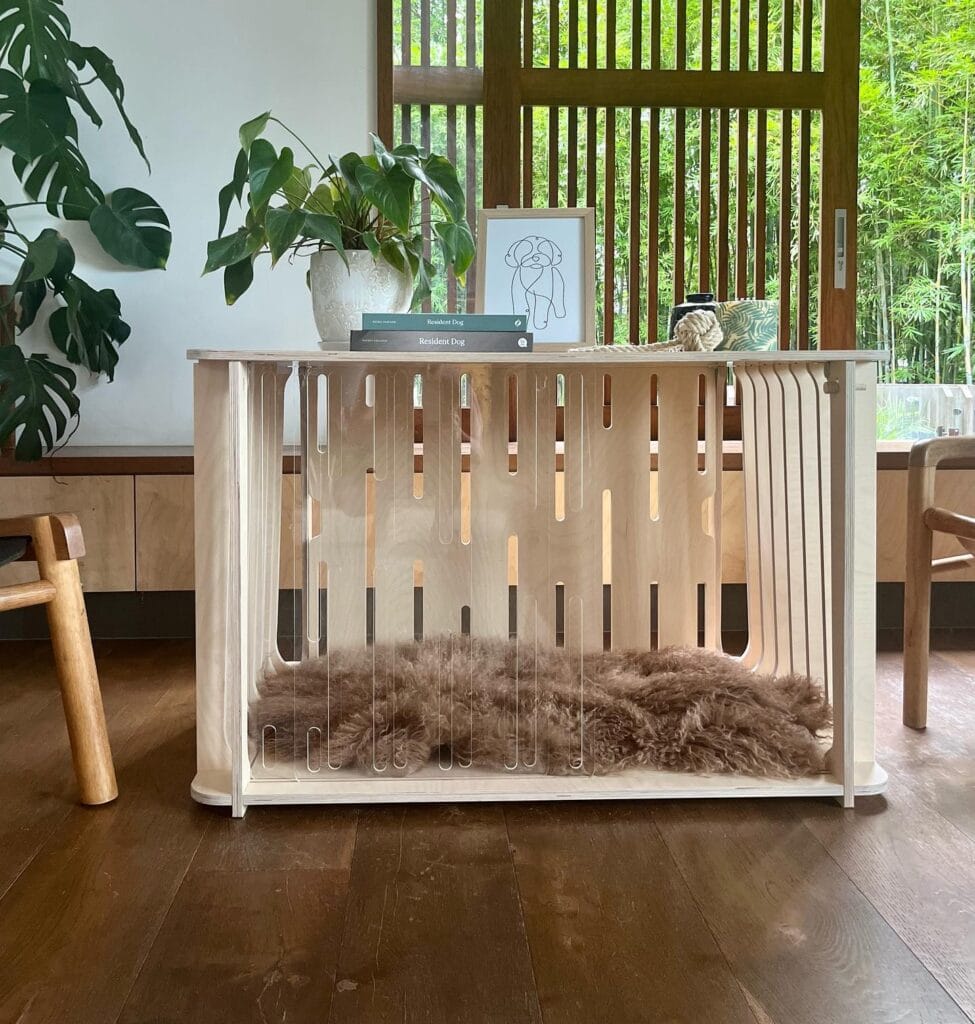
#6: DIY Acrylic & Birch Plywood Dog Crate That Looks Like Actual Furniture
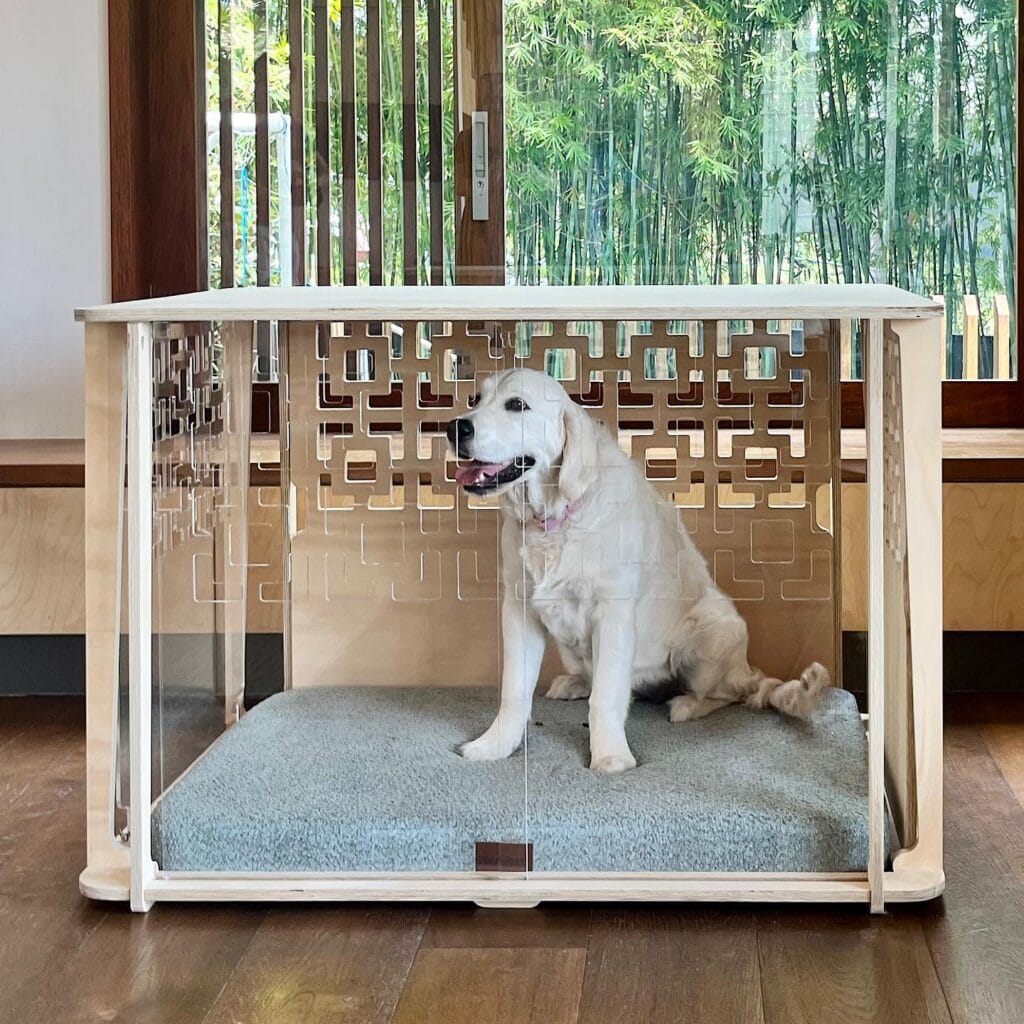
You know that moment when you have a friend over and their eyes go straight to your giant black wire crate in the corner of your living room? Yeah. That moment.
This is what happens when you refuse to let a dog crate ruin your aesthetic.
Materials & Tools You’ll Need:
– ¾-inch birch plywood (for top panel and base frame)
– Clear acrylic sheets — ¼-inch thick, cut to door panel size
– Laser-cut decorative panel in a geometric lattice pattern (can be ordered from Etsy or cut at a local makerspace)
– Wood dowels or corner leg pieces — 1.5-inch diameter
– Piano hinge for the acrylic door panel
– Small barrel bolt latch
– Memory foam dog mat — 3-inch thick, covered in gray boucle fabric
– Wood glue + pocket screws
– Sandpaper — 120 and 220 grit
– Matte white wood stain or primer paint
– Acrylic adhesive
– Drill, jigsaw, measuring tape, clamps
Prep Time: 1 hour | Active Project Time: 6–8 hours | Difficulty Level: Intermediate
### Instructions
Start by cutting your birch plywood into one top panel and one base panel. I made mine the size of my dog (length wise), plus 6 inches on each side. My golden is a big girl so I made mine 42 x 28 inches for both panels.
Sand the two pieces of wood with 120 grit first, then sand them with 220 grit until the surface feels like paper. This may seem like an insignificant step, but trust me, the smoother the wood, the cleaner the stain will sit.
Cut four corner leg pieces of the length you need from your dowels or square lumber. If you have a large dog, like a golden retriever, go with 24 inches tall. This is high enough to give your dog room to sit upright. Less stress in the crate means less scratching sounds at 2am.
Attach the legs to the base panel with pocket screws and glue, then clamp them all together and let them cure for at least one hour.
I attached my laser cut lattice panel to the back and side walls of the tent with acrylic adhesive and thin strips of wood. It feels like an accent, not a cage.
For the front door, secure the bottom of your clear acrylic sheet to one of the front corner legs with a piano hinge. The sheets are hinged on one side and latch on the other so your dog can see out without feeling trapped and whining.
Attach the top panel last. Attach it to the leg tops with wood glue and under the top with corner brackets. Apply the matte white stain in long even strokes, let dry between coats.
A slide in the grey boucle memory foam mat and you’re done. The mat’s cushioned support means your dog actually wants to go in – which makes crate training about a hundred times easier.
If your golden has a special spot outside of his crate for sleep time, 7 Cozy DIY Dog Beds for Large Dogs also has some builds that are clean and gorgeous.
Use furniture feet pads on the bottom of the legs. This helps the crate from moving when my dog is shuffling around inside.
📸 Photo credit: Instagram @thepawsroom_dogcratefurniture
#7: Double Dog Crate Furniture — The Built-In Console Table Your Living Room Deserves
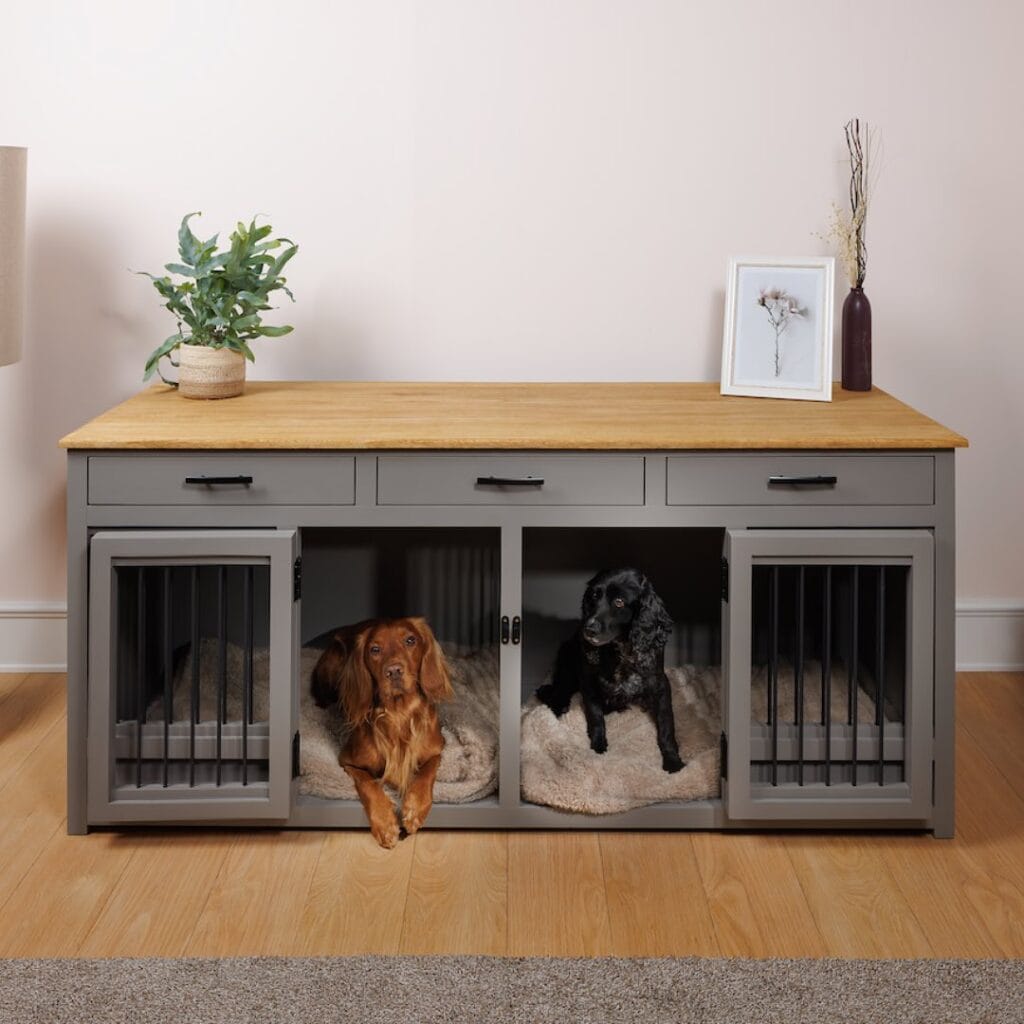
That moment you are trying to get across the living room to the couch and your golden is flopped down right in the middle and you are stepping AROUND her just to get there? Yep. And the wire crate in the corner is just staring at you, and ruins everything you worked so hard to Pinterest-board into existence.
It was the double dog crate console table that made me change the way I live.
Materials & Tools You’ll Need:
– 3/4-inch plywood (birch or oak) for the carcass and top
– Solid oak butcher block (approx. 72″ x 20″) for the tabletop
– Gray chalk paint (I used Frenchic Al Fresco in Silt)
– Black iron bar handles (3 drawer pulls + 4 door handles)
– Black metal crate bars/inserts — pre-cut panels or DIY welded bar grids
– Piano hinges for the 4 crate doors
– Drawer slides (soft-close, 18-inch)
– Wood glue + pocket screws
– Sandpaper (80, 120, and 220 grit)
– Clear matte sealant for the tabletop
– Drill, circular saw, jigsaw, tape measure, clamps
Prep Time: 2 hours | Active Project Time: 2–3 weekends | Difficulty Level: Intermediate
—
### Instructions
Cut out the plywood panels for the main carcass of the cabinet. This will consist of the 2 tall side panels, the full-length top panel which will sit under the butcher block, the shared center divider, and the floor panels that will make up each crate bay. Keep in mind that the finished cabinet will be about 36 inches tall x 72 inches wide x 20 inches deep, giving each dog a bay that will be about 28 inches wide. That should be plenty of space for a cocker spaniel, although you may want to make each bay a bit bigger at 32 inches for a golden retriever.
Start by assembling the outer carcass with pocket screws and wood glue at every joint. Once the carcass is solid, install the center divider, and then add the three drawer compartments across the top of the cabinet. Because the face of the drawer is flush with the front of the cabinet, measure twice before cutting the openings for the drawers.
For the crate bar inserts, you can either weld your own steel bar grids from 1/2-inch round bar stock that’s spaced 2 inches apart, or you can purchase the panels online and cut them to fit your opening. For this build the bars are painted matte black, which also ties in nicely with the hardware. The bars will be attached inside the door frame before the piano hinges. It’s much easier than trying to attach them after the fact.
Sand the whole thing with 80-grit sandpaper then 220-grit sandpaper to smooth out the chalk paint. Two coats of gray chalk paint gives it that dull, dusty look. Remember to seal the wood top, too, because dogs like to jump on the counter and drinks get spilled. Apply one coat of matte polyurethane to the oak top (it won’t look plasticky).
Add a plush crate pad to each bay. That is the moment your dogs walk in, circle twice, and will never look back at the old wire crate again!
Because of the “built in” crate bars, your dog will have a den to lay in that feels safe and enclosed. By being in this secure, enclosed “home” can help to reduce his anxiety which in turn can reduce the amount of whining at night and more calm dog during the day.
But, as if that wasn’t enough, the three drawers up top are perfect for leashes, treat bags, and all that random dog stuff that used to live on my kitchen counter.
If your pup needs more ways to burn energy outside their cozy new space, check out these 7 DIY Dog Agility Course Ideas for Fun to set up in your backyard.
Chalk paint can look a little streaky on the edges of the plywood so I thinned my second coat slightly with water and used a flat brush to get inside those edges. I didn’t use the foam roller on the edges. I was a little nervous about the look of the bar insert openings that I cut out so I taped the cut line first with painter’s tape to help prevent any tearing. I’m not really sure if that was necessary, but it made me feel better.
📸 Photo credit: Instagram @thepetcarpenter
The One Measurement Mistake That’ll Ruin Your Dog Cage Furniture Build
I’ve seen many tutorials tell you to measure your dog’s crate and build around it. Don’t do that.
My family and I decided to purchase a wire crate for our puppy. We had just moved into a new home and thought a wire crate would be best for traveling and any potential potty accidents. I immediately began researching the best wire crate for our sweet puppy. We decided on this wire crate from Amazon. After reading countless positive reviews and pictures of various crate styles and designs, we decided to give this one a try.
Leave a full inch on each side of the steel beam. When you add your interior trim and such, the space will be gone.
The other thing that no one mentions is that wood choice is more important than finish choice. The pine looks pretty, but will dent with the mere touch of your golden retriever when she decides that the furniture is a scratching post. Save yourself the grief and buy the frame in poplar or oak — even if you paint over it.
And if you’re building a whole dedicated dog zone, you’ll definitely want to throw this in there along with 7 Creative Ideas for Your DIY Dog Washing Station.
Build smarter, not prettier first.
Your Home Can Look Good and Survive a Golden Retriever
Now, the fun part. As great as this house is, I’m not going to force you to live without your dog. Both can exist. I promise.
Just choose one product from the list below and try it. You will notice the difference immediately. No more will your guests walk through the house in muddy-paw panic, or will you hide the sofa cushions before they arrive.
When your home is feeling like yours again, it should be stylish, calm and above all…golden-retriever-approved!
Which problem are you tackling first? The mud situation, the fur situation, or “my dog owns this couch now” situation? 😄

Amr Mohsen is a software engineer who traded his keyboard for a leash — at least on weekends. His love for dogs inspired him to share what he learns as a dog owner and enthusiast, bringing a detail-oriented, research-driven perspective to every article he writes. If it’s about dogs, he’s probably already looked it up twice.