I know that your golden retriever is precious but that crate in your living room is screaming “I gave up on decorating.”
I felt so stupid last spring. I had worked so hard to get my apartment just right — cozy throws, neutral rug, etc. Then some big metal eyesore has to be plunked in the middle of my living room? My cousin walked in and said, “Is that a jail cell?” I wanted to hide.
I want you to take a second and realize your dog deserves a little space to call his/her own, while your home is still your home.
And that’s why I gathered these 10 fantastic DIY dog cage designs that actually work as real furniture! The designs are those that can blend into your home’s decor rather than clash with it. And if you need a few more ideas for this fun dog cage furniture DIY ideas, these are it!
Your home. Your dog. Both happy.
#1: DIY Wooden Hay-Style Dog Kennel With a Flip-Top Lid
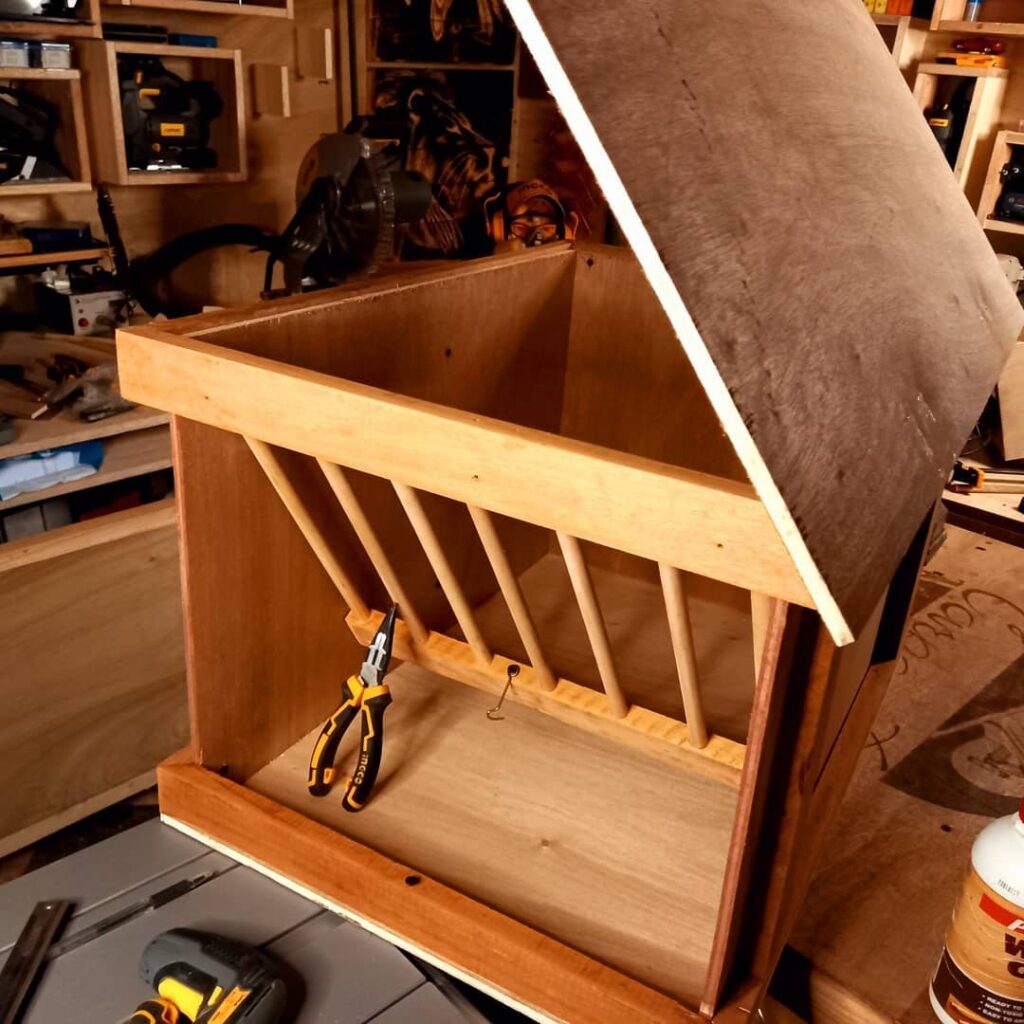
So what happens when your golden comes in from the backyard and shakes mud everywhere and then just flops down on your freshly vacuumed rug? Well, she kind of does own the place. But, giving her a dedicated space of her own can really make a difference.
I LOVE this handmade kennel. It’s giving off full Pinterest-board energy and I’m here for it.
Materials & Tools You’ll Need:
– ¾-inch plywood (for the side panels, back panel, base, and lid)
– Hardwood dowels (approximately ½-inch diameter, cut to matching lengths for the front gate)
– Wood glue (I spotted what looks like PVA wood glue in the background — that white bottle is doing heavy lifting here)
– Wood screws — 1¼-inch and 2-inch lengths
– Sandpaper — 120-grit then 220-grit for finishing
– Piano hinge or two barrel hinges for the flip-top lid
– Small hook-and-eye latch to keep the lid closed
– Drill, jigsaw, miter saw, clamps, measuring tape, pencil
Prep Time: 30 minutes | Active Project Time: 6–8 hours | Difficulty Level: Intermediate
Instructions
Cut the ¾ inch plywood into two identical panels for the side of the kennel. These panels will form the triangular A-frame like in the picture. Cut the top of the kennel at an angle so it has that barn roof look. Cut the angle at about 45 degrees so the panels mirror each other.
Then, cut the back panel out of plywood and make it fit flush between the two side pieces. The back panel keeps the structure rigid, so take your time. Glue and screw this back panel into both side pieces using 2 inch wood screws every 6 inches along the edges.
Cut your base panel next. It is the panel that sits inside of the frame and rests on the lower horizontal support beam. You can see it in the photo on the left where the kennel is a bit lifted off the surface (this raised base keeps your girl off of the cold floor).
The front gate requires ½-inch hardwood dowels to be installed in an angled fashion not straight up and down. This will distribute the pressure across the frame and not allow the gate to be pushed in when a 60 pound dog leans on it. Drill angled holes in the top rail and bottom rail. Push the dowels in with wood glue, no need for nails.
The thing that makes this genius to me, is the top lid. That’s the entire draw of the product. It’s a single piano hinge that runs the length of the back edge of the lid, attaching it to the top of the back panel. The lid opens wide (it is propped wide open in the picture) making it so easy to clean inside it that you do it without even thinking, which keeps your dog healthy and your home smelling less doggy.
Sand everything with at least a 120 grit paper, and then finish with the 220 grit, to give the surface a nice smooth and snag free finish. Wipe down the surface with a damp cloth before applying any stain or sealant.
If your golden already has an outdoor setup, this indoor kennel would be a perfect compliment to one of the 17 Creative DIY Dog Run Ideas for Your Furry Friend.
I would cut my dowels just a little bit longer than needed and trim flush once the glue dries. This is easier than cutting to the exact length before assembly.
📸 Photo credit: Instagram @blazing_art_thou
#2: DIY Industrial Pipe and Wood Dog Pen (With a Personalized Name Plaque!)
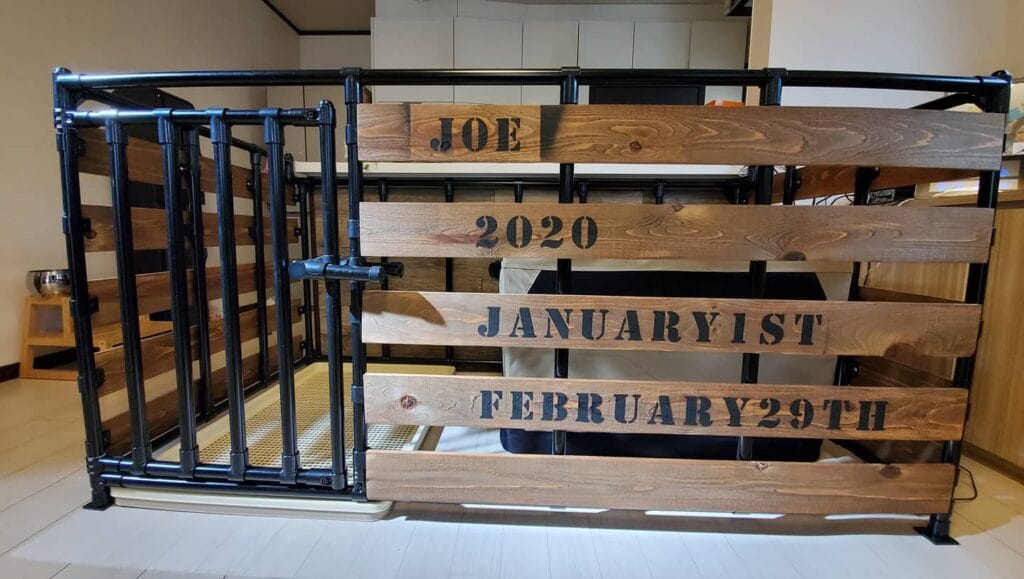
I don’t know if you’ve ever had the experience of a golden retriever thinking that the living room is the pen, but Bailey would sprawl across the whole floor, wagging her tail into my coffee table, and I would be stepping over her every five seconds to try to get to the kitchen.
Fellas, this black iron pipe and stained wood dog pen is the solution to the problem you didn’t even know you had. Plus, it looks like something straight out of your Pinterest board.
Materials & Tools:
– ¾-inch black iron pipes (various lengths)
– Black pipe fittings (T-joints, elbows, floor flanges)
– 1×6 cedar or pine boards (stained dark walnut)
– Pipe wrench and screwdriver
– Wood stain + brush
– Stencils and black paint for lettering
– Metal wire mesh panel (for the floor base)
– Self-tapping screws
– Hinges for the gate door
Instructions
Start by cutting the boards to the same length. In this build, the boards are about 48 inches wide. Stain the boards dark before you assemble them so that the edges will soak evenly. While the boards dry, build the pipe frame using a series of ¾-inch iron pipes connected by T-joints at each corner. The pipes are screwed by hand first, then tightened with a wrench.
Slide the boards horizontally between the pipe uprights so they are about 4 inches apart and use screws to secure them in place. This spacing allows your dog to breath more freely and will hopefully help them to stay calmer. It will also save you from having to replace scratched flooring!
The gate on the left side is hung by two hinges that are bolted directly to the pipe frame. It swings clean and is hooked with a latch. Lay the wire mesh panel flat on the floor as a floor base so it is easy to wipe down.
I cut the name planks, 3 boards slightly shorter than the front panels. I stenciled each board using a bold block stencil with a black craft paint. Then I coated the name planks and the front panels with a matte polyurethane varnish so the stenciling would not be scratched off.
These 13 Genius DIY Dog Stuff Every Pet Parent Needs to Try Today! look so cute if you’re building out a dog-dedicated corner.
Sand all edges of boards that your cat or dog will be walking on so they don’t get splinters in their paws. And remember to test the gate latch when you leave your dog alone!
Prep Time: 1 hour | Active Project Time: 4–6 hours | Difficulty Level: Intermediate
📸 Photo credit: Instagram @c0zy4
#3: DIY Wooden Dog Crate with Metal Bar Panels (The One That Actually Looks Good in Your Living Room)
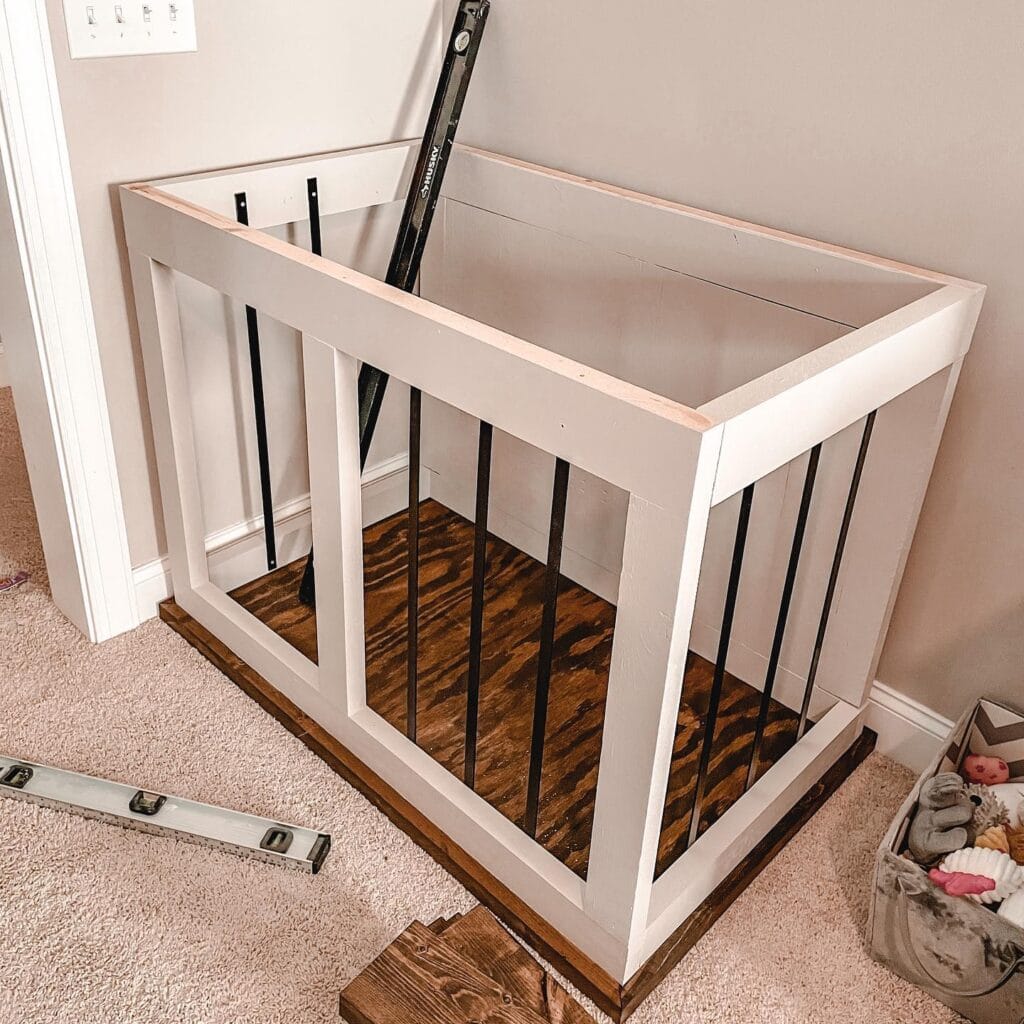
Perhaps you have experienced this with your golden retriever. She decides the corner of the room is her chaos zone. There is fur everywhere, toys scattered all over, and the plastic crate is screaming “I do not belong here”. That is how I felt when my cousin was experiencing the same situation with her lab.
This build is exactly what you need.
Prep Time: 1 hour | Active Project Time: 4–6 hours | Difficulty Level: Intermediate
Materials & Tools:
– 2×4 pine lumber (frame structure)
– 1×6 pine boards (top frame and base platform)
– ⅝-inch plywood (floor panel — stained dark walnut)
– Black metal flat bar rods (¼-inch x 1-inch, cut to 18-inch lengths)
– White chalk paint or semi-gloss white latex paint
– Dark walnut wood stain
– Metal L-brackets (for top frame reinforcement)
– Wood screws, drill, miter saw, level tool, sandpaper
Instructions
Cut the 2×4 pine into four corner posts that are 30 inches tall. Sand every edge of the wood to prevent the golden’s nose from getting splinters. Cut the pieces of the top frame and the base frame from 1×6 boards. Assemble the top and base frames into their respective rectangles.
Paint all wood pieces with two coats of white semi-gloss BEFORE assembly. Just trust me on this one. Painting your flat pieces first will save you so much frustration later.
Attach the corner posts to the bottom of the frame using metal L-brackets (like the ones shown below). Make sure they are tight. Attach your black metal bar rods every 3 inches along each side panel. Drill pilot holes into the top and bottom of the wood to avoid splitting it. Slide the bar rods into the holes and attach with screws.
I have this dark walnut stained plywood floor panel sitting inside the base frame. It protects the carpet from muddy walks and mystery stains.
Secure the top frame last. We used L-brackets on the interior corners to keep things square, and a level to make sure everything was true before anything started to dry and set up.
And the best part is that, this crate turns into a piece of furniture! Your golden can have a cozy and secure den and you get a piece of furniture that compliments the aesthetics of your Pinterest-worthy home. Check out our other DIY elevated dog bed ideas too!
If you’d like a door, you can add a small hinged panel on one side with the same metal rod design on one of the short sides of the face.
Seal the stained floor panel with two coats of polyurethane. It makes for a clean-up after muddy paws a wipe-and-done.
📸 Photo credit: Instagram @homesweetstickelmaier
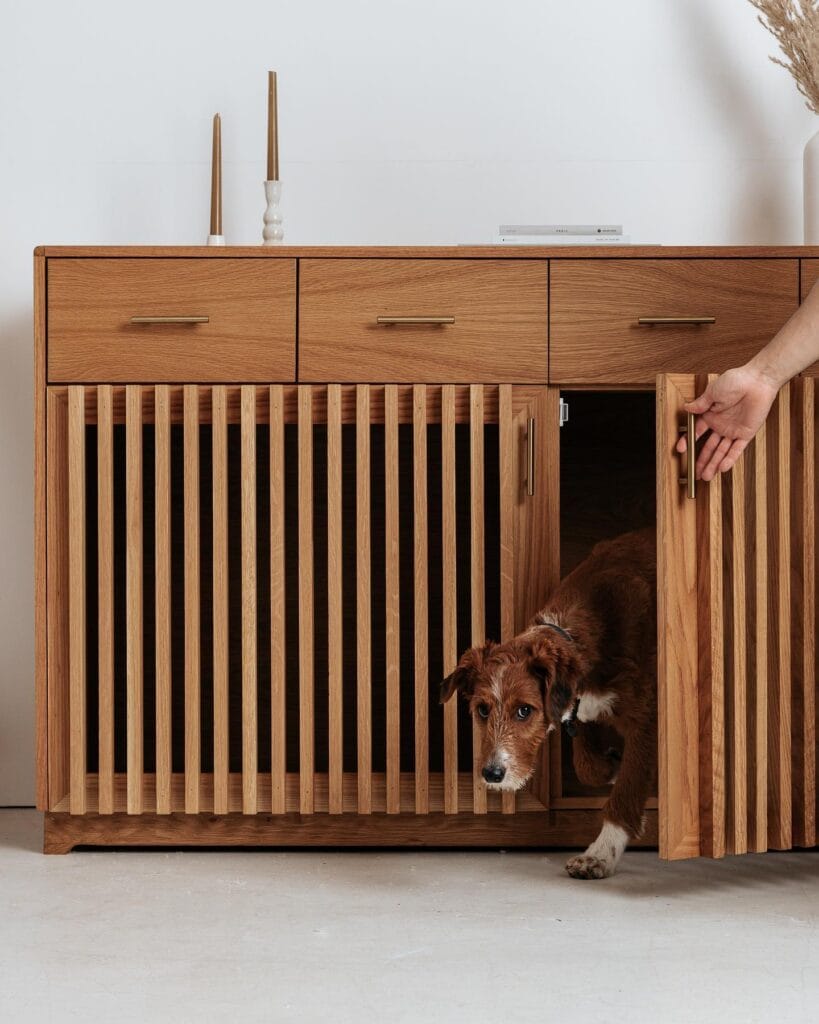
#4: The “Guti” Named Personalized Wooden Dog Crate That Doubles as a TV Console
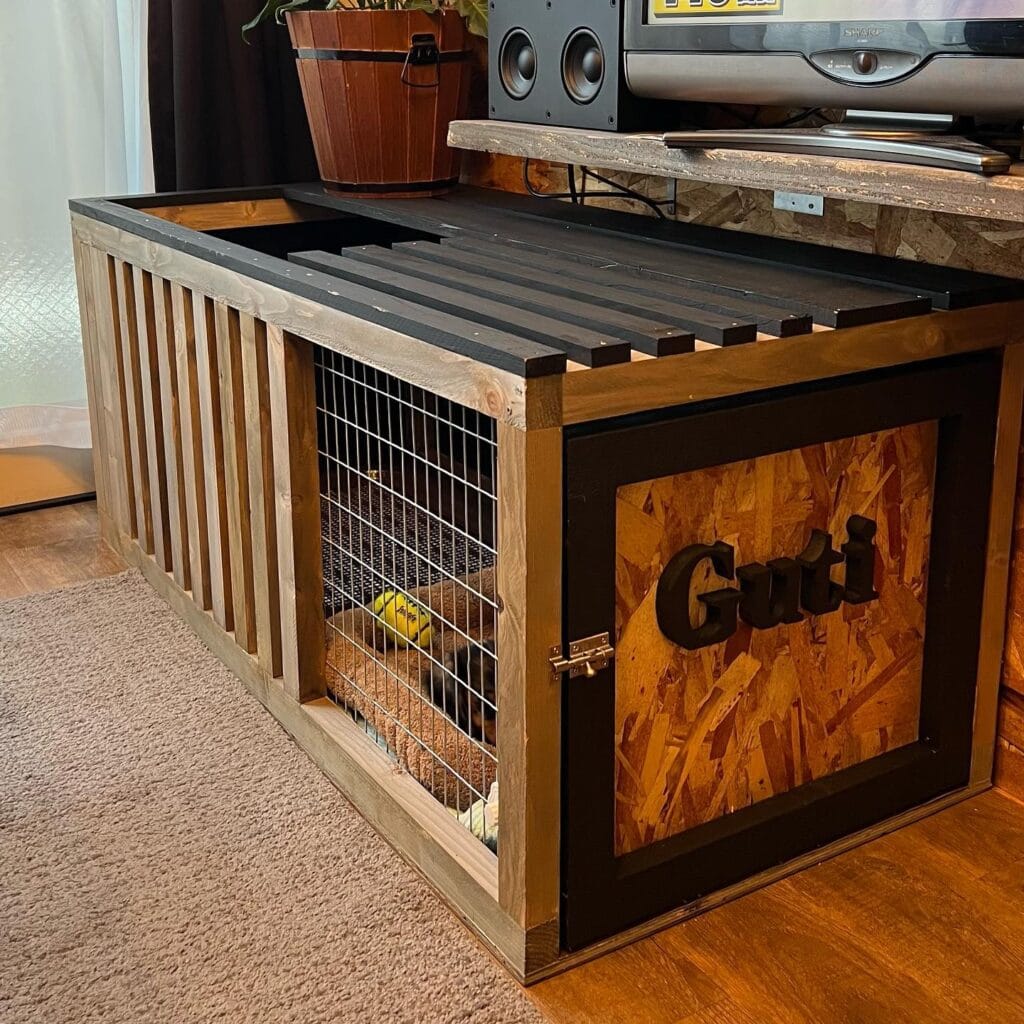
It happens to all of us. Your golden retriever plops herself down right smack dab in the middle of the living room and her bulky plastic crate is just there, standing out amongst all of the work you’ve done to style your home.
I was in such awe when my cousin made this for his dog “Guti”. I seriously couldn’t help but stare at it.
This beauty is a custom-built wooden dog crate. It slides right under my TV console, so it’s literally a part of the furniture. The frame is made out of natural cedar 2×2 lumber for the vertical slats on the sides, and the front has a black-painted OSB panel door with 3D raised block letters spelling out the dog’s name. The top is lined with black-stained wooden slats, spaced just right so air can flow through, and there’s a welded wire mesh panel with a brass latch for the entry.
It also sits on my hardwood flooring without scratching it up. The base is flush and clean.
Materials & Tools You’ll Need:
– Cedar 2×2 lumber (side slats and frame)
– OSB board (front door panel)
– Welded wire mesh panel (door insert)
– Black exterior wood paint or stain
– Natural wood stain (cedar tone)
– 3D wooden or MDF letters
– Brass barrel bolt latch
– Wood screws and corner brackets
– Circular saw and miter saw
– Drill and bits
– Sandpaper (120 and 220 grit)
– Wood glue
– Measuring tape and carpenter’s square
Instructions
Cut the first pieces of wood. With the 2×4 lumber, cut it to 4 pieces so that it forms the base. We cut the pieces to length for 48 inches and width of 24 inches. We used drill and screws at each corner along with corner brackets to hold the pieces together. This base will need to hold some weight so we wanted extra help.
Next up are the four vertical corner posts. I used 2×4 lumber and cut them to 28″ tall. Attach one post to each corner of the base frame using 3 inch wood screws. Make sure the post is perfectly plumb before tightening the screws with your carpenter’s square, or the rest of the slats will not be straight.
For the side panels cut your 2×2 cedar slats to 28 inches and space them 2.5 inches apart on each side of the frame. Screw each slat into the top and bottom rails. Leave the cedar wood grain natural and unstained on the sides so that it provides a warm contrast with the black top, providing a color split that makes it look intentional and not just “homemade”.
I built the top panel separately out of 1×3 black stained planks. They were laid side by side with half inch gaps between them. I attached this panel to the top of the four corner posts. That gap is not just for decoration. It gives Guti ventilation which helps to keep her calm and cool while in the crate.
CUT THE FRONT DOOR: Cut your OSB board to fit the front opening of the door and then frame it with black-painted 1×2 strips to give it that finished panel look. Cut a wire mesh insert for roughly the top two-thirds of the door, staple it to the back of the frame opening, and then cover the edges with 1×2 trim to give it a professional look, so there are no sharp edges. Mount your 3D letters to the door with wood glue and let them cure for 24 hours. Attach the door to the frame with two heavy-duty hinges. Attach your brass barrel bolt latch to the mid portion of the door so it can be opened with one hand.
Sand the entire piece with 220-grit sandpaper before your final coat of paint. The final light sand gives the black sections that furniture store finish instead of the garage project finish.
One thing to remember: Cut a piece of non-slip rubber matting to cover the bottom of the inside of the box to protect your wood floor and give Guti something to grip with her paws so she’s not sliding around every time she settles down.
If you have a personalized name panel on your dog’s crate, chances are that you love it. Every time we see the name panel, we always stop and ask questions about it. If you love it, then 14 Stylish DIY Dog Crate Furniture Ideas You’ll Love might give you some more inspo to make your crate look like it belongs to the set of a design magazine.
Prep Time: 30 minutes | Active Project Time: 6–8 hours | Difficulty Level: Intermediate
I seal the entire outside with a water-based polyurethane coat after painting. This coats the dog noses, paws and the occasional spilled water bowl.
📸 Photo credit: Instagram @mokuzaiman2019
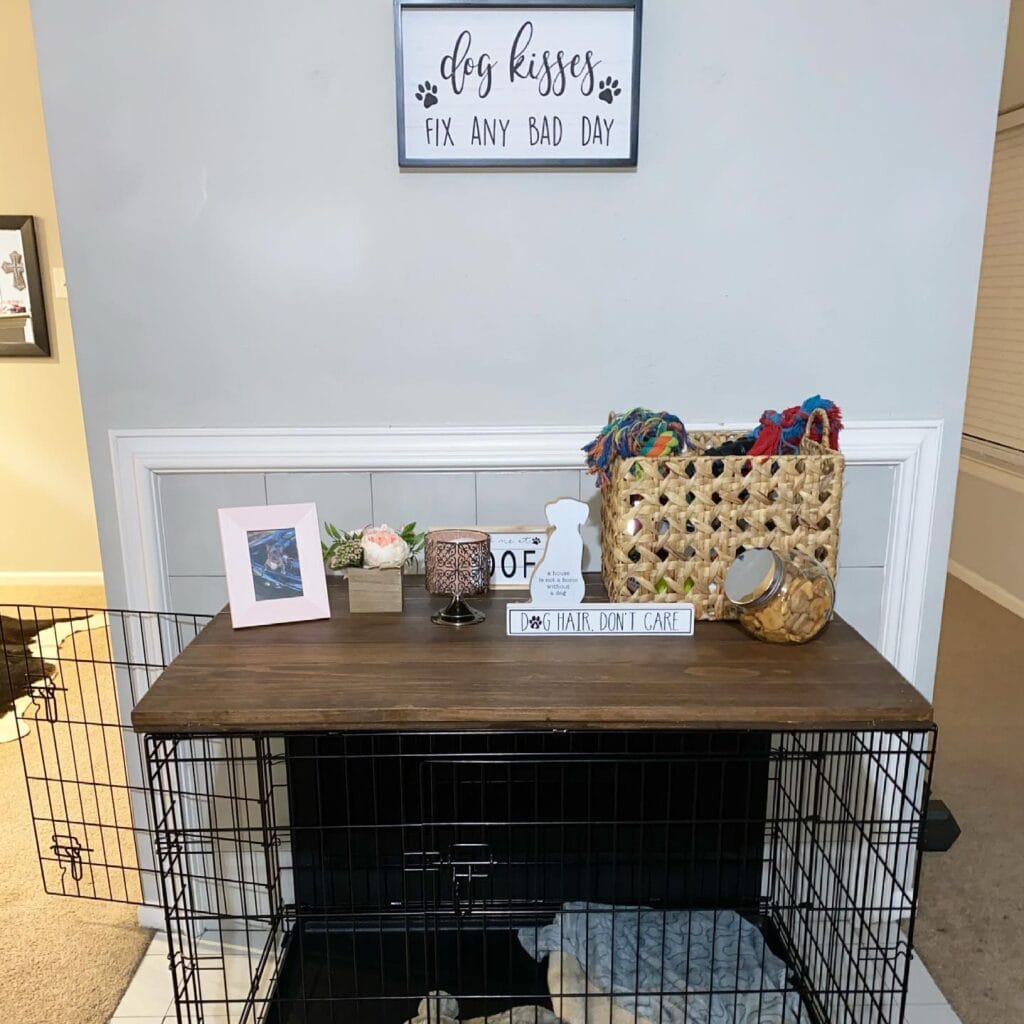
#5: DIY Dog Crate Console Table (With a Styled Top That’ll Make Your Living Room Look Intentional)
Prep Time: 30 min | Active Project Time: 2–3 hours | Difficulty Level: Beginner-Friendly
—
Do you have one of those moments when you’re staring at your golden’s crate that’s been sitting in the middle of your living room for six months? Yeah, mine was blocking my entryway and I kept stubbing my toe on it in the morning.
This is a much different set up than I normally do with crates. But when a wire dog crate is topped with a stained wood console surface, it becomes more than just a kennel. The styled top with woven basket of rope toys, little sign that reads, “Dog Hair, Don’t Care”, and a treat jar turned this into something that could be featured on your Pinterest board.
Materials & Tools:
– Standard wire dog crate (double-door, black metal)
– 1-inch thick pine or poplar board cut to crate dimensions
– Dark walnut wood stain + foam brush
– Sandpaper (120-grit, then 220-grit)
– Woven basket for toy storage
– Small decorative signs, candle holder, photo frame
– Glass treat jar
Instructions
Sand your board smooth starting with 120-grit, then finish with 220-grit to get a smooth surface. Apply two coats of dark walnut stain letting each coat dry 45 minutes before applying the next coat.
The stained wood top sits directly on the crate frame so no hardware is needed. This means your golden has full airflow and visibility inside.
Style the top in three zones: I have a photo frame, flowers and a treat jar in this area. I know a lot of people have the treat jar on their bedside table. Well, the dog can reach it – I can’t! I added a small toy basket for my dogs on the right side of the table to keep it looking nice and curated, not cluttered.
The best part: I like that there is a wall sign over the crate. The Dog Kisses sign over the crate is cute without being overdone. Love this cozy dog-mom feel to the image.
If you want to mix up the materials and do something different, check out some of the other ideas in 7 Creative Dog Crate Topper DIY Ideas.
Seal the wood with a matte polyurethane coat. This will help guard against spills (someone always knocks over the water bowl) and keeps the rich stain looking fresh for years.
📸 Photo credit: Instagram @pepper.exotics
#6: DIY Farmhouse Dog Crate Furniture (The One That Actually Looks Good in Your Living Room)
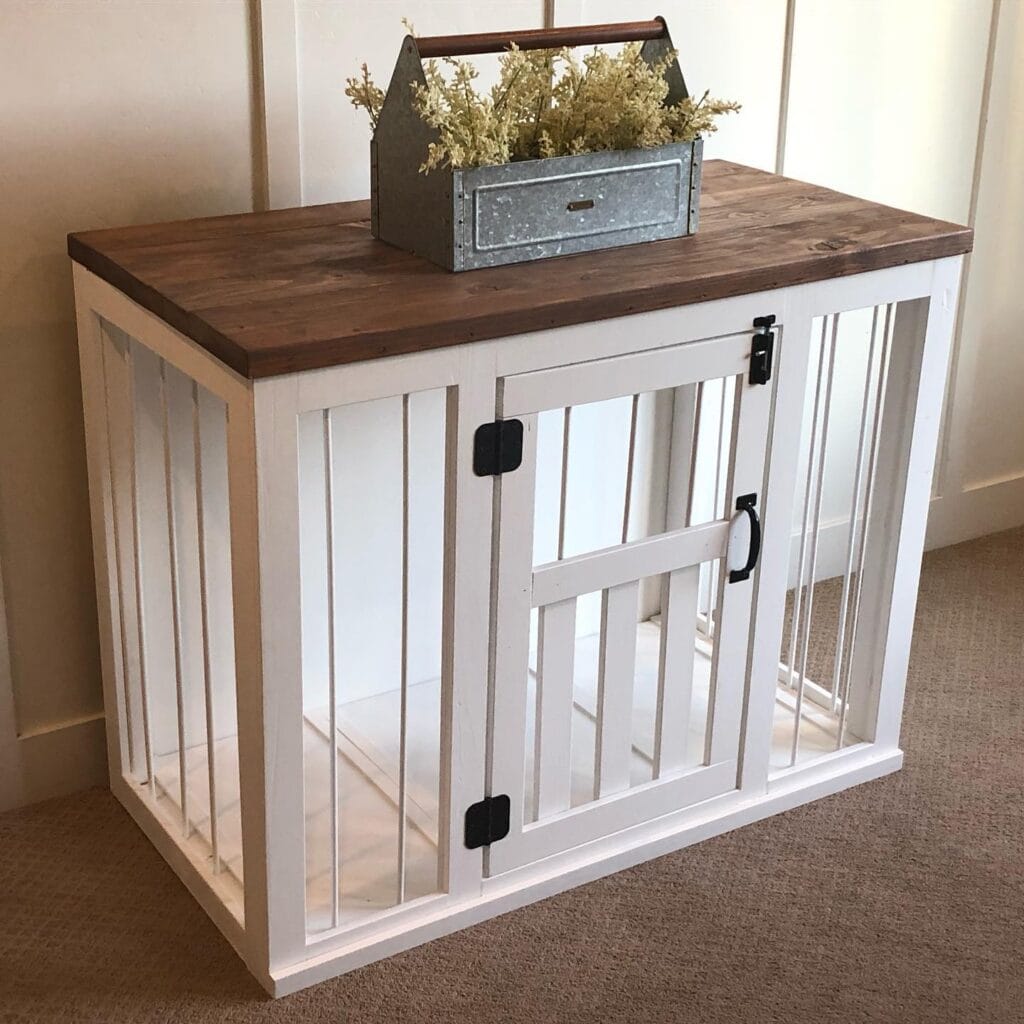
If you are in the same boat as I was when my golden retriever dog finally settled down after zooming around the house and you look over at that black wire crate sitting in the corner of your living room and you just cringe, then mine looked like a prison cell next to my couch. It drove me crazy.
This super easy-to-make white painted wood dog crate with a stained walnut-toned top makes the perfect “end table” and holds all your farmhouse decor on top. Then just pop your dog inside the crate and he’ll have his own little cozy den instead of being an afterthought.
Materials & Tools You’ll Need:
– 2×4 pine lumber (for the frame)
– 1×2 pine slats (for the vertical bars on all four sides)
– 1-inch thick pine board (for the top surface — approximately 36″ x 20″)
– Black iron hinges (x2) and a black iron latch handle
– White chalk paint or milk paint (flat finish holds best)
– Dark walnut wood stain for the top
– Sandpaper (120-grit and 220-grit)
– Wood screws (1.5-inch and 2.5-inch)
– Drill, miter saw, tape measure, and wood glue
– Galvanized metal toolbox planter (for styling the top — totally optional but chef’s kiss)
Instructions
Start by cutting your 2×4 pine into four corner posts that are 28 inches tall. These are the skeleton of the whole thing. I was a little sloppy on this first build and didn’t take the time to make sure these posts were square. As a result, the door never hung square.
Make two pieces of your frame from 2×4, a length of 36 inches and a depth of 20 inches. Screw the pieces together into a rectangle using 2.5 inch screws and glue at each joint. Attach your four corner posts upright to each corner of the base.
Cut 1×2 pine slats to fit in the sides and back of the cage. Cut them about 2.5″ apart, which is wide enough to allow for airflow but close enough so your golden can’t stick a snout through and steal your snacks. Attach each slat with 1.5-inch screws on the top and bottom of the slat. Attach the slats to both side panels and the full back panel of the cage.
For the door, I framed the opening with two vertical 2×4 pieces down the center-front of the crate, leaving about a 14 inch gap for the door frame. I then built a door out of 1×2 slats mounted inside a 2×2 frame, and hung the door on the hinges. I added my black iron latch handle on the right side of the crate — the kind with the little D-ring pull on it that looks just like what’s in this build.
Sand everything with 120-grit sandpaper, and finish with 220-grit sandpaper before painting. I used two coats of white chalk paint, letting the paint dry completely between coats. The chalk paint gives the stool a softer farmhouse look, and isn’t shiny or plasticky.
The top, though, is where things get really fun. I cut my pine board to 36″ x 20″ (slightly wider than the frame) and sanded it smooth. Then I brushed on two coats of dark walnut stain with a cloth in long strokes (you can apply two coats of stain and then one coat of matte polyurethane over top to protect it from water bowls or clumsy paws). I screwed the top down to the inside of the frame from the bottom so there wouldn’t be any hardware showing from the top.
Real talk: The stained top makes this piece look like furniture instead of a craft project. Everyone loves the contrast between the warm brown wood and the crisp white base.
Prep Time: 30 minutes | Active Project Time: 6–8 hours | Difficulty Level: Intermediate
Style the top of your dog’s crate with a galvanized metal planter box filled with dried greenery, just like in the photo, it will add a farmhouse touch to your home. And if your golden is on the bigger side, check out 7 Cozy DIY Dog Beds for Large Dogs to add some cushion inside the crate.
The Dog Den creates a calm, secure spot for your dog, it is also a great way to keep your dog off the floor, leaving your living room looking pulled together without having to hide your dog away.
Just lightly sand all of the paint edges with a fine sandpaper after applying the last coat for a smooth finish as in the photo. This removes the brush stroke effect and makes the white look clean and intentional.
📸 Photo credit: Instagram @thedevondowdell
#7: The Designer Dog Crate That Doubles as a Side Table (Birch Plywood + Acrylic Build)
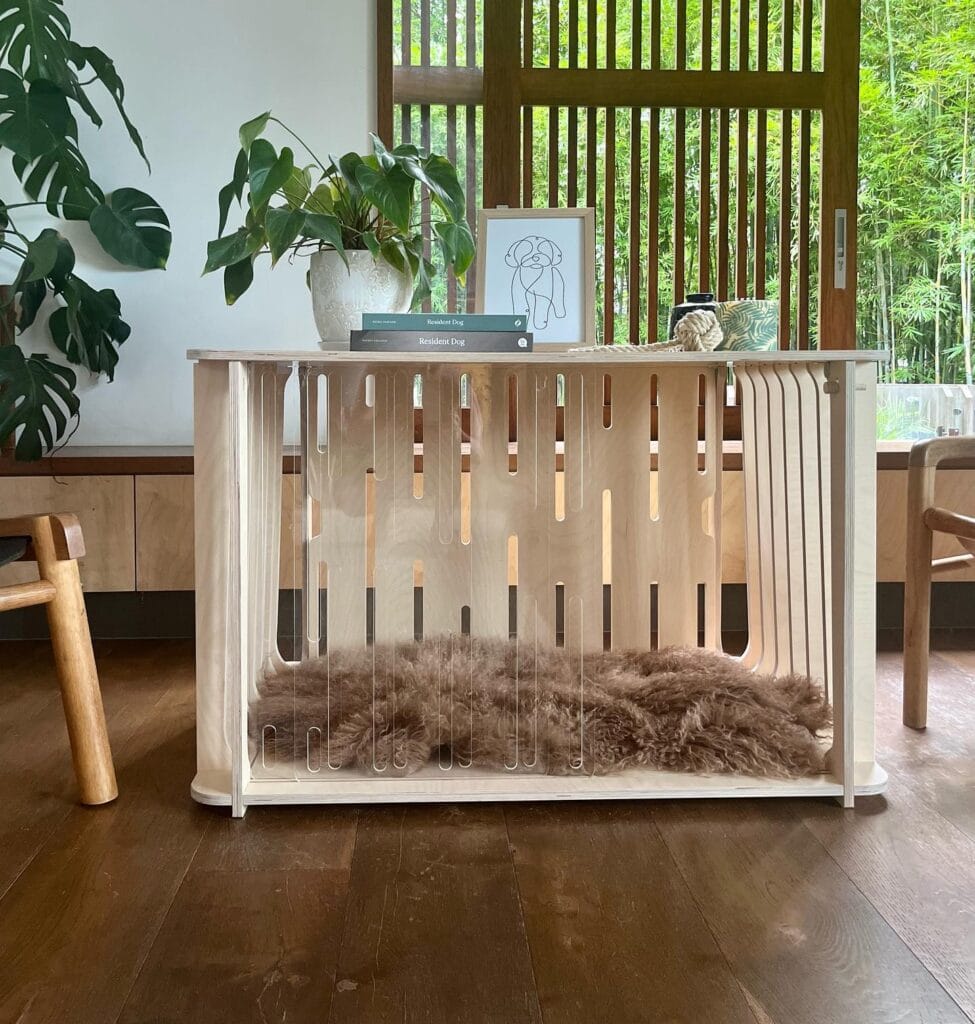
You know that moment when your golden tracks mud all over your living room and make a beeline for her crate? That sad looking, plastic kennel shoved in the corner that ruins your whole aesthetic? Mine used to live behind the couch because I couldn’t stand looking at it.
This build changed everything.
Prep Time: 1 hour | Active Project Time: 4–6 hours | Difficulty Level: Intermediate
Materials & Tools:
– 3/4″ Baltic birch plywood (two 24″ x 36″ sheets)
– 1/4″ clear acrylic sheet (24″ x 36″)
– Rounded pine dowels (roughly 3/4″ diameter, cut to 22″ lengths — you’ll need about 15)
– Sandpaper (120-grit and 220-grit)
– Wood glue + clamps
– Jigsaw with a fine-tooth blade
– Drill with 1/4″ and 3/4″ bits
– Matte water-based polyurethane (clear finish)
– A fluffy sheepskin liner (that brown one in the photo is everything)
Instructions
Start by cutting your plywood into two side panels (24″ x 36″), one top panel (36″ x 18″) and one base panel the same size as the side panels. The top panel will be what makes this piece furniture so it’s important to keep it flat and clean. Sand both sides of all four panels with 120-grit sandpaper until they are smooth and then sand them again with 220-grit sandpaper until the surface feels like skin.
Mark the dowel holes 2 inches apart along both side panels on both sides of the kennel 1 inch from the edge of the kennel. Drill clean 3/4″ holes all the way through the panels. Leave the holes 2 inches apart as it will make the kennel look like the slats are very open and airy. Dogs like to be able to see out but still have the feeling of being enclosed, so this works well.
I then slid both panels into the dowels and slathered a ton of wood glue in each entry point. I clamped everything overnight (don’t skimp on this step – you want it to be nice and sturdy!).
Cut your acrylic front panel to 22″ x 18″ with a jigsaw and a fine tooth blade. It is a good idea to score the cut line with a utility knife so as not to crack the acrylic. Drill two 1/4″ mounting holes at the top of the panel. This panel swings open like a door, so we attach it with small barrel bolts. The acrylic panel is what makes this design so sharp. Not only does your dog get some nice airflow but you get to see her and when your guests come over they see what looks like something out of a boutique furniture store.
I have applied two coats of a matte polyurethane to all of the wood surfaces. It is important that it cures for at least 24 hours before your dog goes anywhere near it.
Drop in the sheepskin liner and done.
The plywood is so strong that my 60 pound dog can lean against the sides without it breaking. The acrylic door keeps her in without making it feel like a cage and the flat top gives me space for books and a plant.
My friend made this for her lab and put it together with two coffee table books and her monstera. Her guests were thinking it was some kind of credenza.
Make sure the polyurethane is fully cured and odor free before you let your dog in the crate. Your dog’s nose is sensitive and a strong chemical smell can make him/her avoid the crate for weeks.
📸 Photo credit: Instagram @thepawsroom_dogcratefurniture
#8: DIY Dog Crate End Table With a Wood Frame (The Coziest Hideout Your Golden Will Ever Have)
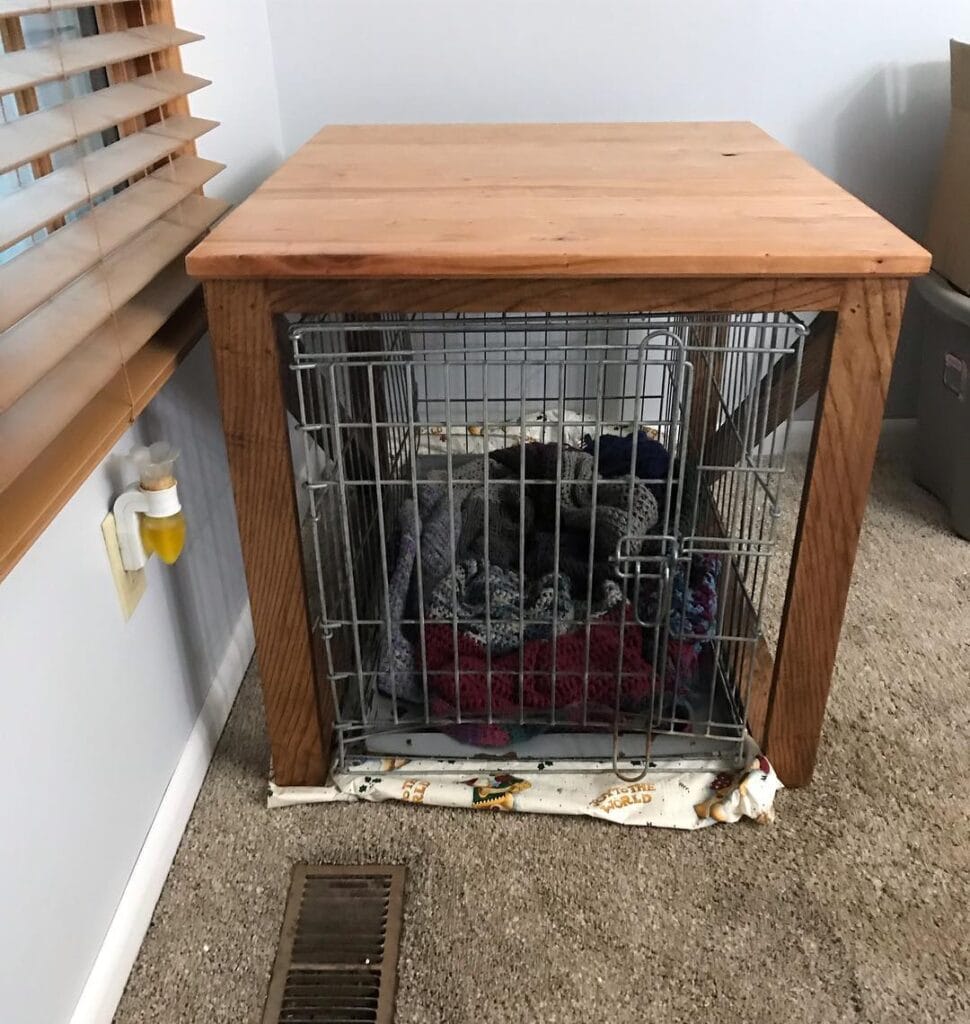
As you know, nothing irritates me more than when my golden has sprawled out on the living room floor and her crate is sitting in the corner looking like a prison cell next to my nice furniture. Well, mine was sitting right next to my couch looking like a prison cell, and I couldn’t take it anymore.
This build wraps a wire crate with a solid oak wood frame with a flat-top surface that also serves as an end table. The one in the photo uses red oak lumber for the corner posts and a wide plank tabletop. The warm honey tone works great in a cozy living room.
Materials & Tools
– Red oak 2x4s (for the four corner posts)
– 1×6 or 1×8 oak planks for the tabletop surface
– Medium wire dog crate (the photo shows a standard single-door wire crate)
– Wood screws and wood glue
– Sandpaper (120-grit then 220-grit)
– Stain or wood finish in a warm walnut or natural oak tone
– Circular saw or miter saw
– Drill and drill bits
– Measuring tape and speed square
Instructions
Measure your wire crate on all four sides to determine the height, width and depth. You will want to make the frame just around the outside edge of the wire crate. Take into account the thickness of the wood when figuring out the length to cut your wood. For example if your wire crate is 12 inches tall, add ¾ inch on each side for your cut height.
Cut the four corner posts to the height of the crate plus the thickness of the tabletop. 20180910_144649.jpg Each post should sit flush with the bottom of the crate and rise straight up. Sand each post with 120-grit sandpaper to knock off the rough edges then follow up with 220-grit sandpaper for a nice, smooth finish.
Assemble the tabletop by arranging your oaken planks side by side and glue them together with wood glue. Clamp them together flat for 24 hours to let the glue cure and set. The glued panel top will provide your room with a wide, stable, flat top that can hold a lamp, a book, or your Sunday morning coffee. In addition, because the top surface is solid, your dog will have a darker, den-like area, which will help your anxious dog calm down faster.
Attach the top panel to the frame using wood screws from underneath so that no screw heads are showing on the outside. Slide the wire crate inside the frame so that it sits in the frame. You will be able to pull it out for cleaning at any time because it isn’t attached to the frame.
You want to apply the stain in long strokes following the direction of the grain. Two coats will give you that dark and saturated color in the picture. Let it dry overnight between each coat.
Line the inside of the crate with a few stacked blankets, just as in the photo above (a holiday print liner is on the bottom of the crate and a stack of knit throws on top). It helps make the space feel less like a cage and more like an actual cozy corner.
Finishing the inside edges of the frame with a router and a simple round-over bit before assembly will make the piece look intentional and store-bought. Also, if your dog is a chewer, seal the interior-facing wood edges with a pet-safe polyurethane finish, protecting the wood and your pooch.
Prep Time: 30 minutes | Active Project Time: 4–6 hours | Difficulty Level: Intermediate
📸 Photo credit: Instagram @treemendouswoodworking
#9: Build a Modern Flat-Roof Dog House From Plywood (That Actually Looks Good)
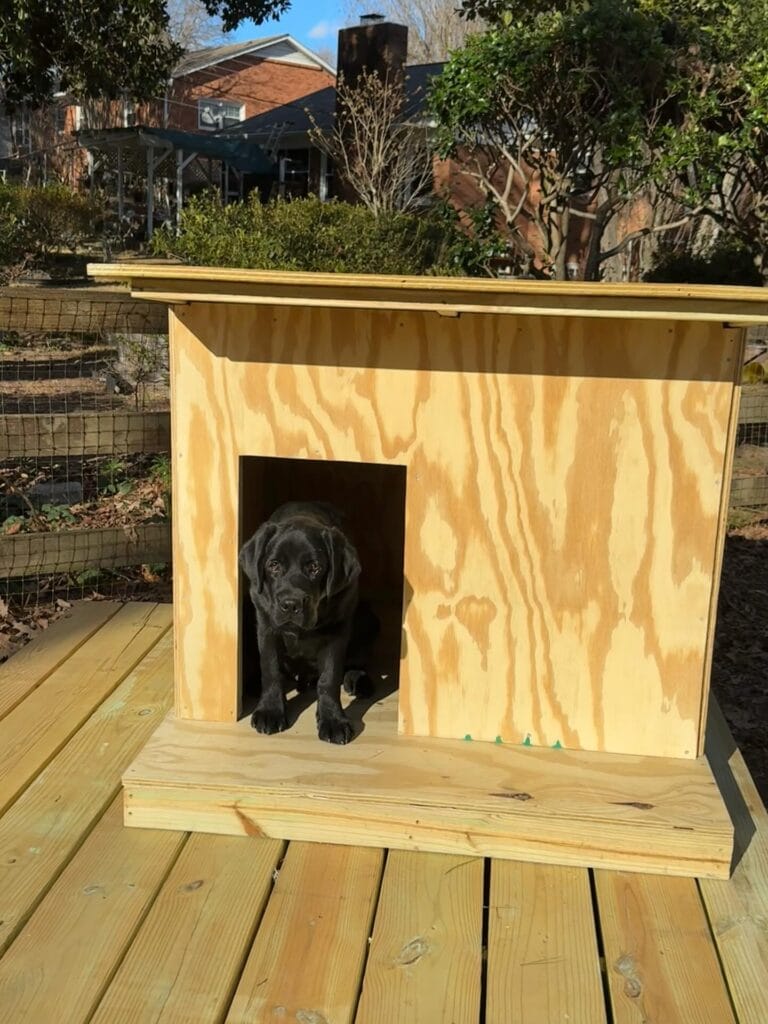
Your dog has taken over the couch, the rug, and probably even your favorite throw pillow. This might be the first time they are actually getting their own space.
This build is straight from the image. It’s a clean, modern looking flat-roof dog house made from ¾ inch plywood sheets, and pressure treated pine decking. The natural tones and grain help keep it from looking too Pinterest-y.
Materials & Tools
– ¾-inch plywood (for walls and roof)
– Pressure-treated 2×6 pine boards (for the raised platform base)
– 1×3 pine trim strips (roof edge detail)
– Wood screws (2-inch and 3-inch)
– Circular saw, drill, measuring tape, sandpaper (120-grit)
– Exterior wood sealant
Instructions
Prep Time: 30 min | Active Project Time: 4–6 hours | Difficulty Level: Intermediate
Cut the plywood into four wall panels and one roof panel. The opening in the picture is on the center-left side, about 12 inches wide by 14 inches tall. It’s big enough for a lab-sized dog to walk through without having to crouch uncomfortably, so they’ll actually use it.
Build the base platform with pressure treated 2×6 boards laid flat. This raises the house off the ground, keeping moisture from building up under the house. It also keeps the floor of the house warmer (the temperature of the air in the house is regulated by the temperature of the base) and helps to protect your dogs’ joints in cold weather.
Attach the 4 wall panels to the frame with 3-inch screws. You will need to pre-drill the holes to avoid splitting. Lay the roof panel flat across the top, then nail down the 1×3 trim strips around the outside edge. (the trim strips are what make it look finished on the outside of the box)
Sand every exposed edge to a 120-grit smoothness. Apply two coats of exterior sealant letting it dry between the coats.
It rests on top of a pressure-treated wood deck, which goes perfectly if you are building your own backyard. If so, take a look at 15 DIY Dog Playground Ideas for Your Backyard.
Leave it bare or put down a cedar shaving floor liner (cedar naturally deters fleas, and will keep your interior smelling fresh longer than regular bedding.
📸 Photo credit: Instagram @winston_the_bear_dog
#10: DIY Double-Door Wooden Dog Crate That Looks Like Actual Furniture
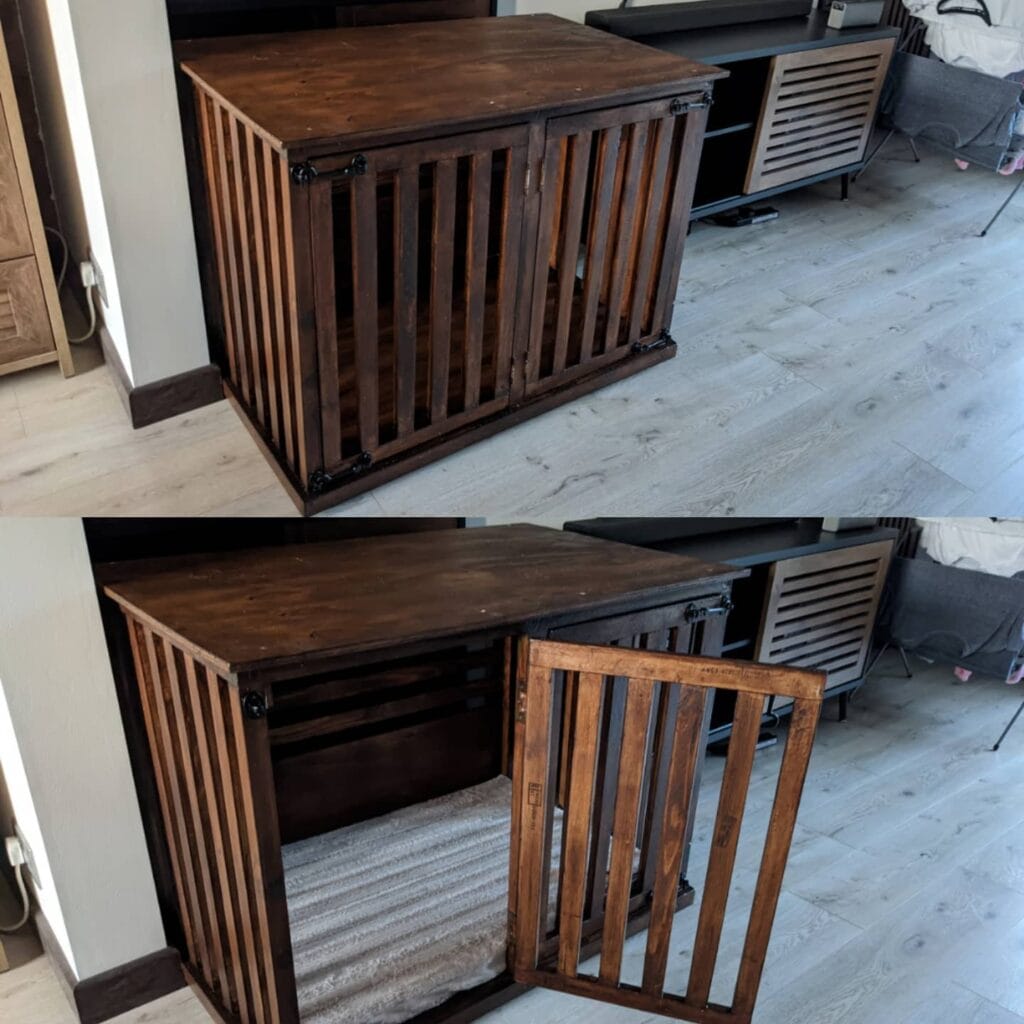
Of course you do. You know that moment when your golden retriever claimed the entire living room. Her dog bed is somehow always in the middle of everything and her chewed corner on your favorite rug where your guests are doing the awkward shuffle to avoid tripping over her stuff.
So I was like that every weekend until I built this.
Materials & Tools You’ll Need:
– 2×4 pine lumber (dark walnut stain finish)
– 1×2 slat boards for the vertical bars
– ¾-inch plywood for the top panel and base
– Black metal hinges and barrel bolt latches
– Wood stain in dark espresso/walnut tone
– Sandpaper (120-grit and 220-grit)
– Wood screws (2-inch and 3-inch)
– Drill, miter saw, measuring tape
– A thick washable dog mat (fits the interior floor)
Prep Time: 1 hour | Active Project Time: 6–8 hours | Difficulty Level: Intermediate
Instructions
Measure out and cut your 2×4 frames into four identical rectangles. Two for the sides, one for the back and two for swing-out front doors. If you’ve got a very nervous cat who will scratch to get out, the two front doors are a good idea as your golden will have easy access from either side.
Sand all pieces with 120-grit sandpaper first, then finish sanding with 220-grit before staining. Do not skip the second sanding, as this will allow the espresso stain to absorb into the wood without blottiness.
Once it’s dry, attach your 1×2 vertical slats with 2-inch screws spaced every 3 inches. This helps make it look cleaner, as if it’s something you’d actually put sideboard on.
Attach the frame with 3-inch screws at each corner. Attach the top ¾-inch plywood panel on top of the frame. It is flush across the entire length. This top also serves as a display surface for your plants or frames, which will earn its floor space in the crate instead of just taking it.
I then used two black metal hinges at the top and bottom of each doorframe and added my barrel bolt latches to the center where the doors meet. I mounted the latches on center so that when I close both doors they don’t rattle.
Slide in a thick washable mat and your girl has her own cozy corner that doesn’t clash with your decor.
The slats between the boards keeps a good airflow running through the crate so your dog stays cool even on a warm day. This crate is made out of solid pine with a plywood top and its heavy enough it won’t wobble if you stack books or a small lamp on top.
If you’re in the midst of your DIY projects for your dog, then you might want to have a look at these 7 Natural DIY Dog Shampoos for a Soft Coat Without Harsh Chemicals as well.
Before driving your screws, plan on pre-drilling every single hole for the slat boards. Pine can split rather easily at the edges, and a cracked slat board can ruin the clean look you’re going for.
📸 Photo credit: Instagram @yosha1008
The One DIY Cage Mistake That’ll Cost You a Full Rebuild
Probably the biggest mistake made when building a DIY dog cage is to build the frame before placing your dog in a natural resting position in the cage.
Not standing. Not sitting. Just sprawled out like the dog’s gold just ran three laps around the backyard and collapsed.
I learned this the hard way. I built this gorgeous cedar frame, sanded it nice and smooth, even stained it to match my living room floors. And then my friend’s lab laid down inside of it and her tail was pressed against the wire. Had to take the side panel off the frame.
However, this is not always an option, as if you don’t know how tall your dog will grow, you may end up with a dog that is too big for your apartment. As a general rule, add 8-10 inches to the full stretched length of your dog, not just its height. Golden retrievers in particular often need this extra room to sprawl out.
Also, using hex bolts rather than wood screws at the corners. Wood screws tend to loosen after your dog bumps the frame a few times.
Why this works: If you can find a cage that will fit your dog and your style, you’ll have furniture, not an eyesore, which is what you’re trying to avoid when you set up a Pinterest worthy space.
Your Golden Deserves a Clean Home (And So Do You)
You’ve got the living room Pinterest dream. The gorgeous rug. The sofa you actually love to sit on.
Don’t let muddy paws and dog hair be the reason you can’t enjoy it.
Choose one of these tools and start there, even one good tool could turn your experiences on a walk with your dog from dreading a rainy walk to not even flinching when your dog bolts out the door.
If you’re a crafty person, a dedicated dog bathing station may be your next best idea.
So tell me – what’s the messiest moment your golden has ever blessed you with? 😎

Amr Mohsen is a software engineer who traded his keyboard for a leash — at least on weekends. His love for dogs inspired him to share what he learns as a dog owner and enthusiast, bringing a detail-oriented, research-driven perspective to every article he writes. If it’s about dogs, he’s probably already looked it up twice.